

Hispanic voters helped bring Trump to power - in Texas, the tide may be turning
Recent polls suggest the president is facing challenging headwinds in the state ahead of the midterms.
Hispanic voters helped bring Trump to power - in Texas, the tide may be turning
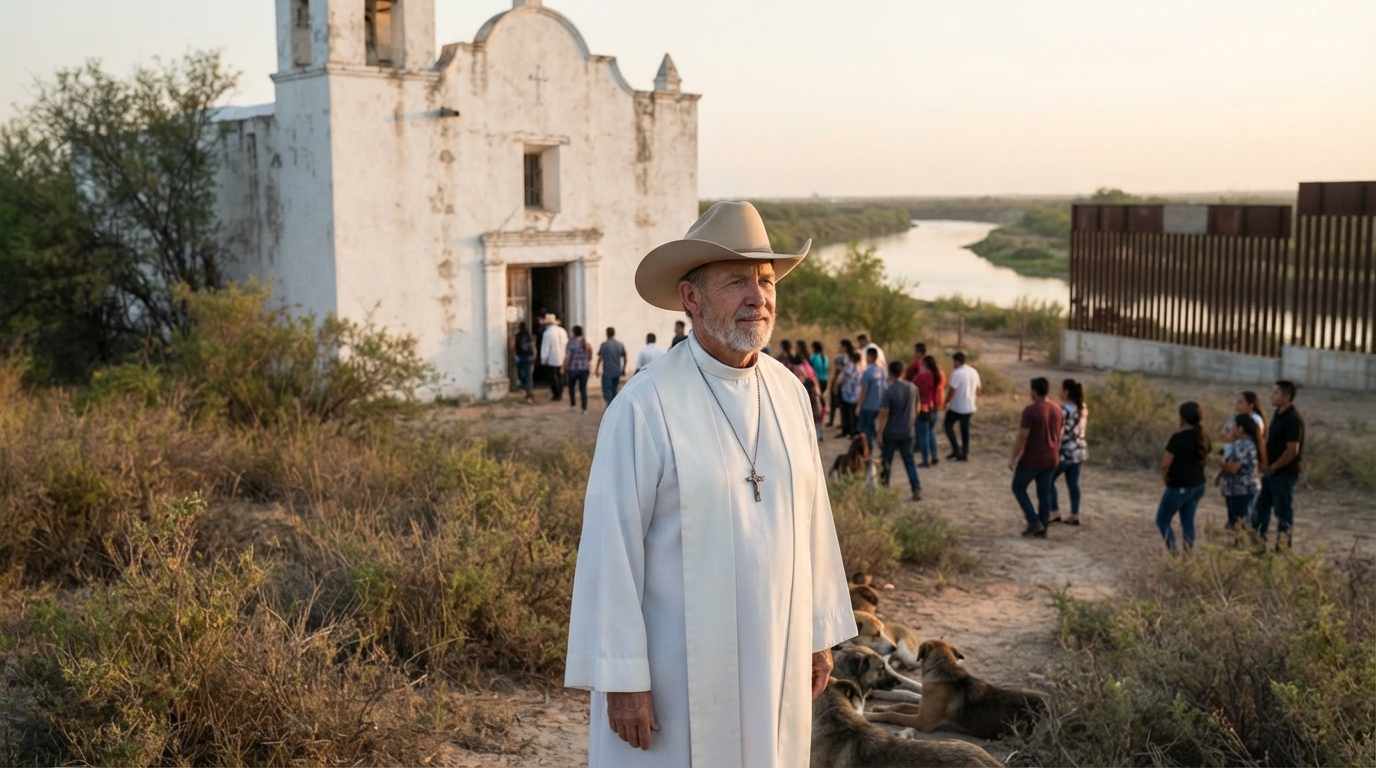
Father Roy Snipes is locally known as the Cowboy Priest - he opposed plans to take chapel land for Trump's border wall
It was just before daybreak in Texas's Rio Grande Valley, and worshippers were arriving for the Friday service at the small La Lomita Catholic Chapel.
The whitewashed chapel, which has stood here since the era of the American Civil War, rises out of the surrounding scrubland and sits roughly 200 yards from the Rio Grande river itself.
As vehicles pulled up outside, Father Roy Snipes' barking dogs announced his arrival. He has served as priest here for nearly 50 years - and locals know him as the Cowboy Priest.
"I'm not sure why I picked that up, but it's nice," he said of the nickname.
In fact, the reason is fairly clear. Snipes wears a Stetson instead of the more customary priest's hat. And a moment later, the chapel was filled with a Roy Rogers song - the singer and actor known as the King of the Cowboys.
During the first Trump administration, Snipes fought plans to seize the chapel's land to construct the president's border wall. Eight years later, at the early Friday service, his brief sermon concentrated on the actions of Immigration and Customs Enforcement (ICE).
"There's no good excuse to detain, incarcerate and deport poor, good folks who are our neighbours," Snipes told the congregation of about 30, mostly Hispanic worshippers.
Government figures obtained by the Deportation Data Project show that Texas accounted for about one-third of all ICE arrests across the US in July 2026 - a bigger share than any other state.
"They said we're gonna seek out, capture, detain and deport the worst of the worst," Father Snipes said in his sermon. "Well, we're here on the border and the cartel is the worst-of-the-worst. So we thought, well, that's a good thing.
"But it turned out, you can hear almost every day, some poor guy going to work and they stop him and detain him and start a big fight."
After the service, two people from the congregation paused to talk. "We're educators, and we have a lot of students that are having to go back because their parents are getting deported," one said.
"The cruelty that we're seeing - I think that's turning the tide, at least I hope so," their friend added.
That political tide is exactly what Democrats hope to shift in Texas in the midterm elections on 3 November. But doing so will not be simple.
This section of the Rio Grande was once among the busiest crossing points on the US-Mexico border. Under former President Joe Biden, hundreds of thousands of migrants passed through here, with more than two and a half million apprehensions logged in a single year.
President Trump pledged to halt these illegal crossings during his 2024 election campaign, and in many respects he has done so.
Border crossings are now at their lowest point in decades. And that promise was one reason behind Trump's remarkably strong support in the state, winning about 55% of Hispanic votes in Texas alone - a record for a Republican presidential candidate.
Javier Villalobos is the Republican mayor of McAllen, one of the largest cities in the Rio Grande Valley. He thinks Republicans will struggle this time, but says the Trump administration deserves credit for reducing the border problem.
"I remember I put out a video… thanking the administration for immediately securing the border. That was great," he said. "And I think generally most people are okay with the deportation of criminals, violent people, or people that really are not productive at all."
But, he added, once deportations target people who are productive and law-abiding, that is where the issue begins.
Mario Guerrero voted for Trump three times in a row - but plans to vote Democrat in November
Recent polls indicate that much of Trump's support among Hispanic voters has faded since 2024. Surveys conducted since late summer show a majority of Hispanic voters in Texas disapprove of the president. They also suggest Hispanic voters are backing Democrats over Republicans by a wide margin.
"When I voted for President Trump, I voted for him because we saw an influx of immigration during the Biden administration," said Mario Guerrero, a young Mexican-American businessman who heads the South Texas Builders Association. It needed to be fixed, he said.
"We thought that we were in the right by voting for Trump, and that he was going to do what was best in order to fix the crisis on the border.
"And I think to myself, we were really not told the extreme that they were willing to go to make a point," he added, before referring to recent shootings involving ICE agents in US cities.
Guerrero is a reminder that, for many people who live and work near the US-Mexico border, security and immigration enforcement are separate matters.
A voter here may support securing the border and stopping illegal crossings, but oppose ICE's actions and the way the administration is carrying out its crackdown on undocumented migration.
Guerrero voted for Trump three times in a row - but plans to vote Democrat in November, partly because of his discomfort with that crackdown.
"There's a man that I know that… last year, had 35 workers that were working for him every day," he said. "Right now, he just told me two days ago that he would be lucky if he would get four to six guys to show up to work."
Even though Guerrero intends to vote Democrat, he says he is neither a Democrat nor a Republican. And that, according to Mike Madrid, a leading Republican consultant and expert on Hispanic voters, is central to understanding the country's largest ethnic voting bloc.
"Latinos are more likely than any other racial or ethnic group to identify as independents rather than Republicans or Democrats," he said.
Partly because of the belief that Hispanic voters were moving permanently toward the Republican Party, Trump pushed states such as Texas to redraw their congressional maps early, before the once-a-decade census.
The plan was meant to take advantage of what Republicans viewed as a realignment in Hispanic voting patterns, especially in border districts that had been Democratic strongholds for more than a century.
Texas's 15th congressional district was among those redrawn, and it has become one of the clearest tests of whether electoral maps can secure political results.
The seat was redrawn after the 2020 census and won by a Republican in 2022. It was redrawn again in 2025, creating a notional 18-point Republican majority for these midterms. Even so, current polling points to a Democratic lead of five or six points.
Bobby Pulido is the Democratic candidate hoping to capture the district. As a well-known Tejano singer and winner of two Latin Grammys, he is already a household name in the Rio Grande Valley.
At an event just weeks before the election, he gave a standard political speech and then performed music. "A lot of people are disillusioned with both parties," he told the BBC shortly before going on stage. "And I hear them."
To win in this part of Texas, you have to be conservative. Pulido has distanced himself from the national Democratic Party brand and has deliberately focused on economic issues.
"This isn't New York, this isn't LA," he said. "When you lead with issues like social justice, climate change and other topics, that's not what people want to hear first. They want to hear about the economy."
That message matches what many current polls are showing - the economy, and specifically the cost of living, rank at the top of most voters' priorities.
At a local avocado festival, a fruit that is a staple in Hispanic communities in the valley, a couple, Dave Baldwin and Veronica Salazar, began talking about rising prices as soon as they were asked about the coming elections.
When asked who they blame for the rising costs, the answer came quickly. "The president," they said.
"He is in control of our destiny with all that, and right now he's not doing a very good job," Baldwin added.
Among many Republican campaigners here, there is a sense that they are on the defensive just weeks before the vote.
Alexis Uscanga, a student volunteer assigned to knock on doors and check on likely Republican voters in the district, was realistic about what he is trying to do.
"The midterms are just purely a game of turnout," he said. "It's not trying so much to convince individuals to vote one way or the other, it's about trying to get our people mostly to show up."
Tano Tijerina, the Republican candidate in the neighbouring, Democratic-held 28th district, praised Trump for "breaking through barriers" but admitted that the "national political headwinds are real".
The Hispanic move toward President Trump in 2024 was one of the most striking political developments of the past decade. While this growing demographic may not have much affection for either party, in a two-party system voters are largely forced to choose.
And if the polling is right - and there is no guarantee it is - even a small swing back to Democrats in November could alter races not only across this state but much farther beyond.
In Texas, it could even be enough to put a US Senate seat in play - and Democrats have not won one there in more than 30 years.