

He questioned Thailand's monarchy dressed as Harry Potter. Now he's in jail for 34 years
Thailand has prosecuted 294 people since 2020 under its lèse majesté law, with sentences going up to 50 years.
He challenged Thailand’s monarchy while dressed as Harry Potter. Now he is serving 34 years in prison
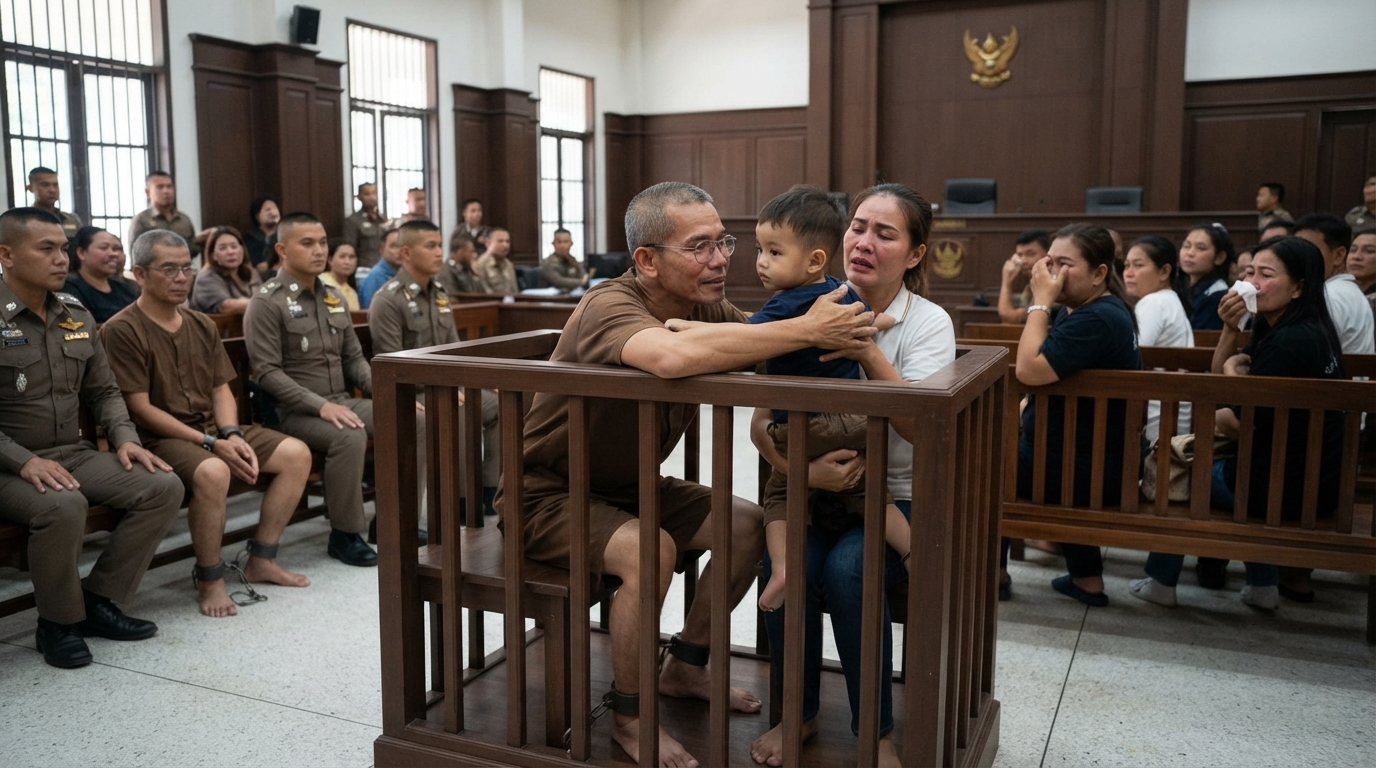
Before they even reach the courtroom door, you can hear the prisoners approaching, the shackles around their ankles ringing with every step.
The five men entering the courtroom know the drill; they are all facing multiple criminal cases and have spent much of the past five years shuttling back and forth to court.
One of them, a slight man with glasses and greying hair, opens his arms to embrace his three-year-old son, who has been brought to court by his partner to see him.
This is Arnon Nampa, a 42-year-old human rights lawyer. His “crime” was to demand that Thailand’s powerful monarchy be examined and held to account. He did so dressed as the title character from Harry Potter at a Harry Potter-themed protest in central Bangkok in 2020.
On Friday, a Bangkok court sentenced him to two years and eight months for breaching Thailand’s lèse majesté law, or article 112, under which more people have been imprisoned for perceived insults to the royal family than in all other countries with such laws combined.
This is only one of 14 cases filed against Arnon under the same charge, bringing the total sentence he has received so far to more than 34 years. The ruling in two cases is still pending.
“To me, this isn’t a surprise,” he later told reporters. “If the country was more open, we would be able to talk about these issues freely.”
The past six years have seen the most widespread use of lèse majesté in Thai history, following the unprecedented student protests in 2020 that for the first time called for a public debate on the monarchy’s role. Two hundred and ninety-four people, including 20 under 18, have been prosecuted, with prison terms of up to 50 years. Dozens remain on trial.
Most people charged under this law are denied bail and kept in jail, even though their cases can drag on for years. Thai officials usually defend the law by saying it “reflects the culture and history of Thailand, where the monarchy is one of the main pillars of the nation, highly revered by the majority of Thai people”.
Article 112 of the Thai criminal code simply states: “Whoever defames, insults or threatens the King, the Queen, the Heir-apparent or the Regent, shall be punished with imprisonment of three to 15 years.”
In practice, however, the law has been interpreted far more broadly, covering a much wider range of comments about the monarchy and a much wider range of people. Saying anything negative about any royal family member, about the monarchy as an institution, even about long-dead kings, or in one case the king’s dog, has led to prosecutions.
“If you ask me what the text of the law says, I can tell you,” says Akarachai Chaimaneekarakate, assistant director of Thai Lawyers for Human Rights, which helps defend those accused of violating it. “If you ask me how the courts interpret the words ‘defame’ or ‘insult’, I don’t think I can give you a definition, because it’s so ambiguous, it’s so vague. Even questioning the law itself, for example, can constitute lèse majesté under Section 112.”
From his cell in Bangkok Remand Prison, where he has spent the past three years, Arnon has been writing to his young daughter and son.
“Dear Pran and Karl, my beloved children,
The winter wind has not only brought us cool weather, but also brings back stories from the past. I miss the time we travelled outside Bangkok that first winter after Karl came into this world. It was such a magical time for me. I shall miss it every winter I spend here until I regain my freedom.”
Hearings like the one Arnon attended weeks before Friday’s verdict are the only times he has seen Karl since he was a baby.
Karl is shy at first, but soon he is happy to be picked up and shown to the other prisoners. His 10-year-old sister Pran sometimes visits their father in prison, and often draws and paints him.
But Arnon and Lookwa, his partner, believe Karl is too young to visit. For now, Karl thinks the court is simply where his father works. Supporters also came, filling the small courtroom. They chat cheerfully with the prisoners, laughing and swapping gossip before the judges enter to begin the hearing. It is an improbably casual setting for men facing one of the most feared charges in Thailand.
The law’s effect has been to suppress any public discussion of the monarchy. Until six years ago, opinions on it were only whispered in private. In one notorious case, a taxi driver was jailed after a passenger reported what he had said while riding in his cab.
That changed on 3 August 2020.
By then, younger Thais were growing increasingly frustrated with the conservative government led by coup leader Gen Prayuth Chan-ocha. The year before, millions had voted for a new party, Future Forward, which promised sweeping reforms, but in February 2020 the Constitutional Court dissolved it on a technicality. The arrival of Covid delayed protests for three months, but as infections in Thailand began to fall, students started holding rallies calling for an end to the military’s role in politics. Arnon Nampa argued that this did not go far enough.
Dressed as Harry Potter, he delivered a speech saying it was time to discuss the monarchy’s opaque power and wealth. He criticised King Vajiralongkorn’s decision to take personal control of the vast assets held by the Crown Property Bureau, and of important army units.
In one speech, Arnon broke a taboo that had hung over Thai society throughout its modern history. For the rest of that year, student-led protests continued, with increasingly bold demands for changes to the monarchy.
At the time, use of the lèse majesté law had been suspended for three years. Sources close to the palace have previously acknowledged that the negative publicity caused by lèse majesté convictions might do more harm than good.
But the protests forced a hurried rethink. From the end of 2020, prosecutions under the law resumed and intensified. Dozens of young activists have fled into exile to avoid imprisonment.
One of them is Supitcha “Melinn” Chailom. The 24-year-old from Chiang Mai in northern Thailand now lives in Montreal, a fugitive from four article 112 charges filed against her.
She was 18 and still at school when she stood and spoke at a protest at Chiang Mai University, just three weeks after Arnon Nampa’s call for monarchy reform.
A local photographer captured the moment she raised her hand in the three-finger Hunger Games salute, drawing loud cheers from the crowd. It became one of the defining images of the protests and made Melinn famous nationwide.
She travelled across the country as one of the movement’s leading voices, calling for changes to Thailand’s outdated education system and conducting polls on what people thought of the monarchy.
“I love playing games, and I dreamed of being a game designer,” she told me from Canada. But her parents did not approve.
“I felt that, as a young person, I could not question, or have a discussion with people older than me. The monarchy gave me the same vibe.”
In November 2020, Melinn joined a protest in the southern city of Hat Yai, where she gave a speech comparing the royal treatment given to the king’s dog with that of ordinary people. Nine months later, police delivered a summons to her home charging her with lèse majesté.
“It was a shock. I wasn’t expecting it because I only talked about the dog. It was during Covid when the police came to my home with the summons, so they knew my parents would be there with me. They tried to stay calm, but I nearly lost my mind.”
Her family tried to persuade her to cooperate with the authorities and admit wrongdoing. But Melinn refused.
She joined a movement called Thalu Wang, which means “breaking through the palace”. Instead of speeches, they devised stunts such as street polls asking people what they thought of royal motorcades blocking traffic, or whether they believed the monarchy had too much power.
“We knew the risks, but we thought it would be safer just conducting a poll. It turns out it was not.”
She received two more lèse majesté charges in 2022 and was detained before being released on bail. She had to wear an electronic ankle monitor and was barred from leaving her home between 4pm and 6am. Her parents were forced to sign a document promising to report on her. She was facing decades in prison.
Melinn decided she had no choice. With a friend, she fled Thailand and eventually received asylum in Canada.
On paper, article 112 is just another law, passed by the Thai parliament and theoretically amendable by elected MPs. It has in fact been amended before, notably in 1976 when the penalty for violating it was raised to between three and 15 years in prison.
But today the Constitutional Court has ruled that the law itself, like the institution it protects, is untouchable. The reformist Move Forward party — successor to Future Forward — was dissolved in 2024, and its leader banned from politics, simply for proposing lighter punishments. And the courts make it extremely difficult for those charged under it to defend themselves.
“In many cases, like the one against Arnon Nampa, prosecutors accuse the defendant of lying about the monarchy,” says Chaimaneekarakate, the lawyer. “But when we ask the judge to subpoena documents or witnesses who could show the truth of what the defendant says, the judge refuses to do it. When one lawyer protested against the court deciding that the trial would be held in secret, she was warned by the judge to be quiet or face a contempt of court charge.”
He says judges sometimes criticise young activists for their alleged actions even before the trial begins.
Arnon has been writing letters to his children since he was jailed three years ago.
As the man who sparked the monarchy debate, Arnon appears to be receiving the harshest punishment. Despite the formidable odds against him, he still prepares carefully for every court appearance, taking part in his own defence and helping other inmates with theirs.
That is not easy; he is not allowed to bring any written notes and must memorise all his arguments.
The judges object to him acting as a lawyer in his standard brown prison shorts, barefoot and shackled. But it does give him a chance to see his family.
The letters he writes are the only other way he keeps in touch with them. He may spend the rest of his life in prison. He wants his children to know him, and to understand, when they are older, why he chose to challenge the system and lose his freedom.
“Since the first day that we made up our mind to take up this mission, we knew of the dangers. Speaking the truth is not difficult. What is difficult is speaking a forbidden truth. I remember well that on the evening of 3 August 2020, after speaking at the Harry Potter event, I felt very good, content, and relieved to have finally begun speaking about the truth, in public,” he wrote to his family last year.
Earlier this year, he wrote: “Living here is a struggle. But it is just a dot in the bigger picture of our movement’s struggle. We must play a part in writing our own history. Become a drop of water that will one day become an ocean.”