

“He calls them enemies — those who dedicate their lives to the country, he recognizes only status, and does not recognize God.” A quiz on the poems of Rauf Parfi
September 27 marked 83 years since the birth of Rauf Parfi, the author of the epic poem "Adashgan ruh" (The Lost Soul) and poetry collections such as "Tavba" (Repentance), "Sukunat" (Silence), and "Xotirot" (Memories). In honor of this date, Gazeta has prepared a quiz based on the poems of the People's Poet of Uzbekistan.
“He calls the one who dedicated their life to the homeland an enemy — he recognizes status, but does not recognize God.” A quiz on Rauf Parfi's poems
Tursunali Parfiyev, who wrote under the pseudonym Rauf Parfi, was born on September 27, 1943, in the village of Shoralisoy in the Tashkent region. After graduating from school, he studied at the Faculty of Philology of Tashkent State University (now the National University) from 1960 to 1965.
Throughout his career, the poet worked as an editor at the State Committee for Cinematography, the "Yozuvchi" publishing house, the Gafur Gulom Publishing House of Literature and Art, and the "Oydin" newspaper.
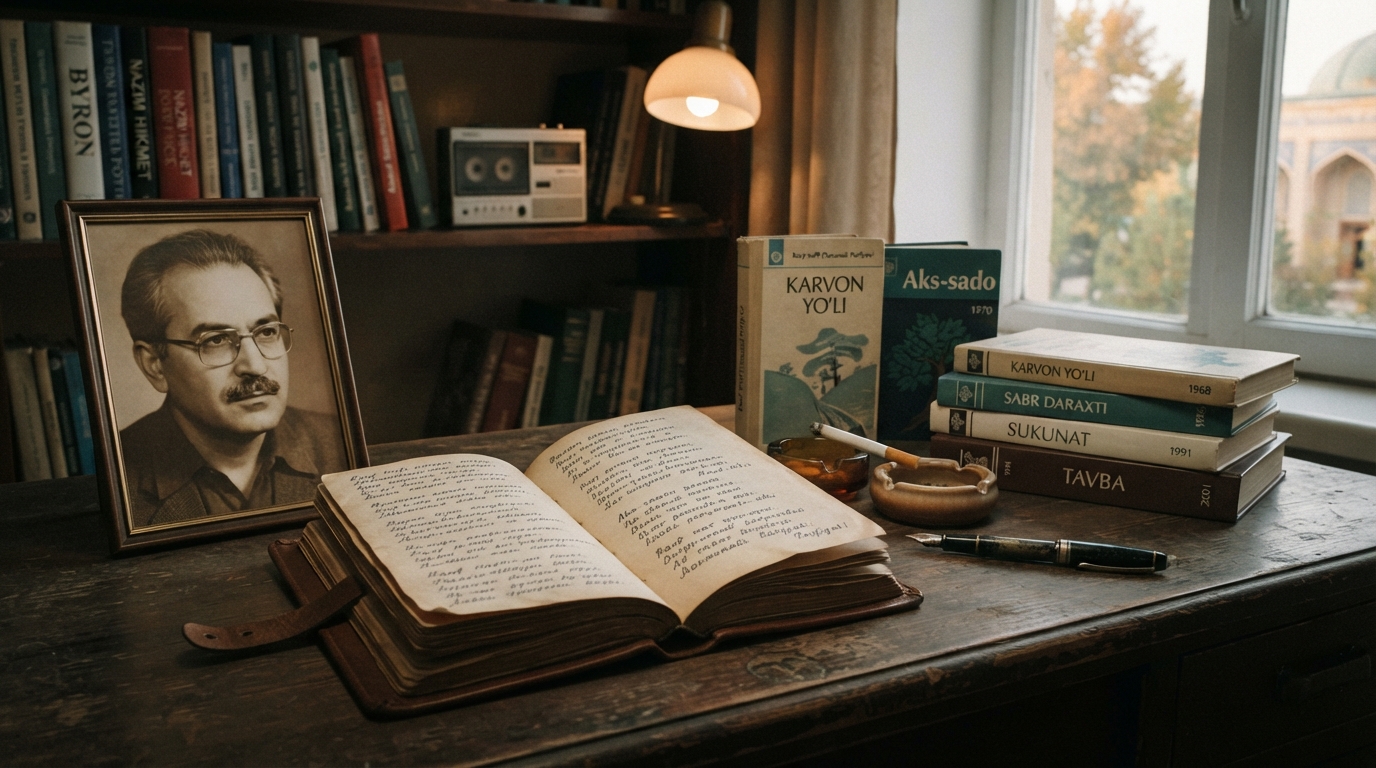
His poetry collections "Karvon yo‘li" (The Caravan Route) was published in 1968, followed by "Aks-sado" (Echo), "Tasvir" (Image), "Xotirot" (Memories), and "Ko‘zlar" (Eyes) between 1970 and 1976. The books "Qaytish" (The Return) and "Sabr daraxti" (The Tree of Patience) were presented between 1981 and 1986. The collection "Sukunat" (Silence) was published in 1991, and "Tavba" (Repentance) in 2001.
The poet, who translated the works of writers such as Byron, Nazim Hikmet, and Karlo Kaladze into Uzbek, passed away on March 28, 2005.