

GSEO Secretary General Shares China’s AI Tourism Experience at Tashkent Conference
Tashkent Times is an English language online-newspaper that brings all latest Uzbekistan news
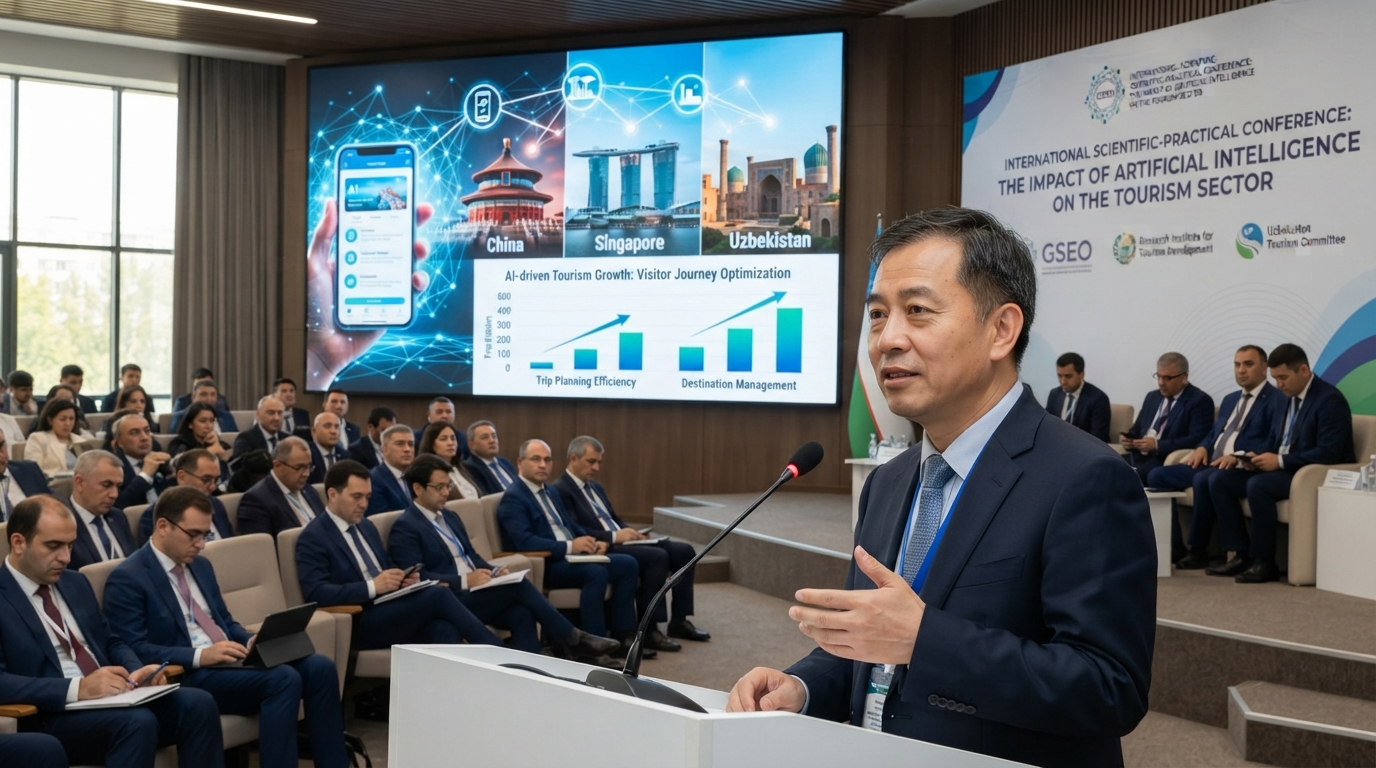
**GSEO Secretary General Presents China’s AI Tourism Experience at Tashkent Conference**
Artificial intelligence can make travel more convenient, but its bigger value may be in helping tourism destinations coordinate services, manage visitor flows and make better operational decisions, Jianbo Wu, Secretary General of the Green and Smart Energy Organization (GSEO), said at an international conference in Tashkent on Friday.
Addressing the International Scientific-Practical Conference on “The Impact of Artificial Intelligence on the Tourism Sector”, Wu used examples from China and Singapore to explore how AI is being used throughout the visitor journey, from trip planning to moving around a destination and using local services.
His main point was that the success of AI should be judged by practical outcomes rather than by technological novelty. A chatbot may answer a traveller’s question, he said, but a more meaningful gain comes when visitors can turn that answer into a usable itinerary and travel between transport, accommodation and attractions with fewer barriers.
Wu pointed to Zhejiang Province’s Zhejiang Travel platform, also known as Haiyou, which was launched in 2025 to support international visitors. The platform can create personalised itineraries based on travel dates, budgets and interests, while combining AI assistants for attractions, hotels and budget planning. It also offers real-time translation in five languages.
Zhejiang has linked these planning tools with an “Easy Go” service code that connects hotel check-in, attraction entry and public transport. The integration tackles a familiar issue for international visitors: services may exist separately, yet still be hard to use as a connected whole. According to a Zhejiang government report, the platform logged 80,000 visits in its first month, an early sign of demand for more integrated travel services.
Wu also spoke about Hangzhou’s efforts to improve the practical experience of international visitors. In 2026, the city launched an airport-based service allowing foreign visitors to secure temporary driving permits and rent cars. By September, visitors from 12 countries and regions had used the service, broadening the choices for travellers who want to explore beyond the city centre.
Hangzhou recorded 1.08 million overnight inbound visits in the first seven months of 2026, up 50.1 per cent year on year. Wu warned against crediting that growth to AI, but said the figures highlighted the importance of making destinations easier for international visitors to navigate.
He also drew a distinction between AI applications and wider digital infrastructure. Online payments, electronic tax refunds and digital check-in systems can improve convenience without necessarily involving AI. AI adds value in other ways, including multilingual support, natural-language interaction and personalised recommendations. The biggest gains come when these capabilities operate alongside dependable transport, payment and visitor-management systems.
The presentation also covered Hangzhou’s newly opened national pilot facility for AI in culture and tourism, which is developing applications ranging from AI travel agents to tools for detecting damage to historic buildings. The facility has said it trained one such model on more than 300,000 annotated records, with accuracy above 87 per cent. For Wu, these efforts show a move away from demonstrations and toward applications that can be tested and improved in real operating settings.
Referring to Singapore’s cooperation with OpenAI and its exploration of AI applications for tourism businesses and visitors, Wu stressed the role of public tourism agencies in bringing technology providers, attractions and businesses together. The key, he said, is to identify applications that solve clear problems and produce measurable benefits.
He suggested three questions for assessing AI initiatives: whether they improve the visitor experience, help destination managers use resources more efficiently, and create economic opportunities for local businesses and less-visited cultural sites. These results, he said, should be measured rather than assumed.
The conference gathered international speakers, academics, public-sector representatives and tourism practitioners to discuss the opportunities and challenges of using AI in the sector. Organised by the Research Institute for Tourism Development under Uzbekistan’s Tourism Committee, the event was part of broader discussions on the sustainable development and effective management of tourism destinations.
Wu’s participation also builds on GSEO’s earlier cooperation with Uzbek partners. The organisation has taken part in international initiatives linking sustainable development with practical cooperation. A joint United Nations project with the Uzbek tourism research institute, Tourism Promotes Poverty Reduction, Employment and Women’s Development in Uzbekistan, was recognised as a good practice in United Nations South-South and Triangular Cooperation.