

Gold is back above $4,600, copper is breaking records: what's happening in the metals market
By the end of August, the metals market appears stronger than it was just a couple of weeks ago. Precious metals are supported by a weak dollar, US debt concerns, and expectations of further signals from the Federal Reserve.
Gold has once again surpassed $4,600, while copper sets new records: a review of the metals market situation
By the end of August, the metals market is showing a more confident position compared to two weeks ago. Precious metals are supported by a weaker dollar, concerns about US government debt, and expectations of new signals from the Federal Reserve. Industrial metals are developing according to their own logic, where the key factor is not so much macroeconomics as a physical supply shortage, low inventories, and changing trade flows.
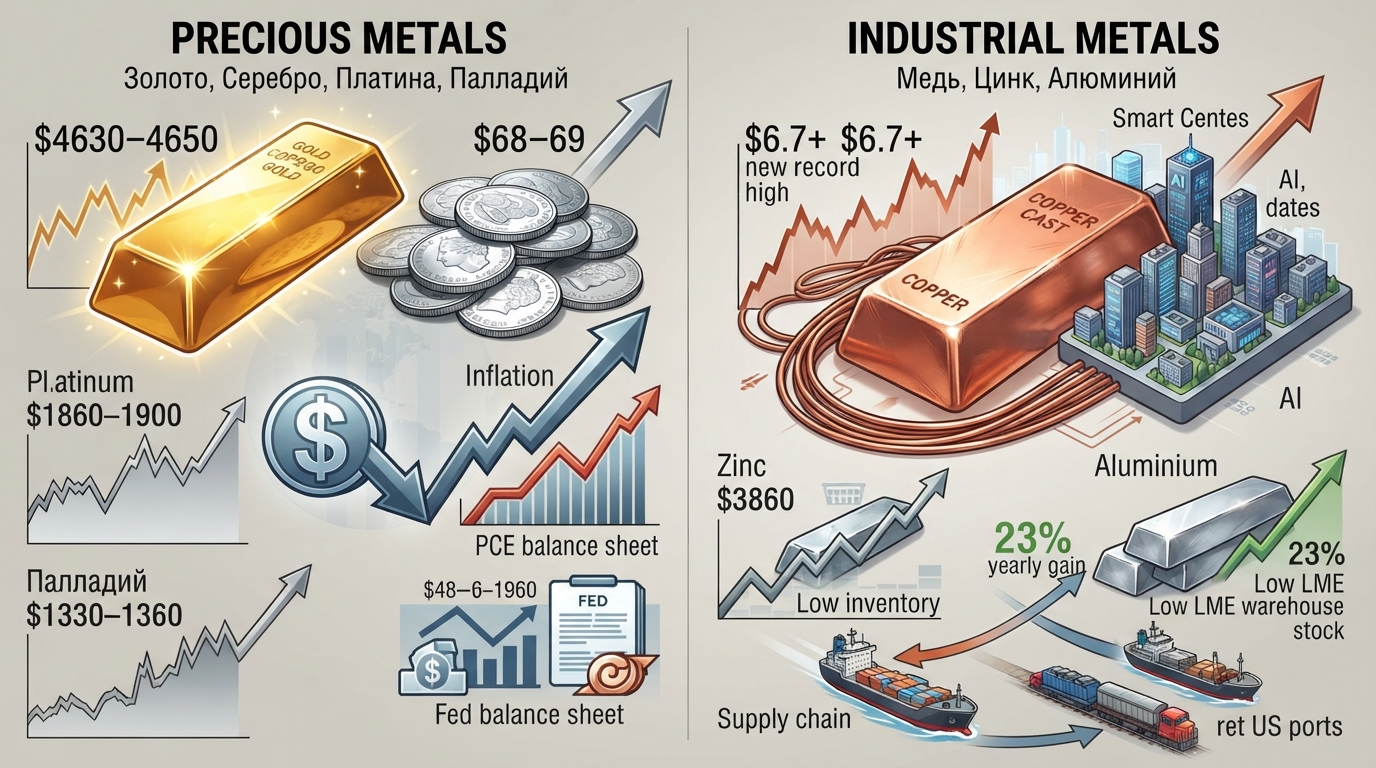
Gold is trading in the range of $4,630–$4,650 per ounce, approaching three-month highs. Silver is holding at $68–$69 per ounce, also remaining near the strong levels of recent weeks. After a period of decline, investors have again turned to safe haven assets: the market is sensitive to the US debt situation, yield dynamics, and potential government intervention in the debt market. Moreover, gold is no longer simply serving as a hedge against geopolitical risks but is once again being perceived as a hedge against broader macroeconomic threats.
However, it is premature to talk about stable growth. US inflation remains the focus: investors are awaiting the release of the PCE index, which the Federal Reserve uses as one of its main price benchmarks. If the data proves moderate, gold and silver will continue to rise. If inflation appears stable, the market will quickly return to discussions about tightening Fed policy. Thus, precious metals are currently at high levels, but their future dynamics remain dependent on the dollar, yields, and signals from the US Federal Reserve.
Platinum and palladium have also recovered amid overall growth in demand for precious metals. Platinum is trading in the $1,860-$1,900 per ounce range, while palladium is around $1,330-$1,360 per ounce. However, there is a significant difference within this group. Platinum appears more resilient, thanks to expectations of supply shortages and demand from hybrid vehicles, where platinum group metals are still needed for catalytic converters. Palladium is weaker: in the long term, it continues to be under pressure from the growing share of electric vehicles and the gradual replacement of palladium with platinum in automotive catalysts.
Copper remains the dominant theme in the industrial segment. Prices rose above $6.7 per pound, reaching a new all-time high. Formally, demand for the metal is supported by traditional long-term factors—the energy transition, data center construction, the development of artificial intelligence, and the modernization of the power grid. However, another powerful factor has now been added: the expectation of possible US import tariffs. Traders are actively moving metal to the US market, leading to a reduction in available stocks in other regions. As a result, a market that may have previously appeared balanced is once again perceived as tense.
Zinc has become another striking example of the market's rapid reaction to a shortage. The price rose to almost $3,860 per ton—a four-year high. Here, low inventories, production disruptions, and market participants' caution following the previous supply cuts are providing support. Chinese exports have somewhat eased the situation for buyers, but haven't completely resolved the problem: available metal remains scarce, and any news of disruptions at mines or factories quickly brings buyers back to the market.
Aluminum is trading around $3,240 per tonne and appears calmer than copper and zinc, but its fundamental picture also remains tense. Over the year, the metal has risen almost 23%, while LME warehouse inventories previously fell to a 36-year low. This indicates that the physical market remains sensitive: supply may formally recover due to capacity restarts, but this process will not be rapid. An additional complication is the inventory structure, where a significant share is in metal, which not all buyers are willing to purchase.
Overall, the metals market is now once again split into two main categories. Precious metals are dependent on inflation, the dollar, yields, and the Fed's rhetoric. Industrial metals are increasingly relying on real shortages, low inventories, and long-term demand from energy, infrastructure, and technology. Therefore, even if the macroeconomic environment periodically puts pressure on commodities, copper, zinc, and aluminum remain the segments where fundamental support appears most noticeable.