

Global life expectancy has almost returned to pre-pandemic levels — WHO
Global life expectancy has almost returned to pre-pandemic levels — WHO
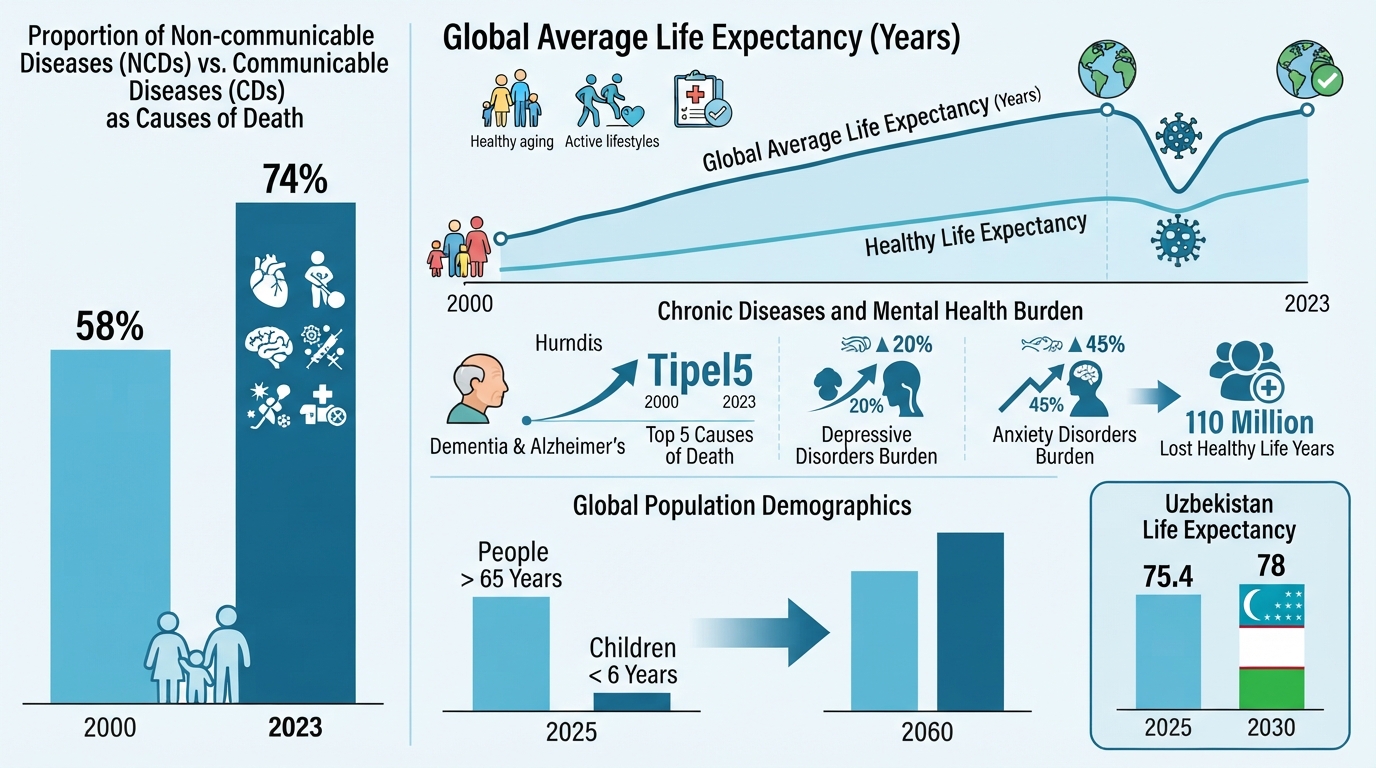
Average life expectancy in the world reached 73.3 years in 2023, almost recovering to the figure recorded before the COVID-19 pandemic. At the same time, the share of non-communicable diseases among all causes of death continues to increase: while in 2000 they accounted for 58% of deaths, in 2023 they already accounted for 74%.
This is stated in the new global estimates of the World Health Organization, covering the period from 2000 to 2023. For comparison, in 2019, before the pandemic, the average life expectancy was 73.4 years.
The healthy life expectancy indicator is recovering more slowly. In 2023, it stood at 62.8 years, which is 0.4 years lower than the 2019 level. This indicator takes into account not only overall life expectancy, but also years lived without health-limiting illnesses and injuries.
Against the backdrop of rising life expectancy, the role of chronic diseases has noticeably increased. Alzheimer's disease and other forms of dementia entered the top five leading causes of death in the world for the first time in 2023, rising from 19th place in 2000. During this period, the number of deaths related to dementia tripled.
Changes also affected the situation with mental disorders. Between 2019 and 2023, the global burden of disease associated with depressive disorders increased by about 20%, and that associated with anxiety disorders by almost 45%. Combined, they led to the loss of about 110 million years of healthy life in 2023 due to premature death and disability.
According to the Ministry of Health of Uzbekistan, in 2025 the average life expectancy in the country was 75.4 years. Within the framework of the "Uzbekistan — 2030" strategy, the goal has been set to increase this indicator to 78 years.
The WHO emphasizes that further increases in life expectancy require not only reducing mortality, but also increasing the number of years lived in good health. The organization's new estimates should help countries identify priorities in the prevention of non-communicable diseases, early diagnosis, and the development of healthcare systems.
In 2025, the number of people over 65 in the world exceeded the number of children under six for the first time, reaching approximately 852 million. According to forecasts, by 2060 the number of elderly people will almost double.