

Germany’s Auto Industry Employment Falls to 2005 Low
Employment in Germany’s automotive industry fell 5.8% year on year to 691,500 workers in the first half of 2026, Destatis said.
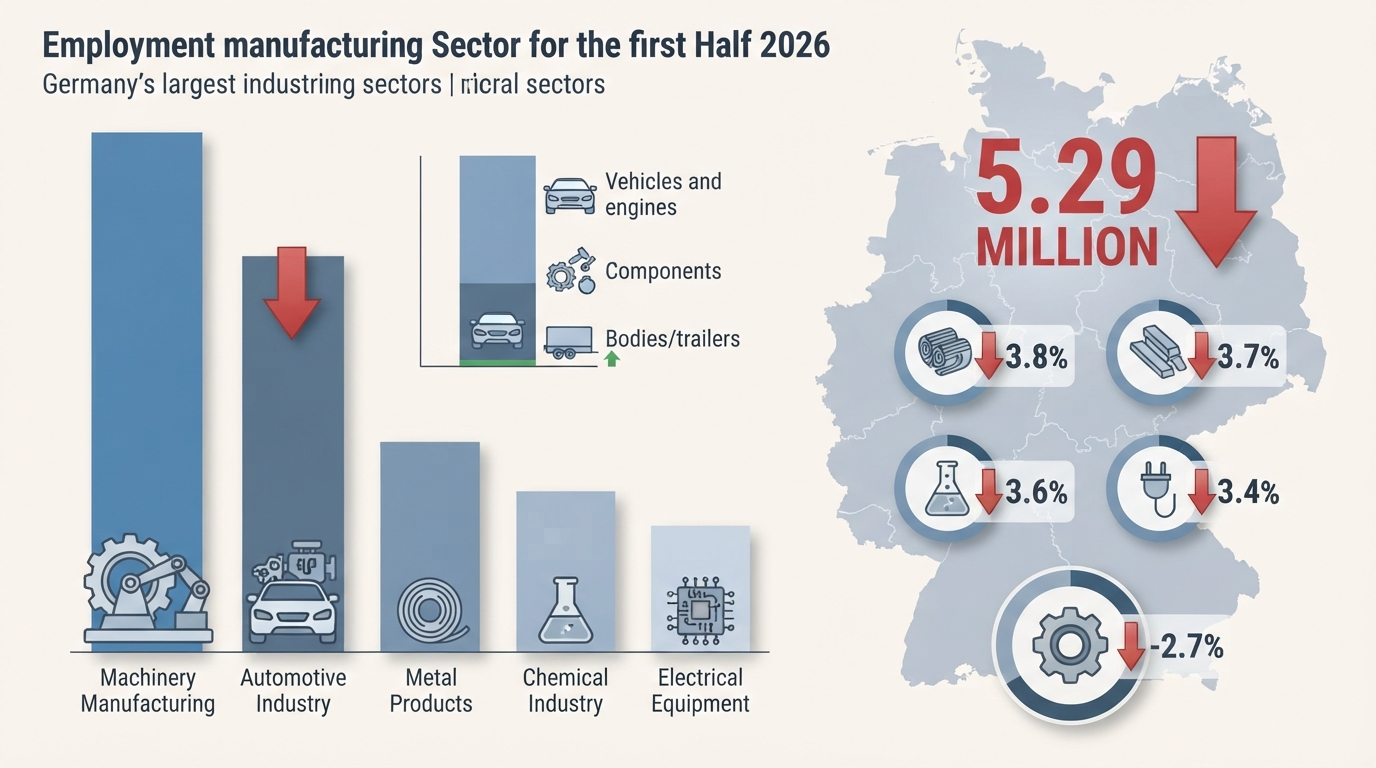
Germany's automotive sector experienced its lowest employment figures since 2005 during the first half of 2026. According to a report from Germany's Federal Statistical Office (Destatis), the industry employed 691,500 individuals at the close of June, marking a decrease of 42,300 people, or 5.8%, compared to the previous year.
This reduction in automotive employment represented the most significant drop among Germany's primary industrial sectors that employ over 200,000 people. Despite this decline, the automotive industry maintained its position as the nation's second-largest manufacturing employer. Machinery manufacturing held the top spot, with 905,900 employees at the end of the first half of the year.
Specifically, companies involved in the production of vehicles and engines saw a 6.1% year-on-year decrease in employment, reaching 429,200. Employment in the manufacturing of automotive components and accessories also fell by 7.6% to 219,500.
Conversely, employment in the production of bodies, coachwork, and trailers saw an increase of 10%, reaching 42,800.
The trend of declining employment was not exclusive to the automotive industry. Across Germany's entire manufacturing sector, 5.29 million people were employed at the end of the first half of the year. This figure represents a decrease of 144,100 individuals, or 2.7%, over the year.
Other significant industrial segments also experienced employment reductions. The number of workers in metal product manufacturing decreased by 3.8%, while employment in ferrous and non-ferrous metal production dropped by 3.7%. The chemical industry saw a 3.6% decline, and electrical equipment manufacturing experienced a 3.4% reduction.
In machinery manufacturing, which is Germany's largest industrial sector by employment, the workforce decreased by 2.7% year-on-year.
More modest employment declines were observed in plastics manufacturing, the food industry, and the production of computers, electronic, and optical products.