

Funding shortages force World Food Programme to cut aid to Gaza
The number of people helped by the UN agency in the Palestinian territory will drop by about a third - from 1.6 million to 1.1 million.
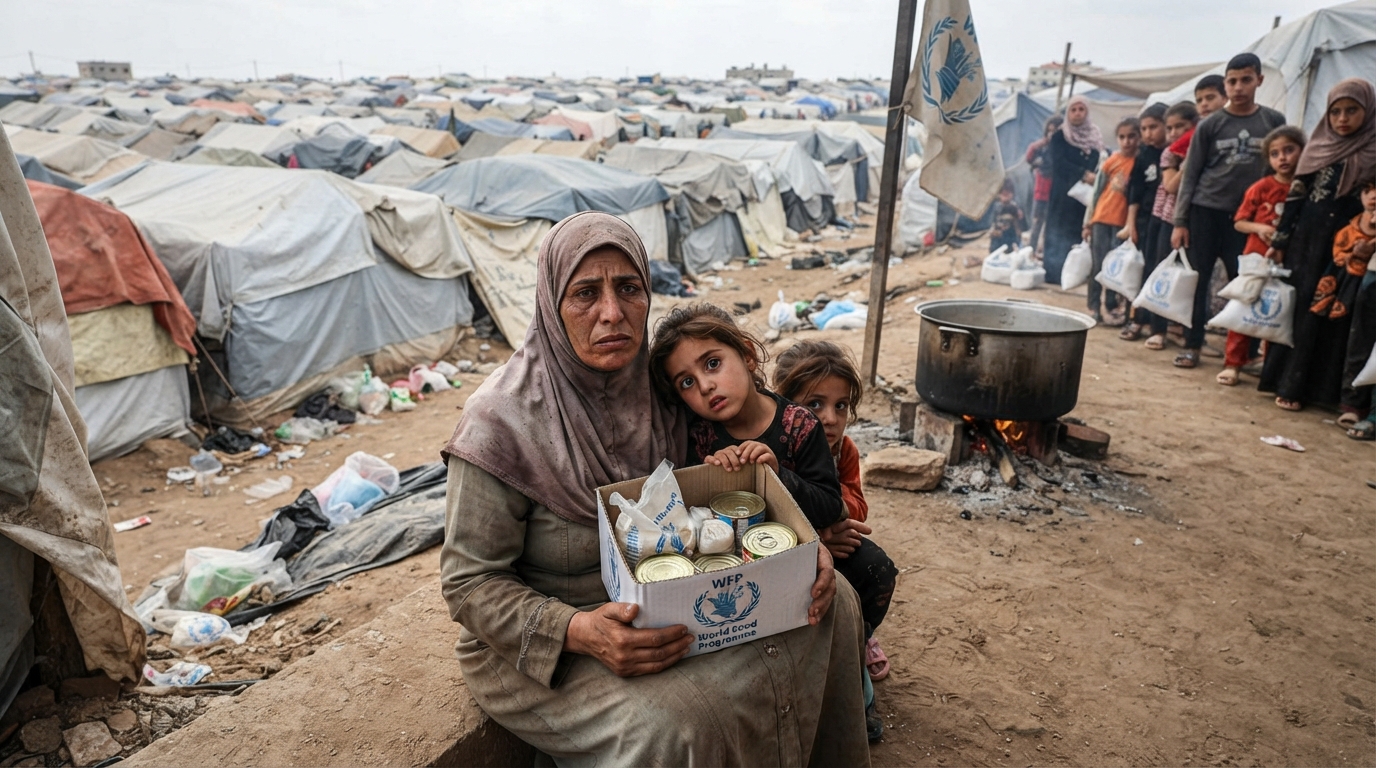
Funding shortfalls force World Food Programme to scale back aid to Gaza
Dalal al-Dahdouh said the WFP food handouts her family received were insufficient even before the cuts
One of the Gaza Strip’s main food-aid providers, the World Food Programme (WFP), says it is being compelled to "drastically reduce lifesaving assistance" to the Palestinian territory because of funding shortages.
In total, the number of people assisted by the UN agency will fall by about a third, from 1.6 million to 1.1 million.
The reductions come as winter nears and at a time when many families in Gaza are still struggling to feed themselves.
One consequence is that the number of hot meals currently distributed by community kitchens will be reduced from 250,000 to 150,000 a day.
Families in hard-to-reach areas, such as near the so-called Yellow Line, which marks Israel's area of military control, will get a meal every other day rather than every day.
Nearly all of Gaza's 2.1 million residents remain displaced, and two-thirds depend on food aid to survive.
Mervat al-Satari, a mother-of-five, says the cuts are a "disaster"
"It's a disaster! What will we do with these reduced rations? How will we provide for the little ones?" said Mervat al-Satari, a displaced Palestinian mother-of-five at a camp in the al-Mawasi area of Khan Younis after hearing the WFP's announcement. "Sometimes we wait for these meals to eat."
"This will affect us a lot. The daily aid was somehow ticking the box but now it will be every two days," said Sawsan Bahloul, who is also from al-Mawasi and is a mother of three. She added that the portions from the community kitchen - usually pasta or lentils, with occasional potatoes and aubergines - were already too small to feed her family.
Shaun Hughes, the WFP's Palestine director, says plainly that the cuts are driven by money, and "not because the needs are coming down, or because we don't have access - we do."
Nearly all of Gaza's 2.1 million people are displaced, with many living in camps like those in al-Mawasi
Since July, cash transfers for some half a million people have already been reduced, leaving them with less money to buy food in local markets. The number of Gazans receiving bags of flour and ration boxes from the WFP will now decline from 1.1 million to 600,000 each month.
The WFP received less than half the funding for its Palestinian operations in 2026 than in previous years. The agency says it urgently needs $450m (£338m) to keep "critical" operations going over the next six months.
Even though a ceasefire between Hamas and Israel was agreed a year ago, humanitarian conditions in Gaza remain dire.
There has been no reconstruction and little recovery, with Israel tightly controlling the entry of goods through crossings. Although food markets are now well stocked, few people can afford to shop there. More than 80% of people in Gaza are unemployed, so most of the population depends on aid.
Two-thirds of the population relies on food aid to survive, according to UN-backed experts
Families now receiving WFP food handouts told the BBC that even before the cuts, the aid was inadequate and offered little variety in their diets.
"The flour isn't enough and the food boxes aren't enough either," said Dalal al-Dahdouh, who is living in the ruins of her home in Gaza City with her family of eight. She fears the new cuts will have "a major impact".
She contrasts the current desperate reality with life before the war. "In the past, thank God, we had our own home and a wonderful life. We had fresh vegetables, proper sanitation facilities and our own land," she said. "Now we live entirely on aid, including WFP vouchers."
There is no cooking gas available in Gaza because the Israeli government regards it as a "dual use" item that could be used by Hamas for military purposes. Wood is expensive, so many families send their children into the street to look for plastic and cardboard to burn as fuel for making bread or heating food.
"It's still a very concerning humanitarian situation, people living in brutal conditions, most people still without a proper home, living in tents, poor access to water and sanitation and healthcare," Hughes of the WFP told the BBC. "Cuts to food assistance are going to compound that hardship that families have been facing for three years now."
Families, including Sawsan Bahloul's, are forced to burn plastic and cardboard as fuel for cooking
Humanitarian workers say that despite a modest improvement in Gaza compared with a year ago, acute food insecurity and the threat of famine returning still hang over the territory.
In July, the Integrated Phase Classification (IPC) - the world's foremost experts on food security - said that two-thirds of the population - 1.4 million people - were "expected to face crisis or worse levels of acute food insecurity in July-December 2026".
For now, the WFP says it can continue supporting bakeries that supply one-third of Gaza's bread needs and provide nutritional assistance to about 300,000 women and children. It also delivers health food snacks to some 200,000 children.
In the occupied West Bank, the WFP is still providing assistance to some 200,000 Palestinians, after halving the number of recipients in September.
The agency says food insecurity is increasing in the territory largely because of rising Israeli settler violence and Palestinian displacement.