

From 500 thousand soums per hour. How scammers lure money from Uzbekistanis under the guise of working on marketplaces
From 500 thousand soums per hour. How scammers lure money from Uzbekistanis under the guise of working on marketplaces
A scam scheme involving remote work offers on behalf of "Yandex Market" and other well-known companies is spreading in Uzbekistan. Victims are offered simple tasks to "promote products," but in the end, this results in a complete loss of their own funds. We look into how the scheme works, what is known about similar cases in other countries, and how to avoid becoming its victim.
### An ad that is hard to miss
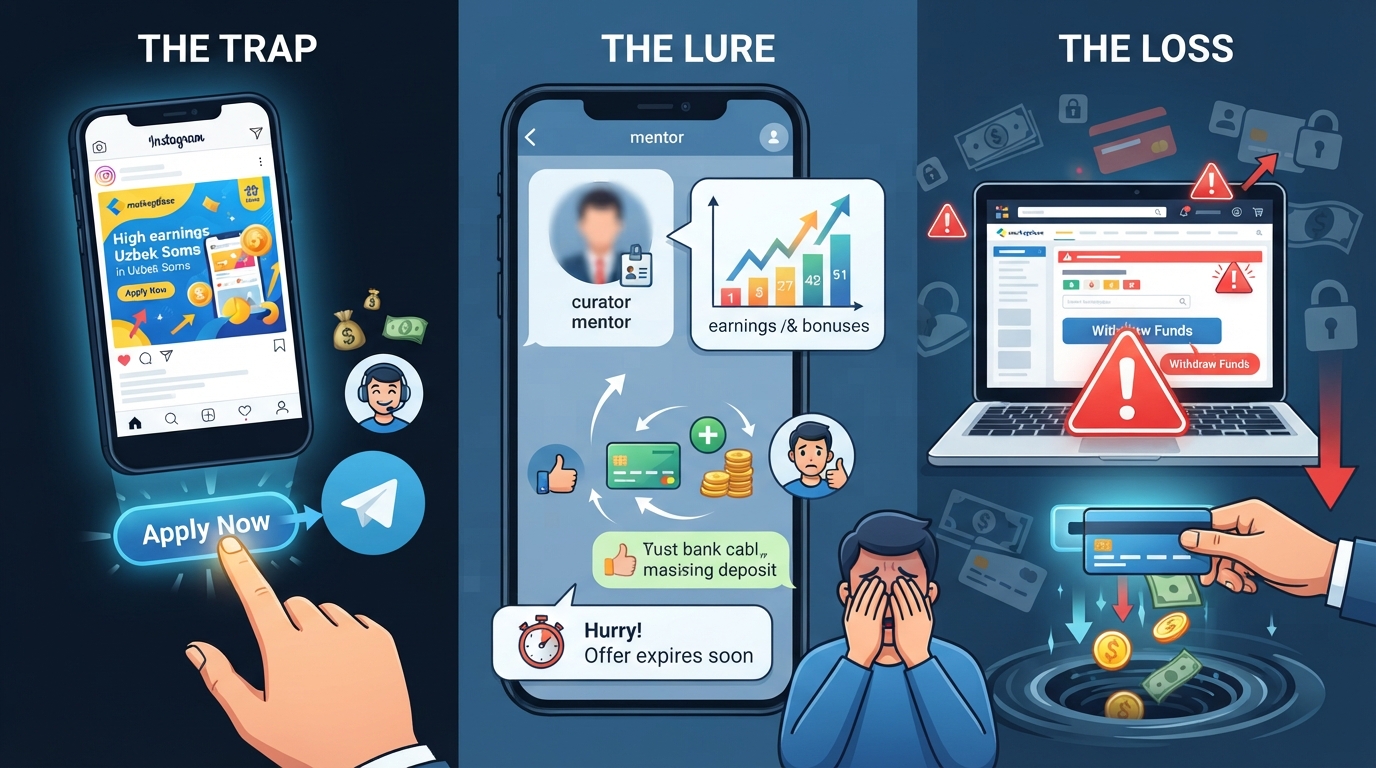
The trap begins with a regular Instagram feed. A post marked "Sponsored" is designed in the corporate colors of a popular national marketplace and promises easy money under the guise of a job vacancy. The conditions look almost perfect: work from home, one to three hours a day, and payments on the day the task is completed. They promise 500 thousand soums for an hour of work, 1.2 million for two hours, and as much as 2.3 million soums for three.
The tasks themselves seem completely harmless at first glance: checking orders, confirming data, and updating their statuses.
But upon careless examination, it is easy to miss strange details. The advertisement is posted by a third-party account with an English name, completely unrelated to the marketplace. The ad itself visually resembles content generated by a neural network. Real companies do not publish vacancies this way, but for a person looking for income, these red flags often go unnoticed. As a result, after clicking the apply button, the user is automatically redirected to Telegram.
### Meeting the "mentor"
In the messenger, the victim is met by a certain "curator" or "mentor." An avatar with the "Yandex Market" logo, a working schedule from 9:00 to 21:00 indicated in the profile, and a business style of communication create the impression of a real employee. Although the advertisement was from Uzum, he introduces himself as an employee of "Yandex Market." This is the first discrepancy that is easy to miss.
The conversation follows a pre-planned scenario. First, the person is asked for their age, name, profession, and phone number. Then they are sent "rules" where orders are allegedly formed jointly with Uzum Market, Amazon, Bonanza, and eBay, and the platform guarantees the safety of the invested funds. The mention of familiar brands is meant to create a sense of reliability. At the same time, the victim is warned not to disclose the details of the work and is forbidden to register multiple accounts. In reality, this is necessary to protect the scheme from publicity and repeated checks.
Once trust is gained, the "training" begins.
### "Training"
The first task includes nine orders. They must be completed on a website styled as "Yandex Market" (pmhnss.cc) or "Savdo markazi" (auns6.com). The mentor sends screenshots with arrows: where to click, what to confirm. The starting balance of 20 thousand soums turns into 61 thousand for nine orders.
Then comes the moment for which it was all started. The victim is asked to link a bank card, and a small amount is indeed credited to it. The scammers deliberately spend a little of their own money: the person sees the credit and is convinced that "everything works."
This is followed by "congratulations" on the first "earnings" and a new portion of promises: a bonus of 3.5 million soums is due for three tasks, along with a transfer to the permanent staff with a salary of 5.5 to 15 million. After such a "victory," the person develops a desire to go all the way.
### The second stage – depositing money
It is at this stage that the scheme is fully revealed. The interlocutor sends a table of "tasks and commission payments." The logic is simple: the more of your own money you transfer to the card, the higher the promised earnings. For example, with a deposit of 100 thousand soums, they promise to return 155–180 thousand, and with a transfer of 700 thousand, the withdrawal allegedly reaches up to 1.18 million soums. At the same time, they ask to send the money to the card of an ordinary private individual and confirm it with a receipt.
When a person tries to withdraw the "earned" money, the system does not allow the withdrawal: the balance is displayed on the screen, but the service writes that the withdrawal is blocked due to an "incomplete order." To gain access to their own funds and the accrued profit, the person is required to pay extra – for example, to deposit 279,899 soums. The "curator" convinces them that orders are assigned randomly, cannot be canceled, and the extra payment must be made strictly within an hour, otherwise all previously transferred money will be lost.
This is how a classic trap works: the person has already transferred their money and, trying to save it, agrees to pay extra. But as soon as they deposit the required amount, the system immediately generates a new "error" and demands the next, even larger transfer.
If the "employee" refuses to transfer more money, the tone of communication changes abruptly. As part of our journalistic experiment, we warned the interlocutor about transferring all materials and details to law enforcement agencies. To this, the scammers only cynically replied that "it is useless to threaten," and all working conditions were allegedly agreed upon in advance.
### This is not just an Uzbek story
Similar schemes have long been known outside Uzbekistan, and the scenario is almost identical everywhere.
Russian specialists from the company "Informzaschita" described it back in the spring of 2025: scammers posed as employees of a non-existent marketplace platform, and used up to 10–12 fake accounts to create a trusting atmosphere. The first task was to add items to favorites for 300–400 rubles.
In Singapore, according to the police, at least 1,399 people have fallen victim to a similar scheme since May 2023, with losses amounting to at least 19.9 million dollars.
In the US, the Federal Trade Commission recorded that the number of reports of "gamified" schemes rose from about 5,000 in the whole of 2023 to 20,000 in just the first half of 2024. At the same time, according to an agency representative, the real scale is larger: only about 4.8% of victims file complaints.
How does the Uzbek version differ? The scammers adapted it for local consumers: familiar brands, soums, cards of local banks, and communication in Uzbek and Russian.
### How to recognize the scheme?
Below are the key signs of deception that will help recognize scammers in time and save your money.
#### At the advertising stage
- **Unrealistic money.** 500 thousand soums per hour for a simple click on orders — such salaries simply do not exist.
- **Suspicious profile.** The ad is published by a third-party account that has nothing to do with the brand. Official vacancies of Uzum and other companies are published only on their websites or in verified channels.
- **Moving to messengers.** All "work" is conducted exclusively in Telegram without concluding a contract or official employment.
#### In correspondence with the "curator"
- **Confusion with brands.** The ad lures with the name of Uzum, but the "Yandex Market" logo appears in the correspondence and on the website.
- **Psychological pressure.** You are constantly rushed ("needs to be done within an hour," "right now"), creating artificial urgency.
- **Requirement of secrecy.** The mentor asks not to tell anyone about the work and not to create other accounts.
#### On the scam website
- **Wrong address.** The domain in the browser has nothing to do with the official website (in our case, instead of a verified resource, there were addresses like pmhnss.cc and auns6.com). In the case of pmhnss.cc, a check revealed that the domain has existed for only three months.
- **Clunky translation.** The website interface is in Russian, but the rules for withdrawing funds or errors suddenly appear in English.
- **Game elements.** The appearance of "VIP levels," "ratings," and "internal commissions" is a common sign of fake platforms created to generate excitement.
- **Blocks and "penalties."** The appearance of "frozen" orders and the requirement to pay the difference out of your own pocket.
#### When transferring money
- **Transfer to a personal card.** They ask to send money not to the current account of a legal entity, but to the card of an ordinary private individual.
- **Fabulous returns.** The promise of 55–70% profit literally for completing one order.
### 6 golden rules of protection
- **You are paid for work, you do not pay.** If they require you to pay something to start working or to withdraw earned money, it is 100% a scam.
- **Verify through support.** Call the marketplace hotline or write in the official app to clarify if such a vacancy exists.
- **Do not transfer money to strangers.** Especially to personal cards following instructions from unfamiliar chats.
- **Stop at the "extra payment" requirement.** If the system asks to deposit more money to save what was previously transferred, do not pay. This will only increase your losses.
- **Consult with loved ones.** Scammers rely on isolating the victim. A simple conversation with friends or family will quickly shatter the illusion.
- **Protect personal data.** Never give anyone your card number, the three-digit code on the back, passwords, or SMS codes from banking apps.
### What to do if you have already transferred money
First of all, stop paying: the next "extra payment" will not return the previous ones. Save the correspondence, receipts, and screenshots of the website. Call the bank whose card was used as quickly as possible and report the fraud: sometimes it is possible to block the transfer. Then file a report with the internal affairs bodies (102). Finally, send complaints about the ad on Instagram and the account on Telegram, as well as to the marketplace whose name was used.
The main thing to remember is that scammers expect the person to be ashamed and remain silent. The faster the victim talks about what happened, the more chances there are to protect others. However, it is highly unlikely that the funds will be recovered.