

France promises 3,000 extra teachers in first step to calm student protests
Education minister Edouard Geffray makes the offer after another day of sometimes violent demonstrations by high-school students.
France pledges 3,000 additional teachers in initial move to ease student protests
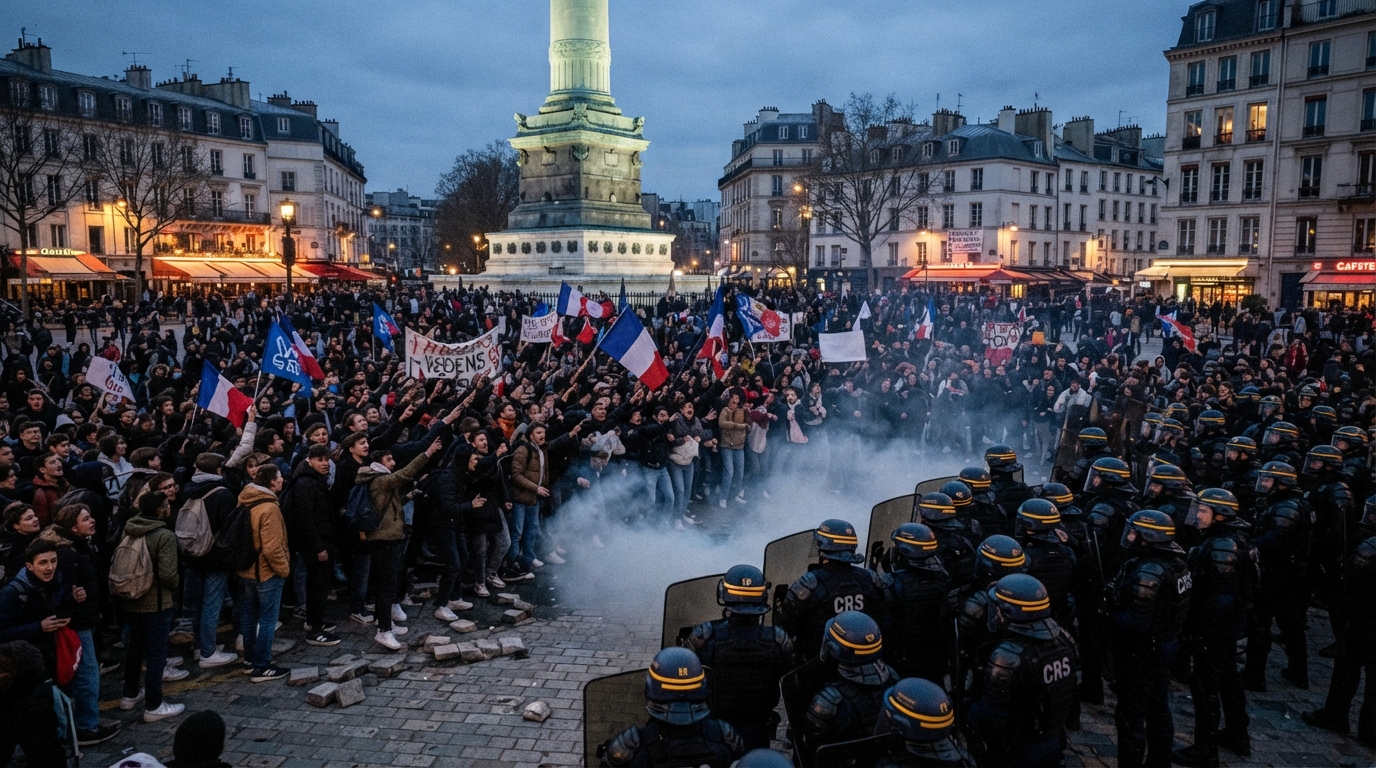
Thousands assembled at the Bastille in Paris hours before the French government offered its first concession to students, promising 3,000 extra supply teachers in the coming days.
Education minister Edouard Geffray announced the measure in a television interview on Thursday evening, after another day of sometimes violent demonstrations by high-school students.
According to the government, 6,877 people have been arrested since the protests began around demands for more resources in secondary education, and 86% of those detained are under 18.
What unions described as Act Four of the three-week movement saw about 71,000 people protest nationwide on Thursday, including 24,000 at the Bastille in Paris.
Police again used tear gas to break up groups that attacked them with paving stones and homemade fireworks.
In Bordeaux, protesters ransacked a lycée, or high school, while in Marseille a deputy-head was beaten up.
On Friday, around 140 lycées — out of 3,500 — were fully or partly closed, a sharp fall from previous days. Even so, another day of action has been called for next Tuesday.
Geffray’s announcement was the first substantial concession to the protesters’ complaints.
It has long been acknowledged across French education that too many school hours are lost because teachers are absent and available supply staff are not used to replace them.
The minister said new software coming online at the ministry would make it possible to assign 3,000 supply teachers to the roughly 500 lycées identified as most in need.
Many of those schools are likely to be in city suburbs with large immigrant populations, where the shortage of teachers is most severe.
Geffray also said more money would be made available through an existing scheme for teachers who want to work overtime to fill gaps.
He added that students’ grievances would be considered in upcoming talks on the education portion of the 2027 state budget.
But the offer did not include any major pledge of new investment on a scale likely to satisfy protesters.
The government is cautious about seeming to buy social peace, knowing that France’s fragile debt situation is being watched closely by international money markets.
Student leaders have reacted with caution, to say the least.
(Lycée Renewal) said students were waiting to see how the promise was implemented in practice: "We've had some announcements which correspond to part of our demands. But obviously people want to see the money and more concrete results."
"As long as we do not have €10bn on the table, we will continue our action," said Sabrine Kharbach of the Union Etudiante (Student Union), which is close to the radical-left France Insoumise (France Unbowed) party of presidential candidate Jean-Luc Mélenchon.
Mélenchon praised Thursday’s demonstrations, saying on X that the students had "retaken the Bastille".
At the opposite end of the political spectrum, however, a spokesman for the hard-right National Rally (RN) condemned the government’s concessions.
"The message is: if you break things, you get given stuff," said Laurent Jacobelli. "When you burn cars, attack police, you gain something in return. It's the legitimisation of violence."
The movement is the most serious student unrest in France in many years, and it comes amid rising tension in the country, with anger over rising fuel prices and distress in the farming sector also likely to spark protests.
Next Saturday, 17 October, has been set aside as a day of demonstrations by a revived "yellow vest" movement.
Meanwhile, the approach of presidential elections in April and May — in which both the hard right and hard left are expected to do strongly — is intensifying the confrontational mood.
The government is hoping that half-term holidays at the end of next week, along with colder and wetter weather, will take some of the force out of the protests.