

France is divided over who to blame for and what to learn from weekend riots
In France and beyond there is widespread disagreement over what led to some of the worst unrest seen in French cities in modern history.
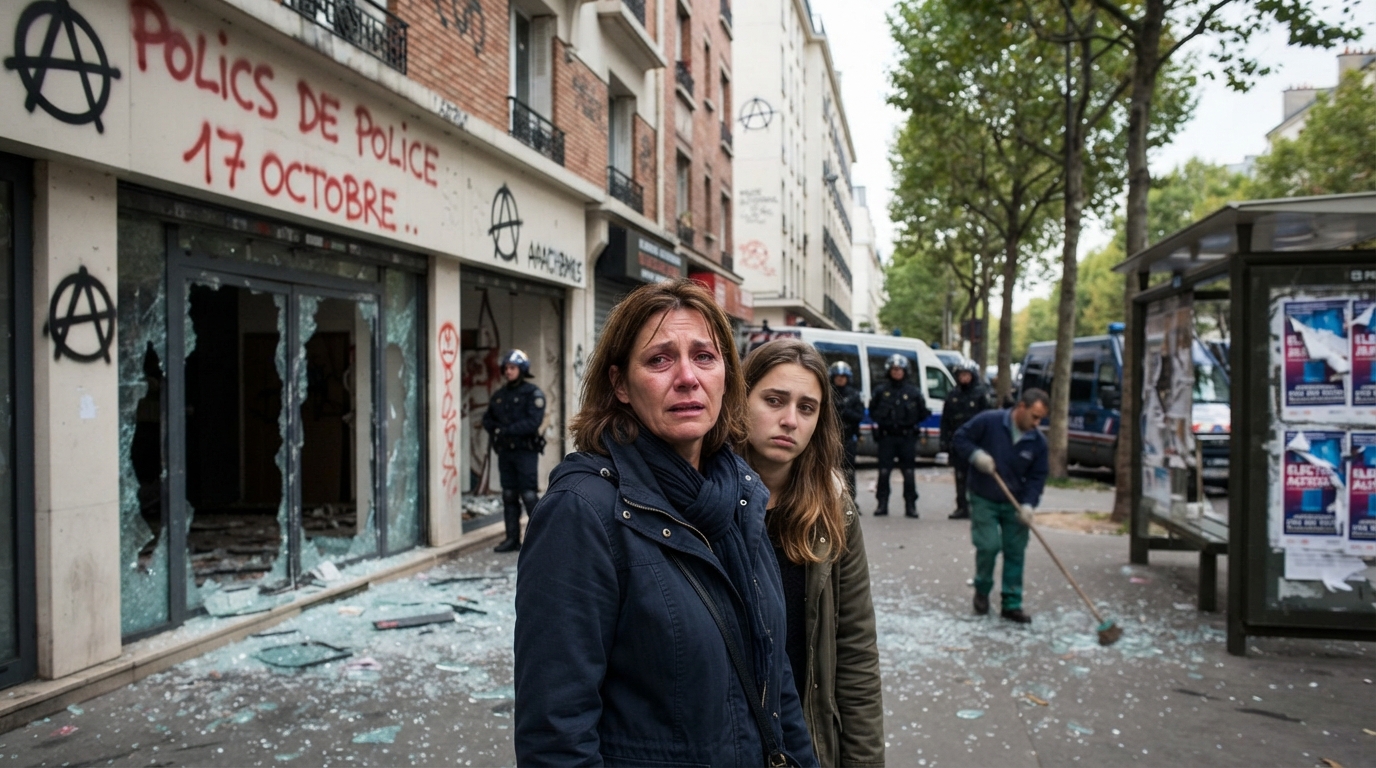
France is split over who should be blamed for the weekend riots, and what lessons should be drawn from them
The French prime minister has accused far-left groups of organising some of the violence
"This is not the face of France! You media all focus on the violence and destruction of Saturday's protests. But that's not the majority. It's not 'us'. That's not France!"
Elisabeth told me this in front of a line of smashed shop windows, with broken glass still scattered across the tree-lined Paris street. The walls were covered in red graffiti insulting French police and signed with the date of the riots, 17 October.
I had stopped her and her friend to ask what they made of what happened on Saturday. Elisabeth was so distressed that she seemed close to tears as she spoke.
"My friend thinks this is civil war in France but I don't. Saturday is about something else entirely."
But what exactly happened? Who was behind the riots? While much of the looting appeared opportunistic, the violence seemed to have been planned in advance. Why stage it now, after weeks of student protests? And who stands to benefit most from the destruction this weekend? Elisabeth was not completely sure.
A range of theories is circulating, both inside and outside France. Simple black-and-white explanations may be tempting, but the reality is that several factors are involved.
Yaël Braun-Pivet, the president of the National Assembly, has suggested a parliamentary inquiry into the riots and the way they were organised.
French intelligence had already briefed government circles earlier this month that left-wing anarchist groups were involved in the student protests. Their mark — a capital A circled in black — was sprayed on many buildings across France this weekend.
French media have repeatedly shown a video filmed on Saturday in which groups of young men dressed in black, with black folded kerchiefs covering their faces, appear to attack several police vans with what seem to be large hammers or machetes.
A French intelligence report dated 29 September, published by Le Figaro newspaper, describes the "manipulation" of student demonstrations by student unions and political movements linked to the radical left. It says the far-left political movement La France Insoumise (LFI) was using violence as an electoral tactic ahead of the 2027 presidential elections.
According to French reports, the mass looting of what is said to be more than 3,000 shops and businesses on Saturday seems to have been largely opportunistic. Many young people quickly went online to try to sell stolen goods, including designer trainers. Some did not even bother to hide their faces. Did they feel untouchable?
Online sales platforms now say they will cooperate with the French authorities to identify as many looters as possible. Police say they are reviewing CCTV and social media footage. President Macron insists that everyone responsible for violence or theft will face justice.
Claims that some people were encouraged to take part in the violence by social media posts have led former French Prime Minister Gabriel Attal, a contender in France's upcoming presidential election, to call for targeted social media blackouts to prevent further violence.
Belgium has also seen violent protests in recent days. On Tuesday, Belgium's Interior minister Bernard Quintin warned of the "TikTokisation" of violence. He said footage of riots is widely shared on social media, reaching a large audience of impressionable young people, while also blaming violence on the streets of Brussels and Liege on "known far left groups".
In France, Prime Minister Sebastian Lecornu and his Interior Minister Laurent Nunez have also clearly pointed to the "hard left" in Saturday's unrest - "pouring oil onto the fire," said Nunez. On Tuesday, Mr Lecornu spoke of "insurrections" planned by "small far-left and ultra-left groups".
He had earlier accused the "far left" of weaponising student demonstrations.
That is something anti-capitalist LFI leader Jean-Luc Mélenchon, who also hopes to become French president, has strongly denied.
Mélonchon took part in Saturday's planned protest. Politicians from his LFI movement have been present at the student demonstrations since they began a month ago in the socially deprived outskirts of Paris, where the demands have been for better state education for all.
The conservative mayor of Limoges Guillaume Guérin blamed the radical left LFI for the disorder in his city, which the party denied
In the Saint-Denis suburb on Monday, I met Lisa Cordat of the FSE student union. She said students had organised themselves for demonstrations through social media messaging or student-led organisations. She said it was "insulting" to suggest they were being manipulated or "told to do this, or do that" by politicians.
"Student anger comes from the ground up," says Lisa.
But many in France also feel a clear frustration at what they see as the politicisation of Saturday's violence. Lina, 25, told me: "Politicians are hunting for scapegoats but don't ask why it all happened. The root causes of Saturday. We feel scared and abandoned."
France's top politicians have been engaged in a blame game since Saturday.
With the presidential election six months away, the contest is fiercely fought, and the unrest on French streets has fed straight into France's already febrile politics.
Mélenchon, who is currently second in most polls ahead of centrist candidates, accused France's centrist Prime Minister of being "responsible for the chaos" because of either "incompetence or a worst-case strategy."
Mélonchon then appeared to suggest that Mr Lecornu may have let the violence unfold in order to present himself as a "party of order" after Saturday's lawlessness, "that would make people forget his failure in public finances."
France is grappling with rising public debt and government borrowing costs.
On the question of intelligence failures on Saturday, President Macron has demanded explanations and a new policing strategy. France's Interior Minister admitted there were not enough officers on the streets, even though the nationwide protests had been widely publicised in advance. After accusations of excessive force at earlier demonstrations, the police seemed badly out of their depth this weekend.
Among all the presidential hopefuls, Marine Le Pen of the anti-immigration National Rally Party appears to gain the most politically from Saturday's shocking scenes.
She is already well ahead in the opinion polls. Le Pen chose to release a presidential-style video address to the nation on social media on Sunday. Dressed formally, seated behind a large desk and with a French flag behind her, she blamed Jean-Luc Mélenchon by name for his associates who "look to throw the country into chaos," she said.
She also accused the Macron government of "running out of steam", saying France was "taken hostage between violence and powerlessness".
She ended her video by reminding French voters that they would have the chance to "choose a different path" in 6 months time.
Le Pen's party advocates law and order and closed borders and, like US President Trump and Vice US President JD Vance, has blamed migrants, among others, for the chaos in France on Saturday.
Teacher Mar said Saturday's violence "suits politicians' purpose. It distracts from weeks of legitimate protests for better public services," she said.
"Politicians aren't listening to what the students need, or what teachers need or what the French people want. They're using the violence to election-campaign to become president and to try to make their opponents look bad."
But more and more people in France, especially among the young Gen Z generation, say they are losing faith in "the system".
That is echoed in other European countries, where mainly youth-led protests erupted - some violently - this weekend in Italy, Portugal and Albania as well as France and Belgium.
These demonstrations are often sparked by soaring living costs, worsening public services and a feeling of powerlessness over people's own lives.
What can individuals do about rising energy costs driven by wars far away in the Middle East or in Ukraine, many ask?
Voters increasingly say they are losing trust in traditional or governing political parties to hear their concerns and respond to them. Young people look at climate change, social inequality, unaffordable housing and AI potentially threatening their place in the job market.
According to opinion polls conducted this year by Pew, 69% of people in France are dissatisfied with democracy. In Spain, it is 68% and in Italy, 62%. (The US is experiencing similar disillusionment, with 69% saying they are dissatisfied with how democracy is working.)
Many of the people I have spoken to in France since Saturday's riots have stressed the need to clearly distinguish between angry but peaceful protesters and those determined to cause violent havoc.
Whatever the politics, is what we are now seeing in Europe's protest wave perhaps a potent mix of frustration boiling over, pleas for the authorities to listen, and, for some, a dark feeling that there is little left to lose?