

Four 'extraordinary' Renaissance paintings stolen from Italian museum
The works were taken overnight without alarms being triggered, raising suspicion of a professional hit.
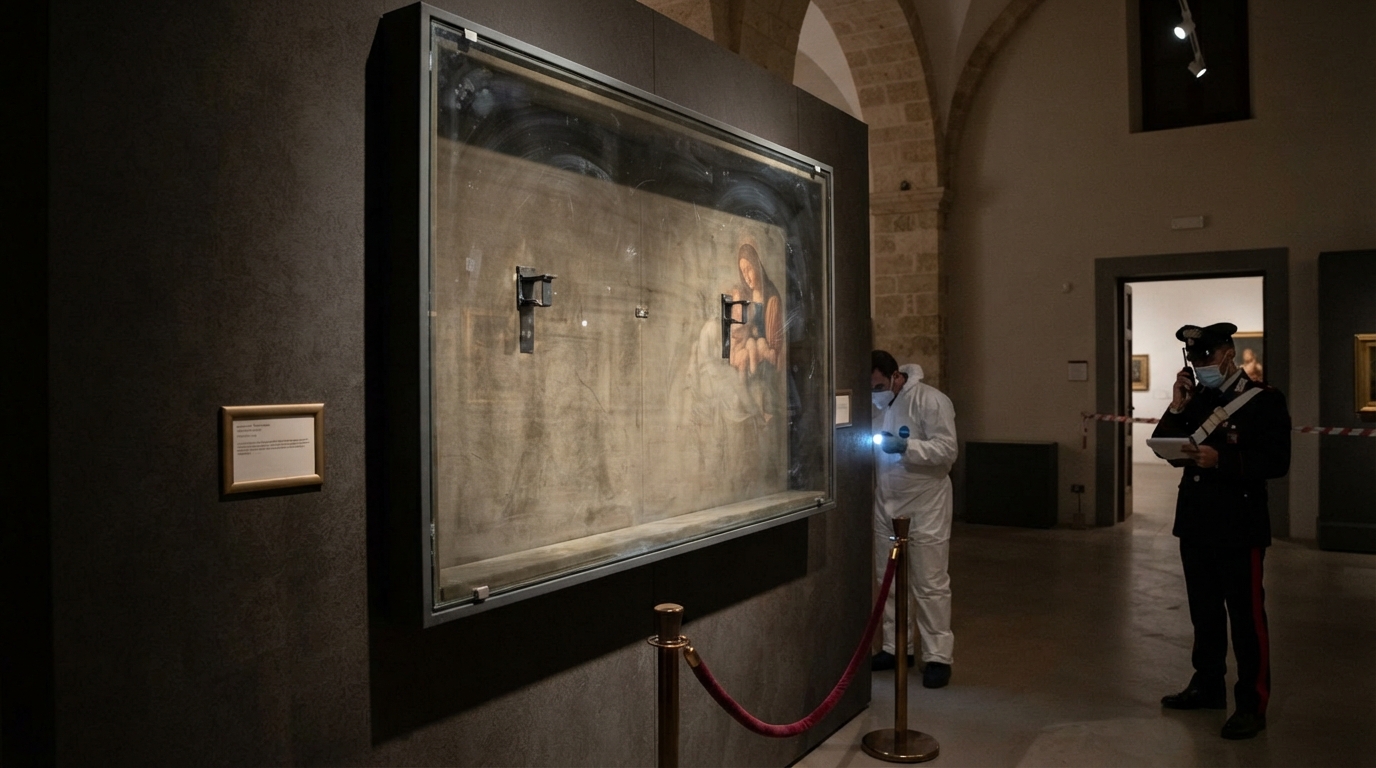
Four "extraordinary" Renaissance paintings have been stolen from a museum in Sicily, Italy, according to the nation's culture minister. Alessandro Giuli confirmed that the stolen works, all attributed to Antonello da Messina, include three panels from the Polyptych of San Gregorio and a double-sided panel depicting the Madonna with Child and Christ in Pietà. The theft occurred on Saturday night at the Regional Interdisciplinary Museum of Messina.
Police are currently investigating how the thieves managed to bypass the museum's alarm system and who is responsible for the crime. This incident adds to a series of museum heists across Europe, resulting in the disappearance of numerous invaluable artworks.
Italian news agency Ansa reported that investigators suspect the paintings were stolen to order by black market art thieves. The Madonna and Christ in Pietà panel, which was briefly exhibited at the British Museum in 2016, was reportedly removed directly from a secure display case. All the stolen paintings are on wooden panels, making them difficult to roll up.
Marisa Mercurio, the museum's director, believes the theft took place around 9:50 PM local time (7:50 PM GMT) on Saturday. She expressed her shock to Ansa, calling it "a great loss for the museum, for the city, the community and the art world."
Antonello da Messina, a 15th-century painter born and raised in Sicily, rose to prominence as a master painter of the early Renaissance. His San Gregorio Polyptych, painted in 1473, features the Virgin Mary holding an infant Jesus Christ, flanked by St Gregory and St Benedict, along with several angels. Only five panels of this artwork, originally commissioned for the monastery of Santa Maria, are known to survive, and three of these were stolen.
The double-sided panel, also stolen, depicts an infant Christ blessing a follower while held by the Virgin Mary on one side, and an adult Christ in death on the other. This piece, likely painted around the same time as the polyptych, was probably intended for private worship due to its small size.
Federico Basile, the mayor of Messina, voiced his "deep outrage" at the "heinous criminal act," stating, "A heritage belonging to all the people of Messina has been violated. Messina will not let its history be stolen."
This theft follows closely on the heels of Italy's specialist art crime unit announcing the recovery of three artworks stolen earlier this year from a museum near Parma. Those paintings by Cézanne, Renoir, and Matisse were valued at a combined €9 million (£7.8 million) and were taken by a gang in minutes, with the museum's alarm system preventing further losses.
The security of priceless artworks and artifacts in European museums came under scrutiny late last year when a gang of thieves broke into the Louvre in Paris in broad daylight, making off with €88 million worth of historic jewelry.