

For large businesses, electricity will become cheaper during the day, while the nighttime rate will remain standard
In Uzbekistan, differentiated electricity tariffs for large consumers have been changed. From 9:00 to 17:00, a reduction coefficient will be applied to them — the tariff will become 1.5 times lower. At night, the previous discount is canceled, and electricity will be paid for at the regular rate.
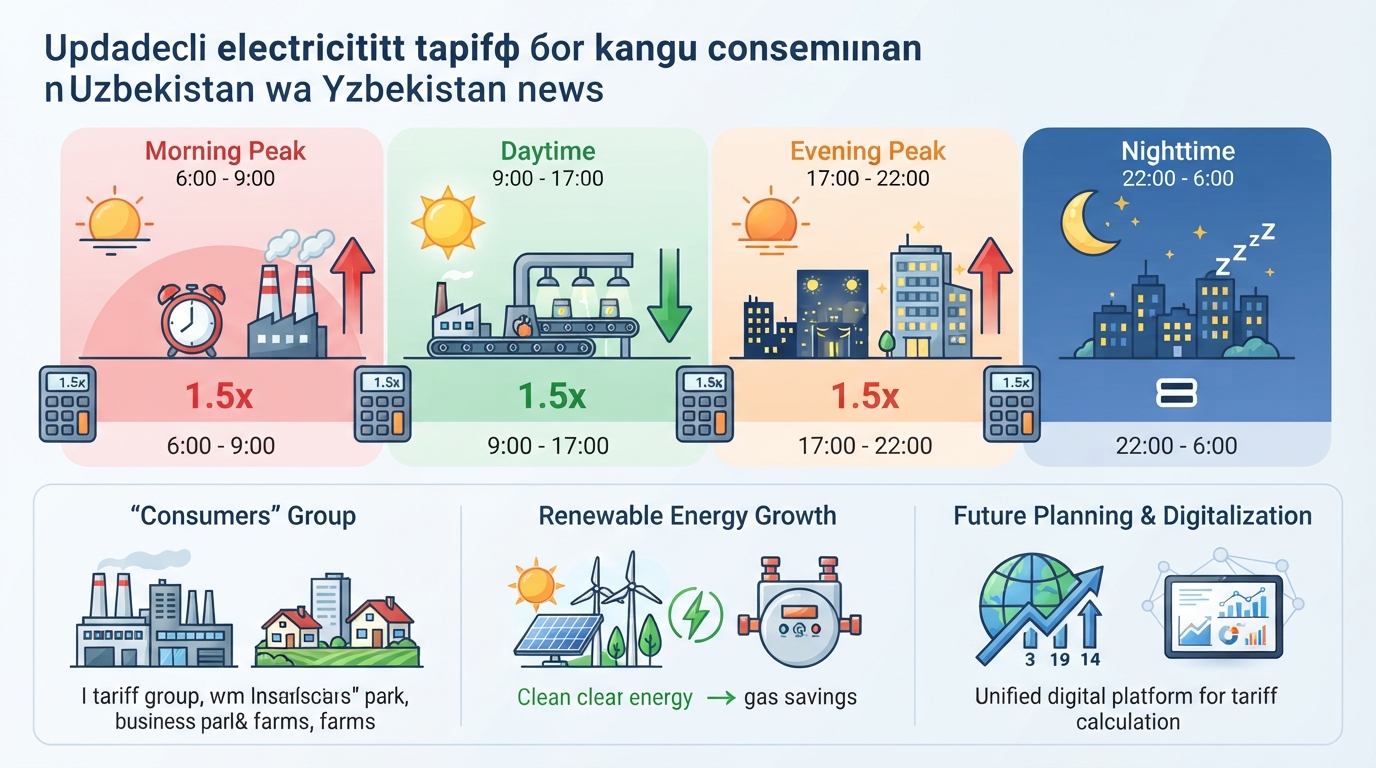
For large consumers, electricity will become cheaper during the day, and at night — at the regular rate
In Uzbekistan, the procedure for applying differentiated electricity tariffs for large consumers has been revised. The reduction coefficient, which previously applied at night, has now been shifted to daytime hours. This is provided for by the presidential decree of September 22 on the further development of the fuel and energy sector.
The changes affect consumers of the I tariff group. Under current rules, this group includes consumers with a total connected capacity of main and backup power supply of 750 kVA and above, who pay for electricity at a differentiated tariff.
At the same time, budgetary organizations, water supply enterprises, pumping stations of farms and water consumer associations, as well as pumping stations financed from the state budget, are not included in this group.
Until now, the day for such consumers was divided into three tariff periods. From 6:00 to 9:00 and from 17:00 to 22:00 — during peak load hours — an increasing coefficient of 1.5 was applied. During the daytime from 9:00 to 17:00, the regular tariff applied, and at night — from 22:00 to 24:00 and from 0:00 to 6:00 — a reduction coefficient of 1.5 times was in effect.
The new decree changes the last two conditions. At night, the established tariff will apply without a reduction coefficient, and from 9:00 to 17:00, the tariff will be reduced by 1.5 times. The decree does not change the increasing coefficient during morning and evening peak hours. This amendment is contained in the changes to paragraph 78 of the Rules for the Use of Electric Energy and Natural Gas.
Thus, the scheme for consumers of the I group now looks like this:
Since June 1, the base electricity tariff for consumers of the I and II groups has been 1,100 soums per 1 kWh. Based on this, during peak hours, electricity for the I group costs 1,650 soums per 1 kWh, and when applying the 1.5-fold reduction coefficient — approximately 733 soums per 1 kWh.
The amendments are being introduced against the backdrop of rapid growth in renewable generation. According to data presented to the president on September 22, the cumulative capacity of solar and wind power plants in Uzbekistan has exceeded 6.3 GW. The authorities also noted that the expansion of renewable energy allows for saving natural gas.
In addition, according to the decree, the authorities will annually prepare three-year forecasts of demand for fuel and energy resources and, based on them, three-year plans for supplying consumers and promising investment projects. Projects from the investment plan must be implemented through a tender, and conducting direct negotiations with investors and granting individual benefits for such projects is prohibited.
Furthermore, starting July 1, 2027, a unified digital platform of the Interdepartmental Tariff Commission in the energy sector is to launch. Through it, regulated enterprises will submit tariff applications and necessary financial and technical data, and tariff calculation is planned to be automated.