

Five reasons India's stock market is sinking even when its economy is growing
The world's fastest growing major economy has one of the worst performing major equity markets in 2026.
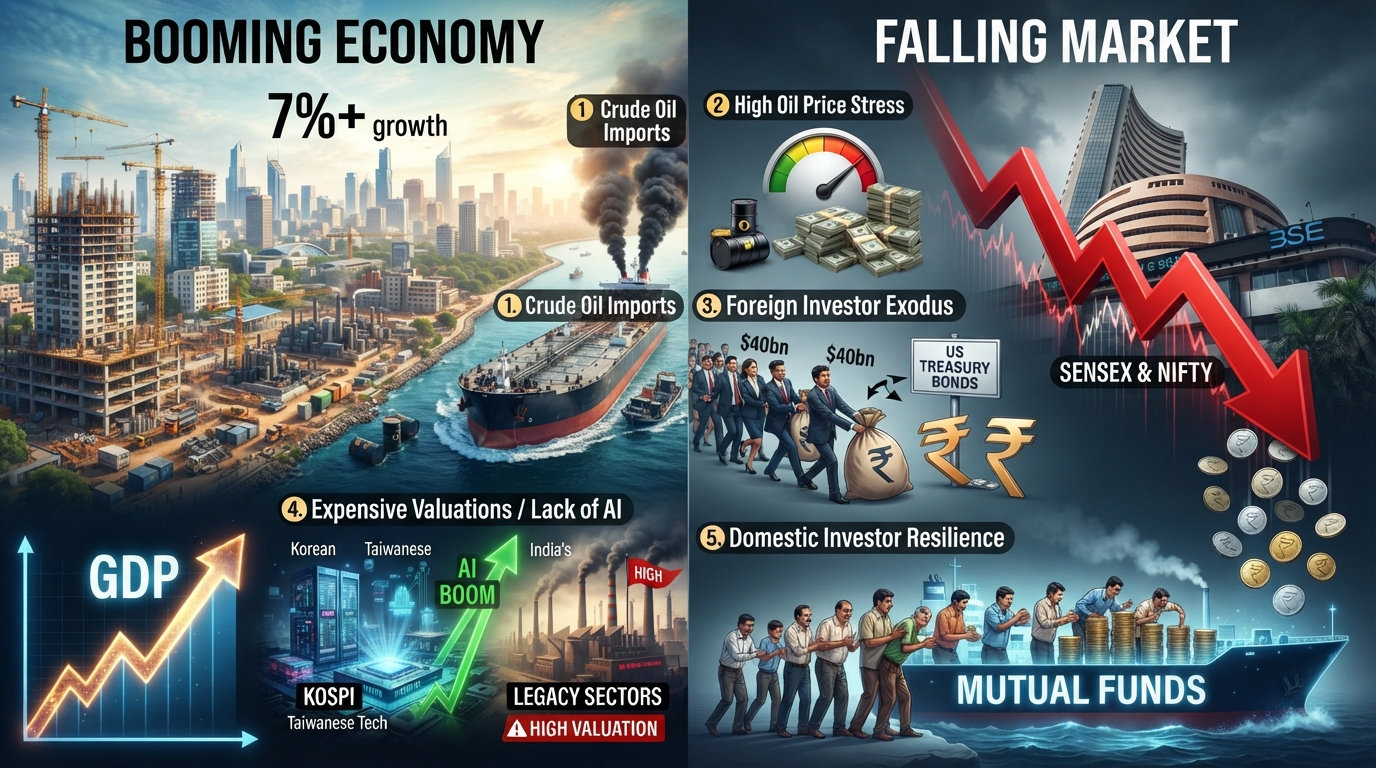
Five reasons India’s stock market is falling even as the economy expands
India has one of the world’s worst-performing major equity markets in 2026.
India’s economy is expanding at an enviable pace of more than 7%, despite global energy shocks, higher interest rates, tariff uncertainty and weather-related disruptions.
Yet the world’s fastest-growing major economy also has one of the worst-performing major equity markets in 2026. In fact, the decline in Indian stocks has deepened in recent weeks.
The benchmark Sensex and Nifty indices, which track the country’s biggest companies, have edged higher since Monday after eight straight weeks of losses — the longest losing streak in 25 years, according to Reuters.
Indian mom-and-pop investors who put money into the Nifty have seen their wealth fall by about 15% this year. By contrast, they would have gained 62% on Korea’s Kospi index since January, or 170% over the past two years.
Taken together, the money foreign investors have put into Indian markets over the past decade — after subtracting sales and withdrawals — is now close to zero. In just the past two years, foreign institutional investors have pulled out a huge $40bn, according to Bernstein Research data.
It is the large pool of domestic institutional and retail money, flowing into vehicles such as mutual funds, that has helped prevent a steeper market drop.
Domestic mutual fund assets under management have risen from about $125bn in 2016 to roughly $900bn this year, while the number of Indians putting money into stocks and mutual funds has more than tripled to 150 million people.
That makes the recent market decline more troubling, since households already dealing with a weak job market, high inflation and slowing consumption are now also seeing their equity savings take a hit.
So what has gone wrong?
Here are five reasons India’s booming economy is not lifting its stock market.
India imports more than 90% of its crude needs
Crude oil prices have stayed between $90 and $100 a barrel as shipping disruption through the Strait of Hormuz enters its eighth month, far longer than analysts expected. There is still little clarity on when conditions will normalize.
“This single variable tends to influence the markets quite negatively,” Hari Shyamsunder, a fund manager with Franklin Templeton Asset Management India, told the BBC. “Markets can absorb crude between $70 and $90, but when prices move above $100 a barrel, it starts putting stress on macro-economic variables such as inflation and also company earnings and margins.”
India imports more than 90% of its requirements — nearly half of its crude oil imports, along with a large share of liquified petroleum gas (LPG) and liquified natural gas (LNG) shipments, come through the Strait of Hormuz.
Although Delhi has diversified its energy sources by tapping Russian oil markets, US President Donald Trump recently threatened tariffs of up to 100% on countries doing trade with Moscow, adding another layer of complexity.
As oil prices rise, inflation rises too and, as a result, interest rates are climbing globally. The effective yield on US government bonds is above 5%, or near 25-year highs.
These are often viewed as risk-free investments. So when rates rise, foreign money tends to leave riskier emerging-market assets such as Indian equities and move toward safer options like US bonds.
For foreign investors, weak returns have been made worse by a softer rupee. In currency-adjusted dollar terms, they have been hurt by the Indian currency’s decline.
Over the past decade, the Nifty has delivered only 6% annualised dollar returns — hardly appealing, especially compared with several other competing markets.
Indian stocks remain expensive relative to earnings compared with other emerging markets
Valuations have been another major worry.
The market correction over the past two years has reduced the premium Indian stocks once held over their emerging-market peers.
“Stocks are cheaper than they have been on average for the last ten years,” says Shyamsunder, adding that the premium Indian shares commanded over other emerging economies has narrowed sharply in recent years.
Even so, they remain expensive relative to earnings, especially because companies in places such as South Korea and Taiwan have benefited from a massive artificial intelligence (AI) boom that has lifted profits.
In India, AI, or the new economy more broadly, is a major missing element in the growth story.
“Many of India’s large caps [big companies] represent a bygone economic era,” Bernstein Research said in a recent note. “Most are not investing in the future, but consolidating their past, often expecting policy to continue shielding them from global competition.”
India is chasing an AI breakthrough — but is it falling behind?
Its smaller companies have also yet to reach the scale needed to attract foreign institutional funds.
While Indian companies are investing in data centres and chip fabrication, the country has not produced a global giant like OpenAI, Anthropic or even China’s DeepSeek — where the biggest share of profits in the AI value chain lies.
According to Bernstein, foreign investor interest will only return to India in a meaningful way if it can build globally competitive industries in these emerging areas.
“We are seeing early signs of this in areas such as space, defence, semiconductors, and deep-tech innovation, but most remain too small to materially influence capital allocation decisions over much of this decade.”
Domestic savings into mutual funds have not slowed despite the market correction
So what happens next?
A number of immediate factors will shape how Indian markets move from here.
“Easing geopolitical tensions and relatively attractive valuations could support a revival in FPI [foreign portfolio investor] inflows,” according to CareEdge, a brokerage, though trade tensions and higher energy prices remain a “challenge for corporate performance going ahead”.
For now, while foreign investors may have given up, Indian savers — though increasingly anxious — have not slowed their monthly investment flows into mutual funds.
The real test will be whether that resilience holds through a deeper correction ahead.