

Energy from waste: How South Korea solved the food waste problem?
**Energy from waste: How South Korea solved its food waste problem**
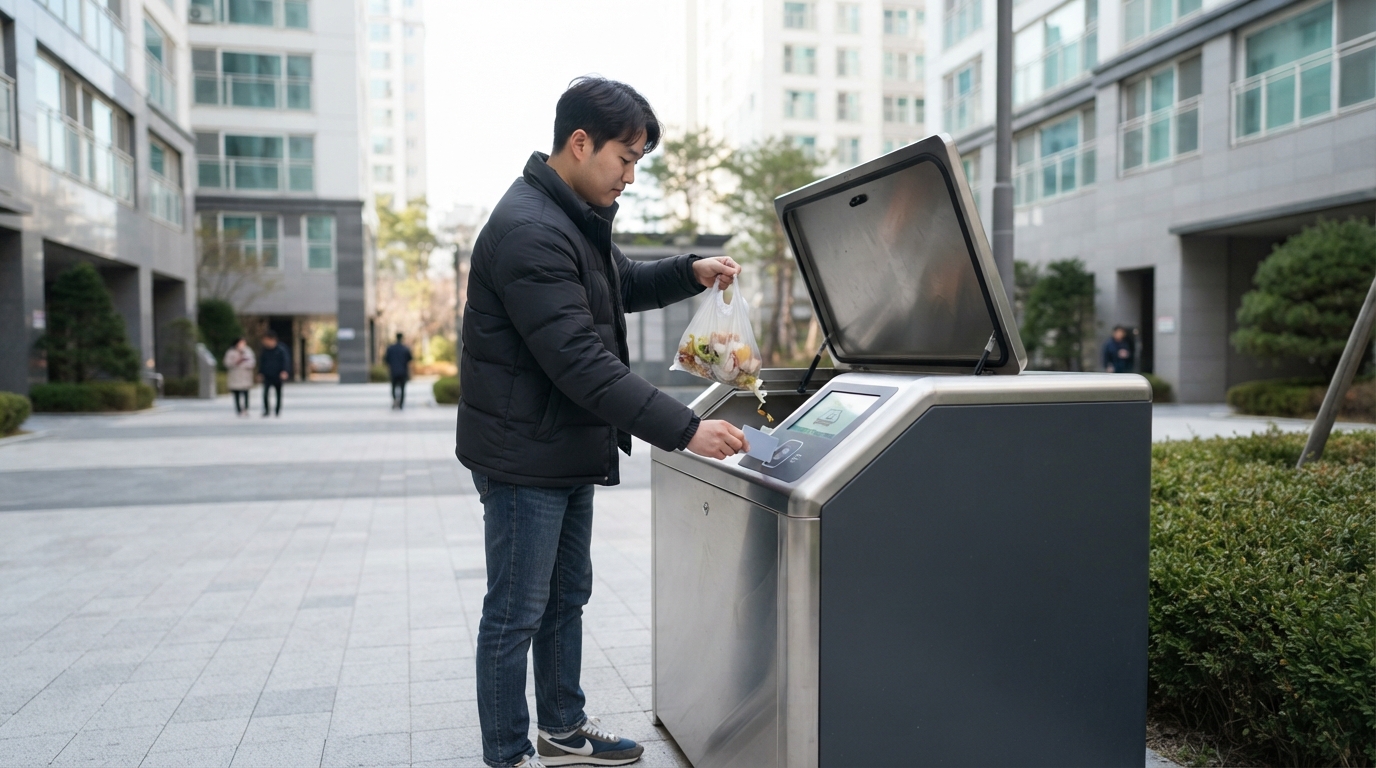
A typical Saturday in Seoul. Seunghvan Hong, a resident of an apartment building, takes a bag containing fruit and vegetable peels, food scraps, and especially rice accumulated over the week, and heads down toward the food waste disposal device in the complex. As soon as he taps his card on the device's scanner, the lid opens automatically, the weight of the waste Hong has discarded appears on the screen, and the corresponding fee is charged to the household's account.
This process takes less than a minute. But behind it lies one of the world's largest and most daring experiments in waste management.
South Korea has leaped ahead of other countries in solving the household food waste problem. Now, New York is also taking its first steps toward replicating this successful experience.
## South Korea's 30-year waste reform
Food waste is a pressing issue in almost all developed countries. In the US, a family of four spends an average of $56 a week on food that is thrown away. Globally, more than one billion tons of food is wasted every year. This accounts for nearly 10 percent of global emissions that cause climate warming.
In South Korea, the search for a solution to this problem began much earlier—due to the waste crisis that arose following rapid urbanization in the 20th century. At that time, because food scraps were mixed and thrown away with ordinary household waste, landfill and sanitation problems intensified sharply.
Since the 1990s, the food waste management system has been gradually transformed, and this is yielding results: the food waste recycling rate in South Korea rose from just 2.6 percent in 1996 to nearly 97 percent in 2023.
## How South Korea reduced food waste to almost zero
In 1995, the South Korean government introduced a system of charging residents based on the volume of waste.
In 1997, collecting food waste separately from other waste was made mandatory.
In 2005, the government completely banned the dumping of food waste in landfills.
In 2010, "smart" waste bins began to be introduced on a trial basis.
In 2013, discharging liquid extracted from food waste into the sea was banned.
One of the changes clearly felt by residents in their daily lives is the appearance of "smart" waste bins equipped with RFID, i.e., radio-frequency identification scanners, which Hong uses every week at the beginning of our story.
According to government data for 2025, 151,934 such devices are used across the country, serving more than 8.61 million households.
"Seeing the weight of the waste and how much I have to pay for it helped me better understand how much food I am throwing away," says Hong.
This system is not limited to reducing harmful emissions resulting from household food waste ending up in landfills: energy can be obtained from food scraps, which also reduces the need for fossil fuels.
## What is the next fate of food waste in South Korea?
The food waste of Hong and millions of people like him is sent to special recycling centers. There, this waste is converted into energy.
This method is much safer for the climate than burying waste in landfills. When organic waste decays in a landfill, methane gas is released. This gas traps heat in the atmosphere 80 times more than carbon dioxide over a 20-year period and accelerates climate warming. In addition, a dark and harmful liquid called leachate is released from the waste. It can seep through the soil and pollute groundwater.
When food waste is sent to a bioreactor, however, the methane generated from decay is collected and used as fuel. True, carbon dioxide is also produced in this process, but methane, which is much more potent, is prevented from escaping into the atmosphere.
The Daejeon Bio Energy Centre, located in the central part of South Korea, converts 70–75 percent of the waste arriving at the facility into energy. The center generates enough electricity to meet the needs of nearly 6,000 households a day. There are more than 340 such complexes across the country. The energy produced in them reduces the need for fossil fuels. In 2024, the government aimed to reduce fossil fuel consumption by nearly 230 billion won (approximately $170 million) in this way by 2026.
However, the system is not without its problems. Operating it requires significant funds. Although fees collected from households cover part of the costs, the government spends more than 600 billion won (nearly $430 million) on managing municipal waste, which also includes food waste.
"South Korea has achieved great success in recycling food waste. But now we have reached a new stage: new technologies and policy measures are helping to improve these results even further," says Munsol Ju, a senior researcher at the Korea Environment Institute.
## Problems in New York: non-compliance and rats
Pointing to South Korea's experience as a model, New York City made separate food waste collection mandatory for residents starting in October 2024.
Now, city residents must put food scraps in a special waste bin or place them in a tightly closed, labeled container and bring them to the curb along with other recyclable waste.
The program, which covers nearly 3,4 million households, has become the largest initiative for organic waste collection and recycling in the US.
However, getting people to comply with the rule is not proving easy: many still do not separate food waste regularly.
To involve residents in the new system, extensive explanatory work was carried out. The New York Department of Sanitation recently conducted more than 60,000 conversations with residents during a door-to-door campaign in all boroughs of the city. Enforcement has also been tightened: since the launch of the program, more than 63,000 warnings about violations have been issued to households that did not comply with the rules.
In addition to the curbside food waste collection program, New York City has installed more than 400 "smart" compost bins in all boroughs to make composting such waste even more convenient. Unlike the special bins collected from outside homes once a week, these solar-powered devices can be used day and night via a mobile app. They are completely free.
"I really like these bins because they make composting much more convenient," says Grace Fu, a resident of Manhattan.
However, there are some problems associated with them as well.
"They attracted so many rats around the building that we were finally forced to move our bin indoors. If the bins were emptied and cleaned more frequently, the situation would be much better," says Fu.
In 2025, the New York Department of Sanitation directed nearly 140,000 tons of organic waste from the city's households for recycling. This amount is equal to nearly 9 percent of the approximately 1.5 million tons of organic waste generated by residents annually.
This is a significant increase compared to previous years. Nevertheless, New York is still far from South Korea's 97 percent milestone.
The collected food waste is sent to one of two destinations depending on which borough it came from. Part of it is taken to the composting facility on Staten Island and turned into fertilizer. The remaining part is co-digested with sewage sludge at the Newtown Creek wastewater treatment plant in Brooklyn to produce biogas and biosolids.
Since nearly 70 percent of New York residents live in apartments in multi-story buildings, South Korea's experience could suit this city, says Steven Cohen, Director of the Sustainability Management Program at Columbia Climate School.
"The RFID bins in South Korea can impose direct responsibility on each citizen for the organic waste they generate. In a circular economy, organic waste must be collected separately, recycled, and reused as an energy source," says Cohen.
New York still has a very long way to go. "The problem is that most people in the city still do not separate organic waste correctly," says Cohen. He says that along with incentives, a better explanation of why recycling food waste is important could increase people's participation in this process.
Returning to Seoul, Hong is going up to his apartment carrying the bags emptied of waste. This task has become a part of daily life for him.
"The food waste problem requires collective responsibility," says Hong.