

EDB increased non-sovereign financing in Eurasia by 50%
The volume of non-sovereign financing by international financial institutions in Eurasia reached $6.8 billion in the first nine months of 2026.
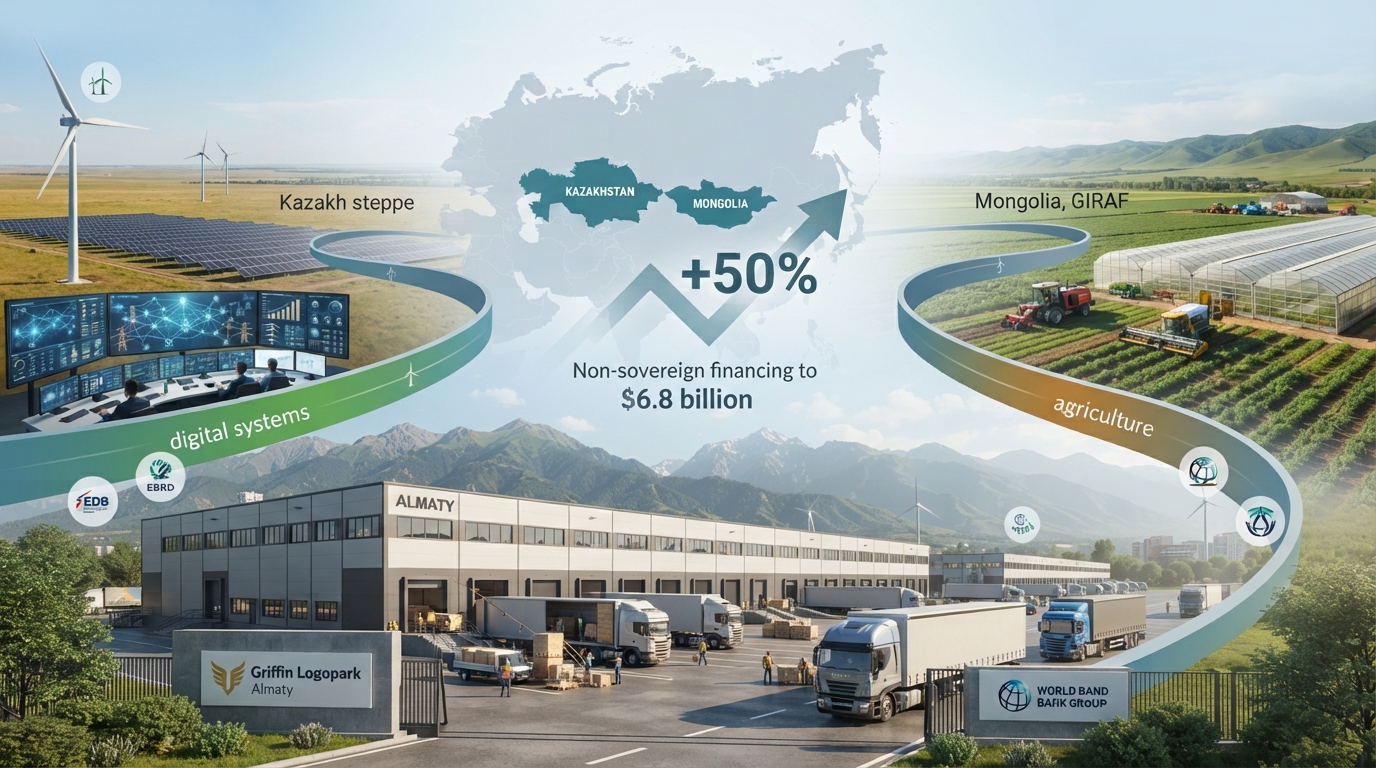
EDB increases non-sovereign financing in Eurasia by 50%
The volume of non-sovereign financing by international financial institutions (IFIs) in the Eurasian region reached $6.8 billion in January–September 2026, which is 50% more than in the same period last year.
In the third quarter, the volume of financing amounted to $1.1 billion, decreasing by 36% year-on-year. This is stated in an analytical brief by the Eurasian Development Bank (EDB) based on the results of the third quarter of 2026.
The EDB attributed the reduction in the quarterly indicator to a decrease in the number of large transactions. At the same time, the negative dynamics in the third quarter did not affect the overall growth of financing since the beginning of the year.
Kazakhstan has become one of the key platforms for expanding the activities of new international financial institutions and partnership mechanisms.
In the third quarter, the country's volume of financing grew by more than $200 million compared to last year. The OPEC Fund approved its first non-sovereign operation in Kazakhstan, and the Turkic Investment Fund began operations, initiating the financing of Kazakhstani projects.
The main sources of non-sovereign financing in the region include the EDB, the European Bank for Reconstruction and Development (EBRD), and the World Bank Group.
The EDB primarily supported infrastructure projects, while EBRD financing was mainly focused on the financial sector. The World Bank actively used guarantee instruments through the Multilateral Investment Guarantee Agency (MIGA).
The importance of guarantees in attracting capital has increased noticeably. In the nine months of 2026, their share in the structure of IFIs' non-sovereign financing in Eurasia reached 22%, compared to 4% in the same period of 2025. The main institutions providing guarantees were MIGA, the EDB, and the EBRD.
Another area of focus was the financing of modern warehouse and logistics complexes. In particular, the EDB provided loans for the construction of the Griffin Logopark Almaty logistics complex. The International Finance Corporation, part of the World Bank Group, is also actively working in this segment.
International development banks are also expanding their participation in investment platforms. In Mongolia, the GIRAF fund was launched, designed to finance the agricultural sector and combine the resources of international development banks, the state, and commercial banks.
In Kazakhstan, the World Bank financed the ALEM program, which provides a venture fund-of-funds mechanism to support tech startups.
The EDB is a multilateral development bank operating in the Eurasian space.
According to the organization, by the end of June 2026, its accumulated investment portfolio included 348 projects with a total value of $22.1 billion.
The bank's main areas of activity are transport infrastructure, digital systems, green energy, agriculture, industry, and mechanical engineering.