

Drought leaves 'barely any apples' to make cider
Some orchards are harvesting just a 10th of their usual crop, and facing an uncertain future.
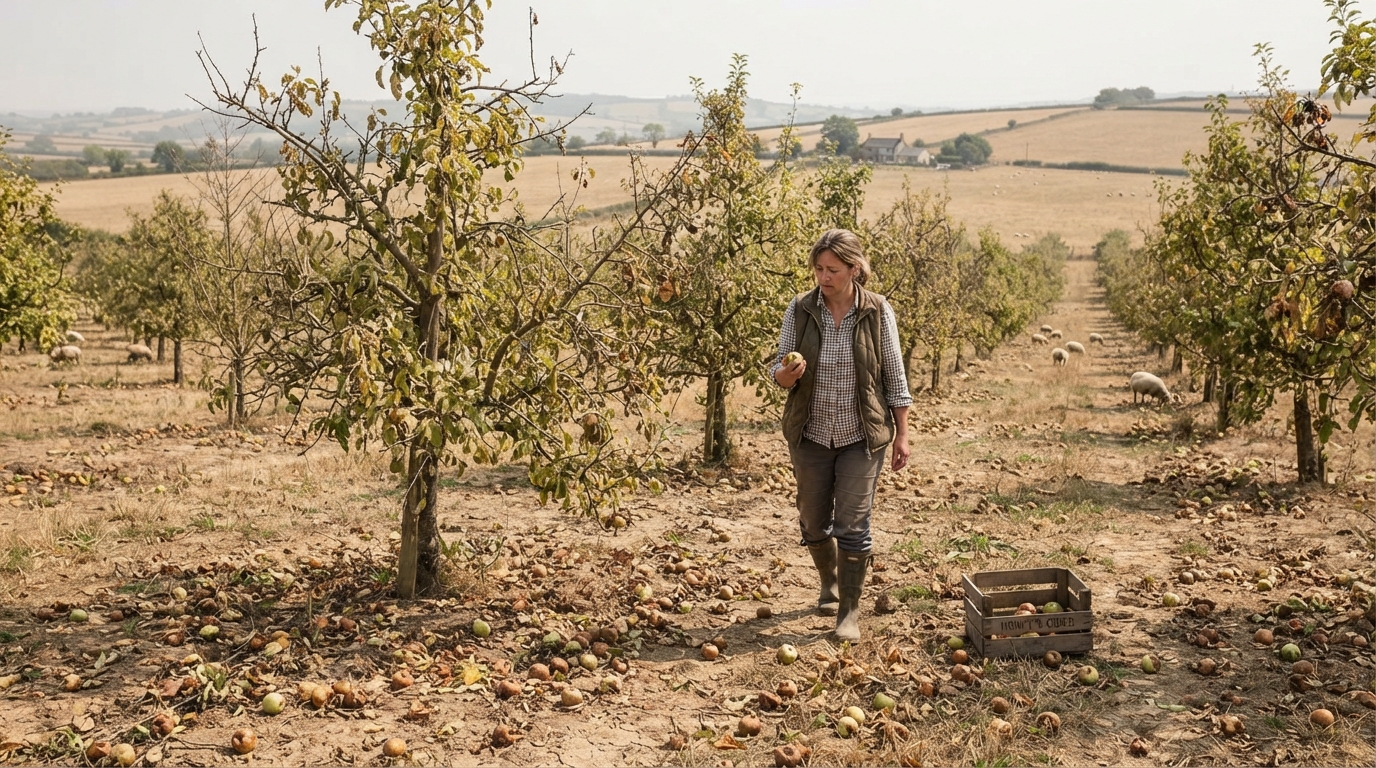
Somerset's renowned cider orchards have been severely impacted by the prolonged summer drought, leading to a drastic reduction in apple yields, according to producers. Many trees have failed to bear any fruit, while others shed their fruit prematurely, causing it to rot before ripening.
Kimberly Jones, of Honey's Cider near Bath, described the situation as "gut-wrenching," reporting that her orchard has yielded only 10% of its typical apple harvest. She noted that her 25-year-old orchard is experiencing its driest year by far, exacerbated by a dry 2025, which stressed the trees and led most to conserve energy by not producing fruit this year. Unlike larger commercial brands, Honey's Cider relies solely on fresh juice, meaning their production will be significantly lower this year due to the lack of fruit.
Neil MacDonald, who oversees over 1,000 acres of Somerset orchards, observed that half of his apples fell before ripening, a consequence of drought-induced stress on the trees. He lamented the irony of the situation: "Nothing sells cider like sunshine," he stated, noting that while their tanks are empty from strong sales, they lack sufficient fruit to replenish them.
Walking through Jones's orchard, apples are conspicuously absent where trees should be laden with fruit. She estimates a mere 10% of their usual crop, if that.
The impact extends to larger operations as well. George Scott, Master Cider Maker at Rich's Cider, a farm near Highbridge that has been pressing apples since 1954, anticipates a significant drop from their usual harvest of 20-30 tonnes. He remarked that there's so little fruit in one orchard that he won't even deploy the harvester, leaving any fallen apples for the sheep. Scott also noted that a neighboring grower, who typically produces 200 tonnes, is down to approximately 30 tonnes. While Rich's Cider has existing stock to prevent their tanks from running dry immediately, Scott expressed concern for the future health of his trees, which have endured two years of drought. With climate scientists predicting more hot, dry summers, he worries about the long-term viability if another dry year occurs.
Not all orchards are completely barren. At MacDonald's Orchard Park Farm near Shepton Mallet, apples are visible both on trees and on the ground. However, the early harvest, three weeks ahead of schedule, is not for cider production. MacDonald explained that these apples, mottled brown and floury inside, are unripe and have rotted prematurely due to drought stress. The harvester is collecting these apples, which represent about half of the expected crop, to be added to the compost heap. "The trees are stressed without any water, so they've just dumped the fruit on the ground to save themselves," he explained.
Somerset's cider apple growers recognize that this is not an isolated incident. Mike Kendon, a climate scientist at the Met Office, stated, "What we used to think of as extreme weather, we increasingly consider as normal."
In response, growers are adapting. Neil MacDonald is now irrigating newly planted trees, a practice he says was unnecessary five years ago. However, irrigating hundreds of acres of cider orchards is not economically feasible, unlike for eating apple growers who command higher prices.
Fundamentally, climate change may alter the very taste of West Country cider. The Dabinett variety, crucial for Somerset cider's bittersweet flavor, has produced very few apples this year, not due to drought, but a mild winter. MacDonald explained that Dabinett requires a cold snap, which has been absent for the past two winters. He is now grafting other varieties onto his Dabinett trees that are more resilient to hot, dry conditions, suggesting a potential shift in the characteristic taste of Somerset cider as the climate evolves.