

Did a goat herder's lucky $200 nugget spark a gold rush in western Kenya?
Prospectors have come to West Pokot county in the hope a gram of the precious metal can change their lives.
Did a lucky $200 gold nugget found by a goat herder ignite a gold rush in western Kenya? Manasse Lomachar hopes the discovery of gold will improve life in his village.
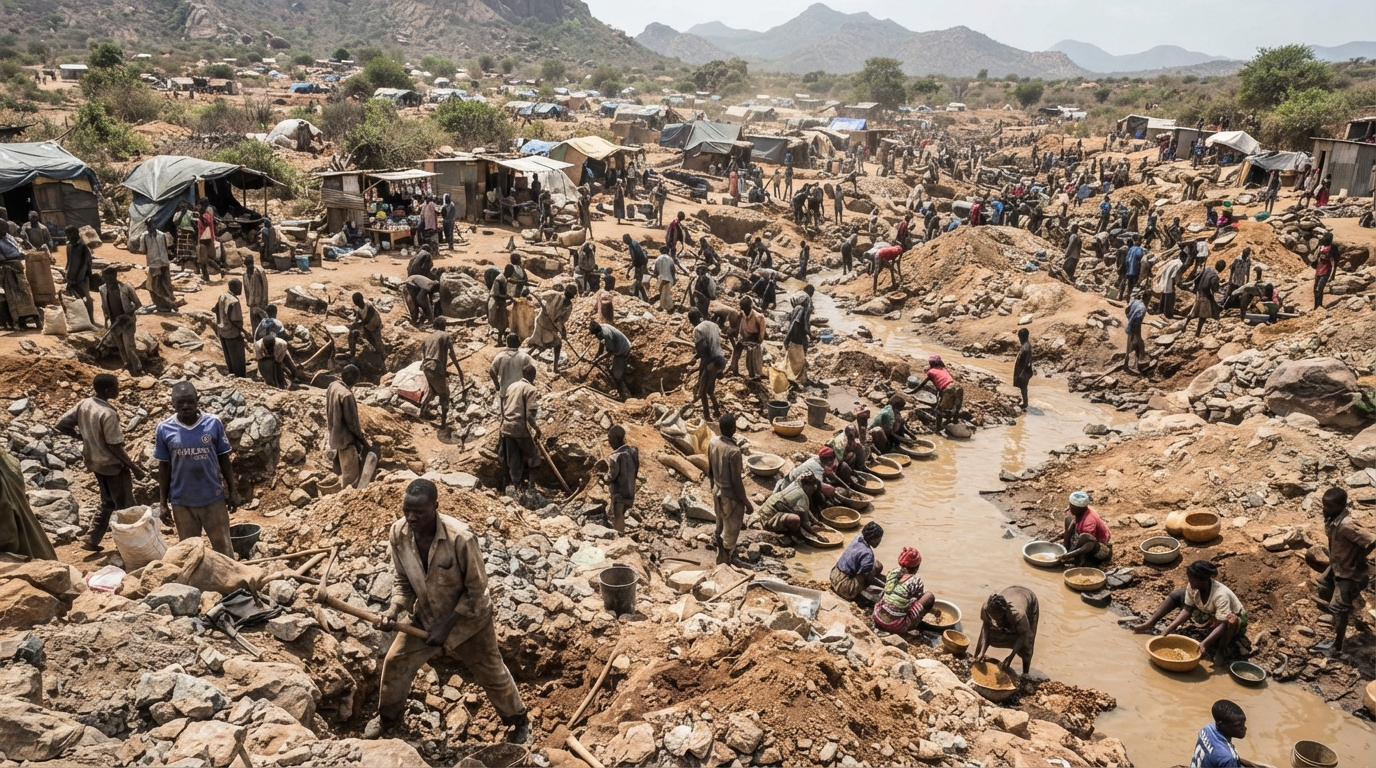
A goat herder from a secluded region of western Kenya informed the BBC that his discovery of a golden nugget has triggered a gold rush, overwhelming his small village in recent weeks. Manasse Lomachar, 33, believes that when people learned he had sold his three grams of gold for 36,000 Kenyan shillings ($280; £205) several weeks ago, it led to thousands of prospectors descending upon Cheporor. Indeed, what was last month merely bushland and rough grazing ground near the village is now scarred by pits, earth mounds, and makeshift mining camps.
It remains unclear whether Lomachar's fortunate find or other recent discoveries sparked the excitement. However, local authorities estimate that approximately 10,000 people arrived at the peak of the rush. Even a small quantity of the precious metal can transform the futures of these men and women—from Kenya and neighboring Uganda—many of whom rely on an unreliable farming income for their precarious livelihoods. Large numbers of people have been sifting through the earth and rocks for any trace of the precious metal. While people do occasionally pan for gold in these areas, significant finds are rare.
Lomachar states his discovery was purely accidental. While searching for a lost goat, he encountered a group of women panning along a riverbed. "I joined them, and that's how [the village] realized there was gold in this area," he recounts.
Patrick Lokolia, a farmer and herder from the neighboring village of Napawoi, joined the gold rush hoping to earn extra money to support his family. "I have children in school, and paying school fees has been a big problem for me," he told the BBC, wearing an old Chelsea football top amidst the mining activity. Eighteen-year-old Abigael Chelengat, who had never mined before coming to Cheporor from a nearby district, arrived hoping to find enough gold to pay her school fees and help keep her younger siblings in school. Behind her, hundreds of people work side-by-side, hacking into the rocky ground with hoes and shovels. Others transport the earth to a nearby seasonal river, where mostly women crouch in the murky water, washing and sifting mud and sand in hopes of detecting a tiny trace of the element. Some more experienced miners are deep in holes, excavating earth and drilling at rocks with the same objective. Hope is sustained by stories of those for whom the effort has paid off, like Lomachar.
Samuel Kiarie, the deputy commissioner of West Pokot county, believes the rush began after two notable discoveries. "Young men found what appeared to be a substantial amount of gold. The following day, women made another significant find in the same area," he told the BBC. Kiarie explains that women have been finding small quantities of alluvial gold along the same seasonal riverbed for years, typically earning $8-$23 a week. However, the uncovering of larger quantities at the beginning of August captured widespread attention. Kiarie reckons that as rumors spread, the number and size of the discoveries were exaggerated, attracting ever larger groups of people with little or no mining experience who hoped to replicate the reported early successes. Since the initial rush, the number of prospectors has decreased to around 2,500 as some have abandoned the search.
While there is little doubt that some gold has been found in the area, questions persist about the size of the deposit and its commercial potential. "I can confirm that small-scale gold traders told us they received an average of about 100 people every day," the deputy commissioner stated, though whether the finds were actually gold is unknown. Individual discoveries reportedly range from amounts worth a few hundred Kenyan shillings to one find valued at approximately 78,000 shillings ($600).
West Pokot county borders Uganda, and communities on both sides share long-standing social and family ties. Mugisha Godfrey, an artisanal miner from Busia in eastern Uganda, traveled to Cheporor after hearing about the discovery from a friend. He immediately set out for the village, spending about 100,000 Ugandan shillings ($27) to get there. However, the living conditions in Cheporor are unfavorable, he says. "We sleep under the trees, and when morning comes, we continue working. Sometimes we work both day and night," Godfrey told the BBC. So far, he has found nothing, but he is not discouraged. "We can't return unless we find something. Only when we have found what we need can we go back home," he asserts. The authorities want to ensure that children leave the site by September when the school term begins.
For others, the gold rush has created opportunities without requiring them to dig. More than 200 businesses have emerged around the site, according to local officials, selling food, water, and other essentials to the village's new population. Irene Ameja traveled from neighboring Baringo county to cater to the crowds. She sells bottled water, soft drinks, bread, milk, and other foodstuffs. "I am hoping that when I leave, I will have made enough money to continue with my business and expand it," she says.
However, the rapid growth of the settlement has also exposed the area's lack of basic services. "This is a forest and we are in the middle of the mountains," she says. "We don't have clean water to drink or even to bathe." For women, she adds, the challenges intensify after dark: "You have to find somewhere safe to stay because most of the people sleeping here are men." Local officials admit the influx has placed enormous pressure on an area with little infrastructure, no piped water, and limited sanitation. Public health officials have been deployed to monitor conditions and help prevent disease outbreaks. The authorities also report increased security patrols amid concerns over sexual violence and the vulnerability of women and girls at the site. As the search continues, miners are digging ever-deeper holes.
Officials are also concerned that children could be drawn into mining activities as schools prepare to reopen in September. Measures are being implemented to discourage young people from remaining at the site once the new school term begins. Those still searching are increasingly resorting to deeper excavation. Several truckloads of material have already been transported to nearby Ortum town for processing, with authorities awaiting the results. Until then, the size and commercial viability of any mining remain uncertain.
For Lomachar, the solution is not to halt mining but to organize it better. He wants the government to assist local miners in establishing safer and more effective methods of finding and extracting gold. "We would ask the government to help us with things like metal detectors, which could help us find out whether there are other minerals here, so that our community can develop," he says. He points to the nearby homes as evidence of the area's poverty. "If you look around, there are hardly any houses with iron-sheet roofs; most are just thatched houses."