

"Despite stereotypes, I did not give up on my dream": Stories of women in uniform within the system of the Ministry of Internal Affairs
October 25 is Internal Affairs Officers Day in Uzbekistan. There are many women in the system who serve selflessly alongside men and overcome stereotypes. Gazeta spoke with three of them about their career choices, professional challenges, as well as work-life balance.
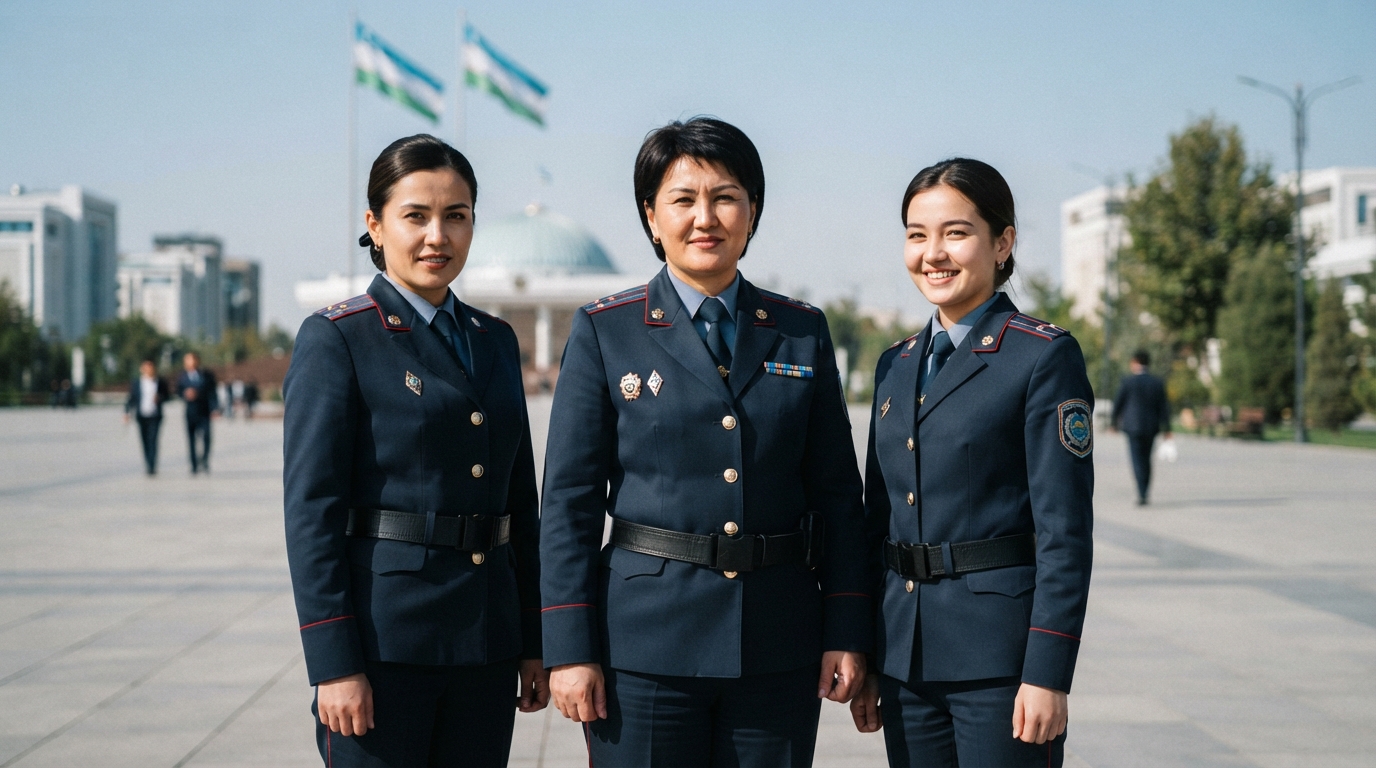
“Despite stereotypes, I didn’t give up on my dream.” Stories of women in uniform in the Ministry of Internal Affairs system
October 25 is Internal Affairs Officers’ Day in Uzbekistan. Women who serve alongside men in various areas of this system make a significant contribution through their dedication. Encountering gender stereotypes and various hardships throughout their professional careers, these women are united by their devotion to serving the Motherland and love for their profession. Gazeta interviewed three of them to hear their stories about their reasons for choosing this profession, the trials they faced in service, and the balance between family and work.
In service for 21 years.
I am from the Norin district of Namangan region. We are two girls in the family; there are no sons. Since childhood, I dreamed of becoming a lawyer and fighting crime. I used to make wooden pistols and imagine myself as a police officer. Watching uniformed officers on television, I admired them. Back then, it was unusual for most people to see a girl working in internal affairs.
There were views such as “What is a girl doing in the police?” or “What business does she have in a place where boys work?” Among my relatives, too, there was no one working in this system.
Despite this, I did not turn back from my goal. I studied humanities at the lyceum and decided to enter the Academy of the Ministry of Internal Affairs. At first, my parents were worried, but in the end, they said they trusted me and supported my decision.
In 2001, on my first attempt, I was admitted to the Academy, ranking seventh. At that time, girls accounted for only 4 percent of the admission quota. I studied investigative activity at the Academy for four years. This period taught me not only the profession, but also how to endure hardships. We held exercises at training grounds and went out to fields to pick cotton. There were times when we walked in the cold and our hands were wounded.
We could go home on leave only once a year, and we didn’t have the opportunity to talk to our parents on the phone every day. My father asked several times: “My daughter, do you really need to study with so much hardship?” I would reassure them by saying that I would finish my studies to the end. I had chosen this profession myself, so despite the difficulties, I didn’t want to give up on my dream.
After graduating from the Academy in 2005, I was sent to work at the Namangan Regional Department of Internal Affairs. Although I had a diploma in investigative activity, because there were no female investigators in the region at that time, I was not appointed to this direction. They said: “We don’t have female investigators, we cannot assign you to investigations.” I stated that I was ready to work wherever I was assigned, and I was placed in the criminal investigation department in the city of Namangan.
For three years, I worked in criminal investigation, anti-human trafficking, and information-analysis fields. But I didn’t want to just sit in an office. I wanted to learn in practice how crimes are solved, what to pay attention to at crime scenes, and how operational work processes take place.
At that time, there was a view that female staff should mainly handle documents during working hours and go home after work. I didn’t want to accept that. I asked my superiors to allow me to stay on duty shifts and go out to crime scenes. Sometimes they didn’t like these requests of mine, but whenever an opportunity arose, I tried to work in the field.
In 2008, I finally transferred to investigative work. I worked as an investigator and senior investigator until 2017. Then I was appointed head of the appeals department. In 2020, on the recommendation of the ministry’s leadership, I transferred to the Traffic Safety Service, and since 2022, I have been working in the information service of this department.
Girls who graduated from the Academy after me also began working as investigators in the Namangan region. This expanded the opportunity to show in practice that women can also perform these duties.
I have faced gender stereotypes since childhood. In the lyceum, too, I was in an environment where mostly boys studied. I heard many statements like “She won’t be able to handle it,” “A boy would do a better job if appointed,” or “A girl will get married tomorrow anyway.”
In the internal affairs system as well, because women might get married, have children, and go on maternity leave, there were cases of skepticism about entrusting them with important tasks. If a supervisor had to choose between a female and a male employee to perform an assignment, they often trusted the man more. In such situations, a woman has to prove her potential. Sometimes you have to go to the supervisor yourself and ask, “Can’t I perform this task?” Only after you show results does trust build up.
Throughout my career, I also made great efforts to show my capabilities. I have seen from experience that women do not work less than men and, in some cases, can achieve good results spending less time. Work efficiency cannot be measured solely by the hours an employee spends at the workplace.
A woman can both fulfill her service duties and pay attention to her family. I have two children. I try to manage monitoring my children, doing housework, and serving all together.
Being married does not mean a woman loses her professional potential.
Therefore, it is wrong to doubt her capabilities in advance. My parents’ trust has always been important to me. My father used to say: “You must work honestly. You wanted to be an internal affairs officer yourself, and we supported you. Now you must go all the way without staining your uniform.” These words placed a great responsibility on me.
Since 2022, I have also been conducting scientific research on the role of female personnel and gender stereotypes in internal affairs bodies. My dissertation topic is “The Role of Female Personnel in the Sustainable Development of New Uzbekistan: On the Example of Internal Affairs Bodies.” I am continuing my scientific research at the Academy of State Policy and Governance under the President. Conducting research along with service is not easy, but I intend to complete it by the end of the year. For me, this topic is not just scientific research. It is also a way to study the problems I encountered throughout my career, to demonstrate the potential of women in the internal affairs system, and to contribute to changing attitudes toward them.
I have never thought about leaving the internal affairs system. I still receive job offers from other organizations. But I cannot imagine myself in another field. I chose this profession myself, and I love my work. I come to service every day with gratitude. If I didn’t have love for my profession and a sense of serving the Motherland, I probably would have left long ago.
Even back when we studied at the Academy, our goal was to stay loyal to our chosen profession and go all the way. The service made me determined, responsible, and resilient to trials. These qualities are important not only at work, but also in daily life. For me, serving the Motherland is not just a job. I consider it my duty to help citizens, raise their legal awareness, and contribute to the safety of society.
I want to remain in this system in the future as well. After retiring, I intend to continue my scientific research and teach at the Academy of the Ministry of Internal Affairs or the University of Public Safety. I want to pass on my experience to young employees.
My current responsibility is to convey reforms, news, and legal explanations in the Traffic Safety Service to the public. The information service acts as a bridge between the system and the public. In addition to disseminating official information, we also conduct promotional work aimed at preventing traffic accidents.
We pay special attention to children’s traffic safety. Together with the Ministry of Preschool and School Education, other organizations, and international partners, we implement projects such as “Attention, Pedestrian,” “Traffic Expert,” and “Model Pedestrian.” Every year, the “Green Light” competition is held among students aged 9 to 14 at school, district or city, regional, and republican stages. I am a member of its organizing committee.
In the past three years, we have also participated in international competitions with our students. In the first two years, we took second place. This year, we improved our result and won first place. We participated with the “Humo” team of School No. 110 in Tashkent in the international competition “Young Traffic Inspectors” held in Kazakhstan. Gathering the highest score, we took first place. This result also demonstrated the importance of work aimed at teaching traffic rules to children.
We are currently working on improving educational materials on traffic rules for students from first to eighth grade. We plan to prepare video lessons based on existing textbooks. Our goal is to create an open and free platform for children, parents, and teachers. On it, it will be possible to watch video lessons, take tests, and reinforce knowledge through games on traffic rules.
The head of our state, Shavkat Mirziyoyev, learned about the conditions at Kindergarten No. 441 during his visit to the Olmazor district of Tashkent city on September 11. A traffic safety club had also been organized there. We informed the head of state about our work in teaching children traffic rules, our results in international competitions, and our future plans.
Our President asked me how long I had been serving in the internal affairs bodies. I told him that I had been working since 2005 and received the rank of lieutenant colonel in 2017. After that, the head of state announced that I would be awarded the rank of colonel.
This was an unexpected and unforgettable event for me. I did not go there with the thought of receiving the rank of colonel. We simply performed our duty and reported on our ongoing work and plans. The positive assessment of our work by our President brought great joy.
The rank of colonel became an important result of my many years of service. When I dreamed of entering the Academy, I also aimed to reach this level one day. This was not a dream of a day or two, but a desire I carried in my heart all my life. However, I do not consider this rank solely my personal achievement. I received it as trust shown in the employees of internal affairs bodies, particularly the Traffic Safety Service. It imposes on us the responsibility to work even harder and continue the work we have started.
I am also active on social networks. I have more than 184 thousand followers on my Instagram page and over 22 thousand on Facebook. Many girls write to me asking about working in internal affairs bodies and how to prepare for it. Parents also ask for advice on helping their daughters enter this system. Seeing such inquiries makes me happy. This means there is interest in this profession among girls as well.
I always tell parents one thing: do not block your daughters’ paths, do not become victims of stereotypes. First of all, listen to what your child wants. Every child has their own interest, dream, and vision of the future. If your daughter genuinely wants to serve in internal affairs bodies, benefit her Motherland, and fight against violations of the law and crime, support her. When a person chooses their profession themselves, they do not easily give up even when facing difficulties. They will have a goal and inner drive.
I would also like society not to look differently at women serving in internal affairs bodies. We are also part of this society: someone’s spouse, elder sister, younger sister, or mother. We simply serve through the profession we chose. Stopping or fining a person who violated a traffic rule does not stem from personal hostility. This is done to ensure safety on the roads and compliance with rules. Our goal is not to punish someone, but to preserve people’s safety.
Having worked in this profession for 21 years, I did not turn back from the path I chose. I strived to reach my childhood dream, faced obstacles, and had to prove myself. Now, through my own experience, I want to tell other girls: if you genuinely want a profession, work toward your goal.
Being a girl should not be an obstacle to your dreams.
Senior investigator of the Investigation Department of the Bekobod City Internal Affairs Department, lieutenant colonel. Awarded the medal “For Faithful Services.” In service for 15 years.
We are three children in the family. My brother and sister also worked as investigators in internal affairs bodies and are now retired. I admired them. My mother also played a big role in my interest in this field. In her youth, she dreamed of becoming an internal affairs officer, but could not achieve her goal. Therefore, she wanted her children to work in this field.
Since childhood, I watched many movies about solving crimes, such as “Inspector Rex” and “Julie Lescaut.” I imagined myself in the place of the characters in them. My parents also always supported me. Following in the footsteps of my brother and sister and serving in internal affairs bodies was both a dream and a great responsibility for me.
In 2007, I applied to the Academy of the Ministry of Internal Affairs for the second time and joined the ranks of cadets that year. I still clearly remember when they read out my name and surname when the mandate results were announced. Hearing this news, my parents cried tears of joy, proud that their third child also became an internal affairs officer.
After graduating from the academy in 2011, I began working at the Buka District Internal Affairs Department. The first days were not easy. Right as I started my service, I was assigned a case under Article 273 of the Criminal Code related to drug trafficking. Because I was a new employee, there were difficulties, but my experienced mentors guided me and taught me the nuances of the work. Over time, my skills and experience grew.
While working in Buka, I met my future husband. He also works in the internal affairs system as a forensic expert. Since we are in the same field, we understand each other’s profession well. Later, I transferred to work in the city of Bekobod and have been serving here ever since.
Usually, my workday begins at 08:00 in the morning. After the briefing, we plan daily tasks and begin investigative actions. Each case has its own characteristics. Some require more time, knowledge, and experience. Because I have long work experience and serve as a senior investigator, I am often assigned more complex cases. Being a woman does not prevent me from handling these tasks. My superiors also trust me.
An investigator’s activity does not consist solely of working with documents in the office. We go out to crime scenes, study the circumstances of the incident, and, if necessary, conduct investigative experiments. Due to the circumstances of some citizens, we may also go to their place of residence to interrogate them. In my work, fraud crimes have occurred often. In addition, I have investigated theft, bodily harm, and drug-related crimes.
For an investigator, legal knowledge alone is not enough. It is also important to understand human psychology, correctly assess the situation, and be physically and mentally prepared. During work, one may encounter issues related to economics or other fields. Therefore, through every new case, we keep learning something.
In my opinion, one of the most important qualities of an investigator is impartiality. They must listen to every person involved in the case and not draw conclusions based on one side’s words. The testimonies of the witness, victim, and accused must be fully studied. By understanding a person’s pain, listening to them to the end, and comprehensively verifying the evidence, a just decision can be reached.
Before choosing my profession, I also heard statements like “What business does a woman have in this field?” or “Wouldn’t it be better if she became a housewife instead?” But these thoughts did not turn me back. Because my goal was clear. Women also have their own place in law enforcement agencies. For example, during the interrogation of women or conducting personal searches, the participation of a female officer is required in accordance with legal requirements. In this respect, too, having female specialists in the system is considered important. Over the years, I learned to communicate with people of different characters, to understand them, and to manage situations. Now such circumstances do not present difficulties as they did before.
Balancing work and personal life is not always easy. Sometimes children get sick, or we ourselves fall ill. But we must finish the work we started. If for some reason I cannot continue the work, my conscience bothers me.
At such times, my colleagues help. If I cannot come to work or lack the opportunity to continue investigative actions, I trust them. We work as a good team. Therefore, I have not faced major difficulties due to family or other problems.
I have never thought about leaving my job. I have seen some employees move to another field due to hardships in service. But our mentors taught us to try to overcome whatever situation arises. We were raised with the understanding that when encountering a difficulty, one should not turn back.
Being an investigator is an honorable profession. There is a big difference between doing one’s work with love and enjoyment and working just to fulfill a duty. I go to work in the morning loving my profession. That is why I have never regretted choosing it.
This profession changed my worldview. Through every crime and investigative action, I learn new things. Through my service, I come to understand more deeply how to interact with people, evaluate situations, and conduct myself before society. My profession increased my self-confidence, taught me to be disciplined, to value time, and to establish proper relationships with people. If a person works on themselves every day, their experience grows, and they also grow as an individual.
Recently, by decree of our President, I was deemed worthy of the medal “For Faithful Services.” My mother, above all, was very happy about this news. The head of our internal affairs department and our prosecutor were also the first to congratulate me by phone. My colleagues were even happier than I was. Unfortunately, my father could not see this joyful day. If he were alive, he would have been very happy.
What I have to say to girls who want to work in law enforcement agencies but hesitate is that they should not be afraid and should not back down from their goals. If a person has confidence, desire, and drive, they will certainly master their chosen profession. True, working in this field is not easy. Not everyone wants to take on such responsibility. But girls who set the goal “I can handle it” should give it a try. There will be difficulties, but they can be overcome.
I would like women serving in law enforcement agencies to be treated with respect in society. Women are also standing shoulder to shoulder with men, fulfilling responsible duties. Their labor should be valued.
Inspector of the Safe Tourism Provision Department of the Samarkand Regional Internal Affairs Department, captain. In service for 7 years.
I studied at the Faculty of French Philology at the Samarkand State Institute of Foreign Languages. After graduating, I taught French at a school for seven years. Since youth, I admired people in uniform, but I never imagined I would work in the internal affairs system. None of my relatives worked in this field either. I was the first in our family to choose this profession.
When the Safe Tourism Provision Department was established on the initiative of our President, because of my knowledge of French, I was offered to work in this direction. The emergence of this opportunity was also aided by my sister applying to the Internal Affairs Academy. While her documents were being reviewed, information about close relatives was also checked. During that process, the fact that I was a French language teacher caught attention, and later I was invited to participate in the selection process.
The selection consisted of several stages. Documents and biographies were reviewed, and our level of foreign language proficiency, physical fitness, and health were checked. About 15–20 commission members asked questions on political, social, historical topics, and foreign languages. In the end, out of approximately 15 candidates, two women and two men were selected.
At that time, I had two children: my son was four years old, and my daughter was eight months old. Due to my family circumstances, I had little time to prepare seriously for the selection. At first, my husband also opposed my applying. In his opinion, working in the internal affairs system was difficult for a woman with a family; I needed to deal with household chores and children first. But my father-in-law supported me. He is an educated man, a doctor. He spoke with my husband and helped him understand me. I also felt that my parents would be happy with my choosing this profession. We were three girls in the family, and I am the eldest child. I really wanted to live up to their trust.
I was nervous during the final stage of the selection. Other candidates seemed better prepared to answer questions than I was. I said to myself: “Even if I cannot get the job, I must not bring shame to my father.” I tried to answer the questions to the best of my ability. In 2019, I passed the selection, and on January 11, 2020, I started work. This was the beginning of a completely new life for me.
I still remember my first days when I started work. On the eve of January 14 — Defenders of the Fatherland Day — our department organized a holiday for children living in an orphanage without parental care. We attended that event with our team. Wearing the uniform for the first time was also a special event for me.
However, shortly after I started work, the coronavirus pandemic began. The flow of tourists dropped sharply, and the service routine changed as well. It was a period when movement restrictions were imposed in Samarkand, and driving a car without a special permit was not allowed.
My home was in the Sogdiana neighborhood, and my place of service was in the area where the Islam Karimov Mausoleum is located. Because the distance was nearly 10 kilometers, I walked to and from work. I had neither a car nor a special permit. I walked that route every day for about ten days. In the summer heat, I carried food on the road. Because shops were closed, my food sometimes spoiled. There were days when I had to walk for several hours. Since some male colleagues were deployed to posts, I carried out service alone in some places. Later, I asked the leadership to change my place of service to an area closer to my home.
Despite this, these difficulties did not cool my passion for my profession. Since I was just starting out, I thought that if I overcame everything, it would be easier later.
There are still not many women in the internal affairs system. We still encounter views that a woman should not work in this field. There were times when I heard such statements from my colleagues as well. My relatives, on the other hand, are proud of my profession. Especially elderly people coming to sacred sites pray, saying: “May our grandchildren be like you.” At such moments, I forget my fatigue.
In my opinion, one of the most difficult issues for a woman in this profession is maintaining a balance between service and family. I have three children. Many major events are held at the Samarkand Tourism Center, such as triathlon competitions, chess tournaments, international meetings, and state visits. At such times, our work schedule becomes even tighter. Sometimes roads are closed, and we have to go to service early or return late. There are times when we work on Sundays as well.
On such days, my conscience bothers me because my children stay at home. Before going to work, I try to prepare food. On my day off, I do housework and prepare semi-finished meals for the coming days. When I am late, my mother-in-law watches the children and cooks food as well. Without their help, managing service and family together would be even harder.
I have never seriously thought about quitting my profession. Sometimes, after finishing household chores, I slept for only an hour or two before going to service the next day. I think what keeps me in this profession is patriotism, loyalty to the Motherland, and dedication to the profession.
When we first started work, we were told: “You cannot just wear this uniform and take it off whenever you want.” In our youth, we did not fully understand the meaning of these words. Over time, I realized that wearing the uniform itself is a great responsibility. As the stars on the epaulettes increase, the responsibility on your shoulders increases as well. Now you look at yourself and say: “I must be worthy of this profession, I must not tarnish it.” The service changed me too. Previously, I was quite shy. Even if I trusted my knowledge, I couldn’t express my thoughts freely in front of people. Now, no matter who I talk to, I try to explain my thoughts and conduct the conversation properly.
Currently, I serve as an inspector in the public order maintenance group of the Safe Tourism Provision Department of the Samarkand Regional Internal Affairs Department. My main place of work is the Samarkand Tourism Center, that is, the Silk Road Samarkand area. Major hotels, a congress hall, and the “Eternal City” complex are located here. There are many large events, international meetings, and state visits.
Our service day begins with the morning lineup. After receiving tasks, we are assigned to designated areas. We monitor the situation and provide information to the department’s duty unit. If necessary, we also assist colleagues in other areas. In Samarkand, service is conducted along routes such as historical monuments, the tourism center, and the Imam Bukhari complex. Depending on the schedule of visits and events, our place of service may change.
Tourists approach us on various matters. Someone asks for directions, someone needs help calling a taxi. Since the Samarkand Tourism Center is located farther from the central part of the city, finding public transport or a taxi here is not always easy. Some tourists do not have internet; at such times, we help call a taxi. Sometimes they forget their belongings in a hotel or taxi, and large groups can get separated from each other. Tourists who lost their phones also apply frequently.
Situations related to tourists’ health also occur. Due to climate or weather, some experience allergies, while others’ blood pressure rises. In such cases, we assist in calling medical aid and organizing the necessary help. We are trained in first aid; every six months, we undergo refresher training and update our relevant knowledge.
To be a tourism police officer, wearing a uniform alone is not enough. One must know a foreign language, have information about historical monuments, understand the city’s infrastructure well, and meet physical fitness and health requirements. We are not tour guides or professional interpreters, but if a tourist asks about a destination or historical site, we must be able to provide accurate information.
In my opinion, the tourism police are considered the face of our country. When a tourist arrives, they first pay attention to the environment around them and people’s conduct. We must not leave a person who approaches us with a question unanswered; we must help to the best of our ability. Because from a tourist’s interaction with us, their impression is formed not only of our service, but also of the culture and upbringing in our country.
My knowledge of French still comes in handy in my work. When I speak to tourists from France in their own language, they become very happy. Sometimes they call other people in their group to talk to me. Communicating in their own language alone leaves a pleasant impression on them. However, today many tourists speak English. Therefore, I feel the need to learn English as well and develop my skills. A few years ago, I also learned Turkish. Now I am working on strengthening my English, which is demanded more in daily service.
I also have dreams related to the French language. Last year, when I received an invitation to a scientific conference, an opportunity arose to go to France. But because I sprained my leg and was in a cast, I could not go on the trip. This was one of my long-standing dreams. God willing, I want to visit France one day.
Currently, I am conducting scientific work as an independent researcher at the Bukhara State Technical University. My research is dedicated to the multimodal vector and visualization of tourism terms in the French and Uzbek languages. Allocating time for scientific work amidst service and family duties is not easy, but I try to continue studying and researching.
I would like people to view women working in the internal affairs system as ordinary human beings as well. We are also someone’s mother, daughter, elder sister, or spouse. We have families, children, and concerns. Our difference is in the profession we chose and the duty entrusted to us. One should not think that a woman cannot do this work. If a person has the desire, ambition, and loyalty to their profession, they can overcome difficulties.