

Deputies pointed to corruption risks in the new public procurement rules. The bill was returned for revision
Amendments that allow state procurement to be deemed valid with the participation of a single supplier sparked debate in the Legislative Chamber. Deputies pointed out risks of corruption, restrictions on competition, and contradictions in the draft law. After lengthy discussion, the document was sent back for revision.
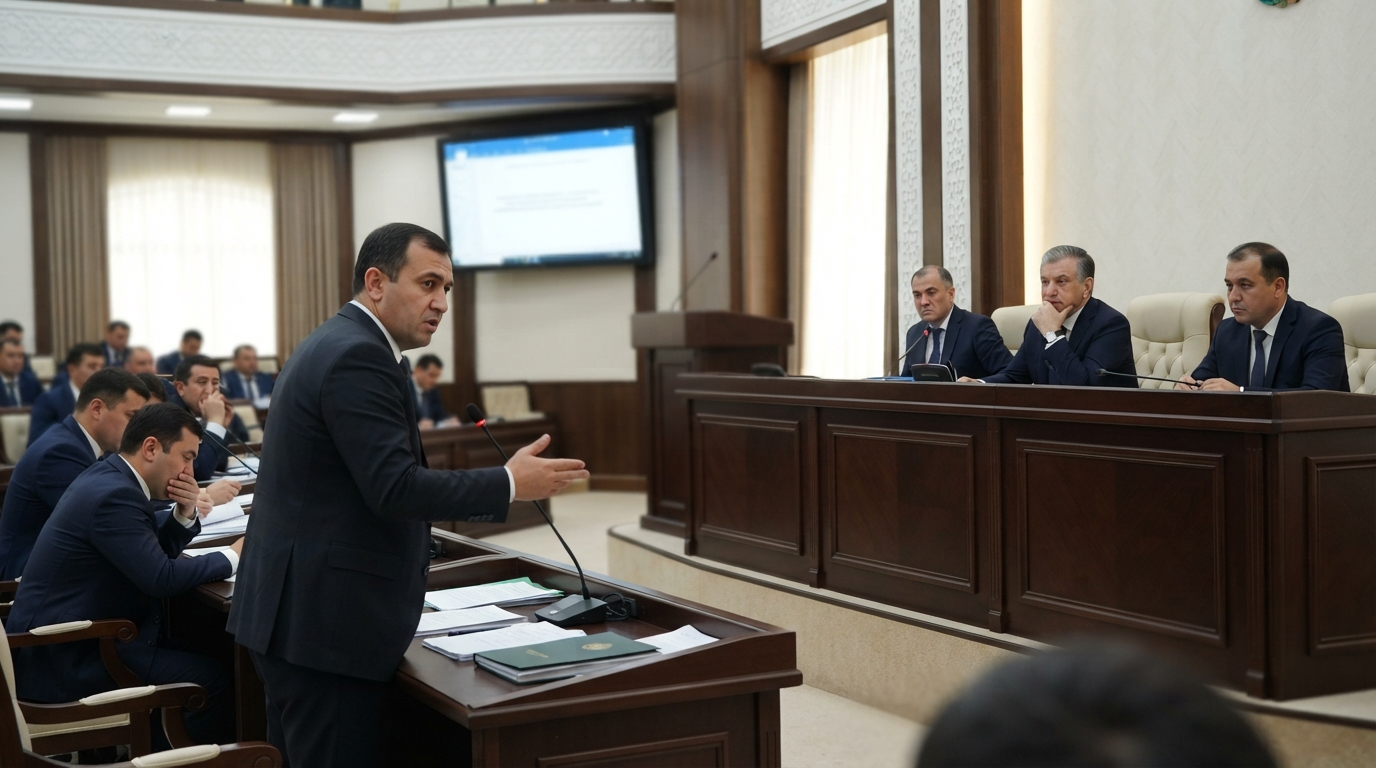
MPs see corruption risks in new public procurement rules. Bill sent back for revision
A bill that allows certain public procurement procedures to be recognized as valid with the participation of a single supplier has caused disagreement in the Legislative Chamber of the Oliy Majlis. MPs stated that there are potential corruption risks, restrictions on competition, and contradictions in the wording. Following a lengthy discussion, it was decided to return the document for revision.
The draft law on improving the public procurement system was considered in its second reading on October 13. One of the main proposals concerns situations where only one supplier participates in a procurement process.
Under the current rules, if only one bid is received for the selection of the best proposal, or if no bids are received at all, the procedure is recognized as having failed. The state customer has the right to announce a new selection process or use another procurement method provided for by law.
The draft law proposes allowing a repeated selection process to be recognized as valid, even if only one supplier participates in it again, provided that this supplier had already submitted a proposal the first time. At the same time, the procurement conditions and evaluation criteria must remain the same, and the participant's proposal must meet the established requirements.
Similar changes are proposed for tenders. In addition, there is a plan to recognize electronic reverse auctions for lowering the starting price as valid in the presence of a single participant.
During the discussion, MP Saidullo Azimov drew attention to an amendment to Article 61 of the Law "On Public Procurement", which regulates the selection of the best proposal.
In his opinion, the requirement to maintain the previous criteria during a repeated selection process could limit competition and create an advantage for a sole supplier.
"If a new selection process is conducted according to the same criteria, the exact same firm will come out on top again. Why is such a restriction being established... This creates fertile ground for corruption, meaning it increases the likelihood of a repeat victory by the same participant," the MP stated.
As an example, Azimov cited the procurement of paper for a school with a delivery condition of 15 days and an applicant's authorized capital of 1 billion UZS. If only one bid was received, the customer could extend the delivery period to a month or change other criteria to attract additional participants.
However, in the proposed version, after changing the conditions, it would no longer be possible to use the simplified procedure for completing a repeated selection process, even if the same company turns out to be the sole participant again.
The MP suggested allowing customers to revise the conditions during a repeated selection process while retaining the ability to conclude a contract with a sole participant.
Representatives of the relevant committee countered that maintaining the original criteria is necessary to speed up procurement and reduce bureaucratic procedures.
"If the criteria are changed when announcing a new selection process, this could lead to further delays," explained a committee representative.
According to him, procurements are conducted via an open electronic platform where all potential suppliers have equal opportunities to participate. Therefore, the proposed mechanism does not involve moving to the direct conclusion of contracts without announcing a procurement process.
The Speaker of the Legislative Chamber, Nuriddin Ismoilov, drew attention to the wording according to which a repeated selection process in the presence of a sole participant "may be considered valid."
In his opinion, such wording leaves it to the discretion of the procurement organizer to decide whether to recognize the procedure as valid or not, even if the established conditions are met.
"What does this mean? It means it might also not be considered valid. In other words, everything is left to the discretion of the organization conducting the selection... If they don't like me, they might not recognize it as valid. Explain what kind of norm this is?" the Speaker addressed the developers.
He suggested making the rule mandatory, eliminating the possibility of ambiguous interpretation.
Another issue concerned the status of the supplier. According to the bill, a repeated selection process can be recognized as valid if a company that previously participated in the first procedure takes part in it.
However, Ismoilov noted, if the first procedure was recognized as having failed due to a single bid, the question arises whether the company that submitted it can legally be considered a participant in the selection process.
The Speaker warned that such ambiguity could become a basis for legal disputes.
"We must act in a way that prevents any misunderstandings. There should be no corruption mechanisms. People must participate in procurement without fear," Ismoilov emphasized.
During the discussion, it was proposed to clarify the wording by referring to the supplier who had previously submitted a proposal.
MP Zafar Khudoyberdiyev drew attention to an amendment to Article 54, which allows an electronic price-reduction auction to be recognized as valid with the participation of a single supplier.
He noted that the law defines such an auction as a competitive procurement method and asked whether the new rule contradicts this principle.
Other participants in the discussion also pointed out a potential conflict with the Civil Code, according to which auctions with a single participant are recognized as having failed.
The developers explained that posting an announcement on an open platform already ensures equal opportunities for potential participants. In their view, a mandatory requirement to have multiple suppliers could lead to formal competition, including the involvement of affiliated companies.
Furthermore, holding repeated auctions requires additional time and financial costs from both state customers and entrepreneurs.
After a lengthy discussion, Saidullo Azimov once again insisted on revising the controversial provisions. A representative of the relevant committee admitted that the comments touch upon conceptual issues that cannot be resolved solely through drafting amendments.
"We are not refusing to refine it. But the issues raised by Azimov are conceptual in nature. They cannot be resolved with one or two editorial or legal-technical amendments. We agree to take the bill back for revision," he stated.
Nuriddin Ismoilov suggested presenting the revised version next week.
"Let's be careful with public procurement. Prepare the bill for next week. Specialists, you should also study it carefully. If disputes arise tomorrow, it will be difficult for the participants," the Speaker noted.
MPs supported returning the document to the committee. Thus, the bill was not approved in its second reading at the meeting on October 13.
In addition to the rules for procurement with a single participant, the bill provides for extending preferences in procurement funded by budget resources not only to domestic goods manufacturers, but also to local service providers and contractors.
It is also proposed to create regional commissions to consider complaints from public procurement participants. Their members will be prohibited from participating in the consideration of issues if there is a conflict of interest or affiliation.
Another amendment concerns the procedure for providing information on public procurement, including direct contracts, for preparing reports on the execution of the state budget. During the meeting, the Speaker demanded the elimination of a discrepancy between the stated objective of the change and the content of the corresponding article.
The amendments were introduced by the government on August 13 and passed the first reading on September 8. After revision, they are to be submitted again for consideration by the Legislative Chamber.
Despite reforms, nearly half of public procurement in Uzbekistan is still conducted through non-competitive methods.