

Delhi's unusual challenge: Keeping monkeys and pigeons away from global badminton event
After wildlife intrusions made headlines at an earlier tournament, organisers are taking extra measures for the badminton world championships.
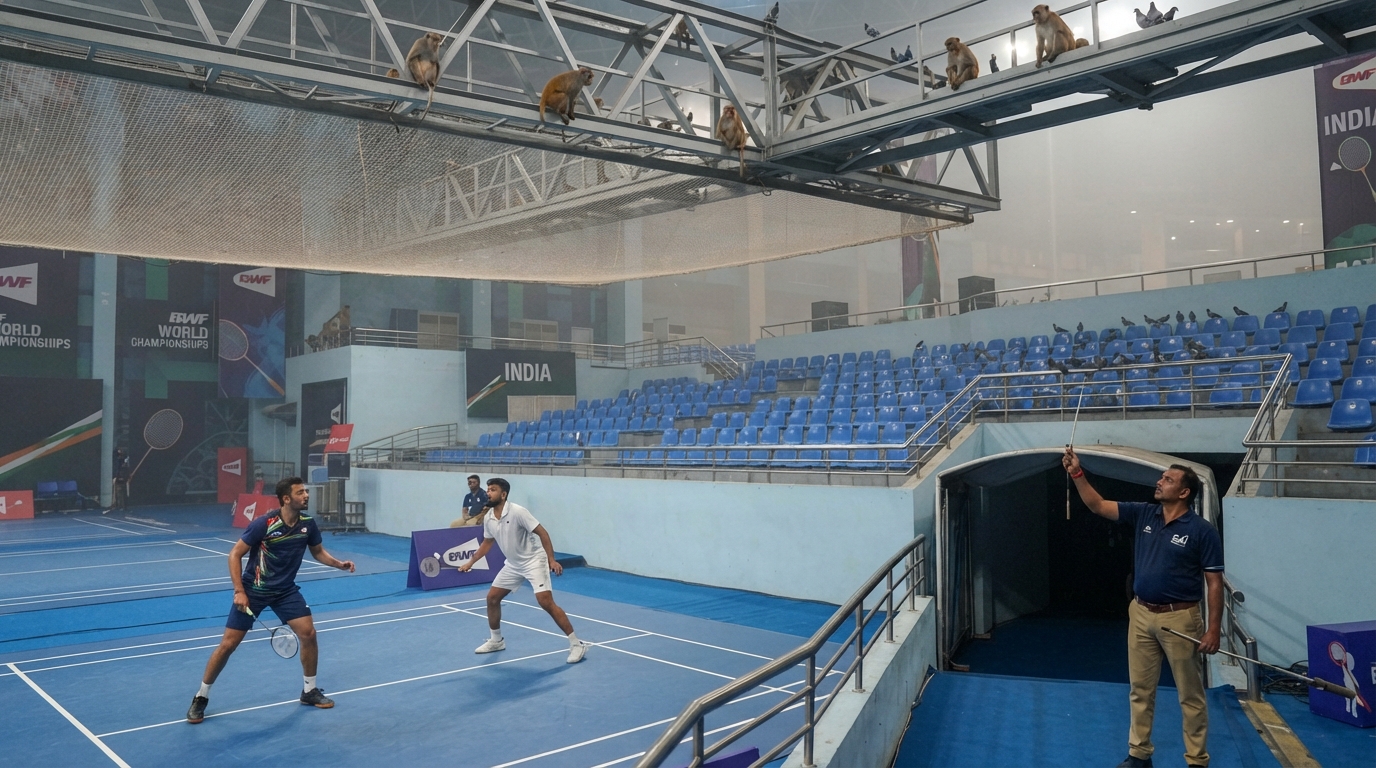
Delhi is facing an unusual challenge: preventing monkeys and pigeons from disrupting an upcoming global badminton event.
The BWF World Championships are set to commence in Delhi on Monday, and Indian sports authorities are implementing additional measures to deter wildlife after previous intrusions overshadowed another competition earlier this year.
In January, when India hosted the India Open badminton tournament, organizers had anticipated that the focus would be on intense matches, top international players, and the excitement of hosting a major tournament in the capital. However, the event garnered attention for entirely different reasons. Complaints arose regarding air pollution, matches were halted due to pigeon droppings on the court, and a monkey was observed inside the stadium.
Now, as Delhi prepares to host the BWF World Championships starting Monday, organizers are taking steps to ensure that the spotlight remains on the sport. The tournament, a significant event in the badminton calendar, will take place at the Indira Gandhi Indoor Stadium from August 17 to 23.
Officials informed the BBC that the stadium's wooden doors have been replaced with automatically locking double-door systems. High-grade nets have also been installed over openings that could potentially allow birds or animals to enter.
"As a secondary measure, we have also applied a non-toxic gel in areas and on handles where pigeons might have landed," stated Sanjay Mishra, general secretary of the Badminton Association of India. He added that other potential entry points, including roof gaps and exhaust vents, have been sealed or repaired.
The stadium has also undergone a comprehensive renovation to enhance its appearance and atmosphere. The Indira Gandhi Indoor Stadium was originally constructed for the 1982 Asian Games and subsequently renovated before the 2010 Commonwealth Games.
"Structural upgrades have been carried out at the three main arenas within the stadium," said Ambar Pratap Singh, executive director of the Sports Authority of India, in a social media video. He also mentioned that the lighting has been rectified after players complained about shadows on the court during the India Open.
However, it is the efforts to keep monkeys away from the venue that have garnered the most attention leading up to the tournament. A video circulating on Indian social media earlier this week showed a man seemingly imitating the call of a langur—large, long-tailed monkeys prevalent across much of South Asia—and quickly went viral. Langur calls have traditionally been used to deter smaller rhesus macaques, which are common in the city.
Several Indian and international news outlets reported that individuals who mimic langurs had been hired to keep other monkeys away. Even two-time badminton Olympic medalist PV Sindhu commented on X: "Our solutions may be uniquely Indian, but so are our warmth, our spirit and our hospitality."
However, senior official Mishra told the BBC that the association had not specifically employed anyone as part of the championship measures. He clarified that due to the stadium's large area, a person capable of imitating langur calls was briefly present in the northern block.
The use of langurs to scare away rhesus macaques is not a new practice in India, particularly in Delhi. During the 2010 Commonwealth Games, authorities deployed black-faced langurs at some venues to deter smaller rhesus macaques. In 2023, when India hosted the G20 summit, authorities placed life-size cutouts of langurs across the capital to scare monkeys away.
The India Open 2026 generated more headlines for poor air quality and animal intrusions than for the matches themselves. Monkeys were just one of the issues at the January games. During the tournament, a men's singles match between Singapore's Loh Kean Yew and India's HS Prannoy was interrupted twice after pigeon droppings fell onto the court.
Additionally, there was the problem of poor air quality. Between October and January, air pollution in northern India, especially in the capital Delhi, reaches hazardous levels. This occurred again this year, leading to player complaints. Singapore's Loh stated he struggled to breathe and wore a mask outside his hotel room, while Denmark's Mia Blichfeldt described the conditions as "unhealthy."
For India, these incidents were embarrassing as the country aims to establish itself as a major host of international sporting events. India is slated to host the Commonwealth Games in 2030 and has also submitted a bid for the 2036 Olympics.
The badminton world championships present an opportunity for India to demonstrate its capability to stage a major global sporting event and maintain focus on the competition. This year's tournament will feature the reigning men's and women's world champions, China's Shi Yuqi and Japan's Akane Yamaguchi, respectively. India will be hoping for a strong performance on home soil, with Sindhu leading its challenge in the women's singles.
For the organizers, much is at stake. They will want the most significant stories from Delhi over the coming week to revolve around the players, the matches, and badminton, rather than the local wildlife.