

County Down man among three jailed for planning mosque attack
The three men pleaded guilty to attempting to engage in terrorist activity in November 2025.
County Down man among three jailed for planning mosque attack
A man from County Down is one of three men who have been jailed for trying to carry out a terrorist act, namely the damaging of a mosque in Galway.
Garrett Pollock, 36, of Kilhorne Greene in Annalong, received a sentence of 10 and a half years, with the final year suspended.
Darren Gorman, 34, of O'Moore Place in Portlaoise, was handed an eight-year sentence, with the last year suspended, while Karolis Peckauskas, 39, of Newfoundwell Road in Drogheda, was sentenced to eight years in prison, with the final year suspended.
The Special Criminal Court in Dublin heard that they had drawn up detailed plans to blow up the Maryam Mosque on Monivea Road between 4 and 5 November 2025 when they were arrested.
Pollock also admitted possessing an explosive substance, which was discovered in four glass jars concealed in a drawer in his van on 4 November.
On Friday, Ms Justice Caroline Biggs said modern Ireland is a multicultural and diverse country, and that the actions of this group bring shame on the country.
Biggs said it amounted to attempted arson with a terrorising message intended to be spread worldwide.
She added that it was clear this was meant to be the first of many attacks.
The men were members of the self-styled Irish Defence Army, which Det Insp Alan McDevitt described as a violent right-wing extremist group.
He had earlier told the court that the group was a breakaway from the online Irish Citizens Army and communicated on the messaging app Signal, RTÉ has reported.
McDevitt said gardaí did not know when the attack was planned for, but the men intended to use improvised incendiary devices such as pipe bombs and "Molotov cocktails".
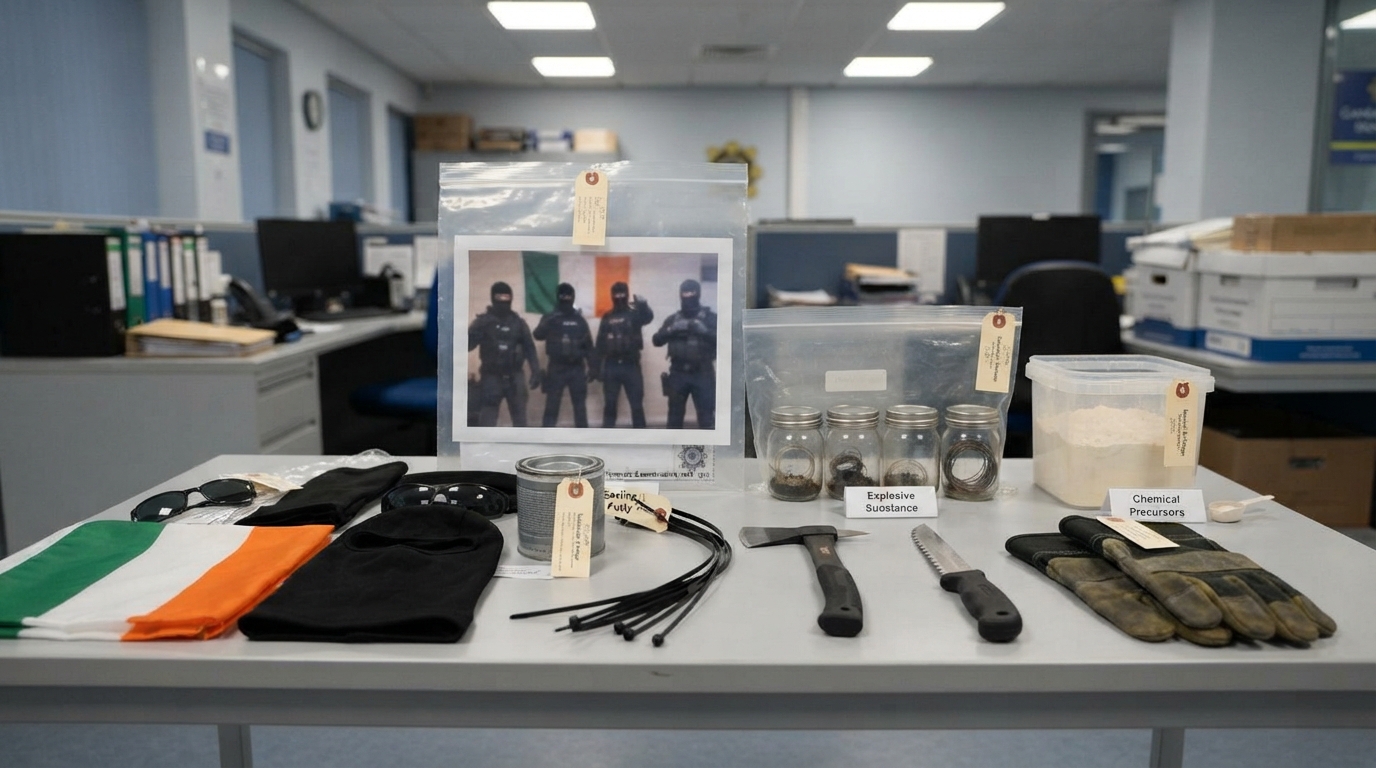
Items seized by gardaí included cable ties, hatchets, knives and masks.
Five litres of chemicals were also taken and were found to be suitable for use in pipe bombs.
Officers also recovered sunglasses, balaclavas, a can of sealing putty and an Irish flag.
The men had recorded a video on Pollock's phone in Gorman's kitchen in Portlaoise, claiming responsibility for the attack.
The footage showed four masked men in tactical gear standing in front of the Irish flag.
In the video, they said they would like "to take responsibility for destruction of first mosque introduced into our great country in Galway".
The court also received a written letter from Pollock expressing remorse and shame for his actions.
It heard that Pollock was "radicalised" online after he began misusing alcohol and cocaine.
Pollock, who works as a gym instructor, consumed radicalised material about supposed threats immigrants posed to the community, which was described as "emotive, ill-informed and AI-generated".
The court heard that after making contact with a group and being invited into smaller groups, he found a sense of belonging and became radicalised very quickly, and wanted to prove his commitment to them.
A doctor who assessed Pollock said his actions took place in the context of emotional dysfunction, low self-esteem and isolation.
Gorman's defence counsel had earlier told the court that his psychological report points to extremes of submissiveness and vulnerability, that he was a drug user and addict, and that he also had certain mental health issues.
They added that he had no history of violence, hatred or terrorism.