

Copenhagen tops the list of the world's most livable cities
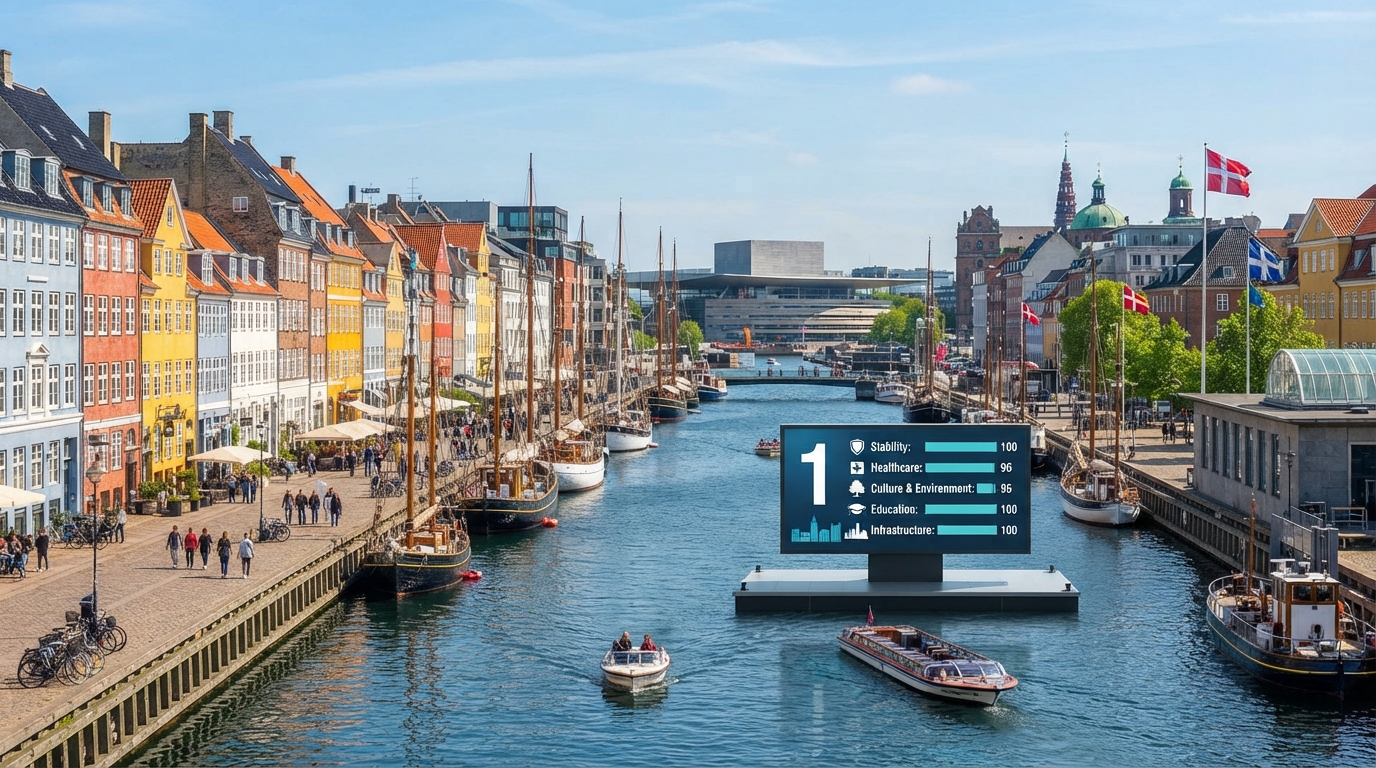
Copenhagen tops the list of the world’s most liveable cities
The Danish capital Copenhagen has been named the world’s most liveable city for the second year in a row. The top ten in the 2026 ranking includes Vienna, Melbourne, Sydney, Zurich and five other cities with high ratings for safety, healthcare, education and infrastructure.
**How does the EIU determine a city’s liveability?**
The ranking is compiled by the Economist Intelligence Unit (EIU), an analytical division of The Economist Group. In May 2026, experts assessed 173 cities on 30 indicators grouped into five broad categories:
* **Stability** — the risk of crime, conflict, unrest and terrorist attacks.
* **Quality of healthcare** — the availability and quality of public and private healthcare services.
* **Culture and environment** — the ability to enjoy climate, goods, food, sports and cultural entertainment.
* **Education** — the availability and quality of education.
* **City infrastructure** — roads, public transport, housing, communications, water and energy supply.
Each category is rated on a scale of 1 to 100, then combined with different weights. Sustainability and culture account for 25% of the final score, medicine and infrastructure for 20%, and education for 10%. The closer the result is to 100, the more comfortable the city is considered according to the EIU methodology.
**Top 10 cities in the world in 2026:**
The top ten are cities from Australia, Switzerland and Japan. Australian cities took three places, while European cities took four. Vancouver was the only North American city to make the cut.
1. Copenhagen, Denmark — 98 points
2. Vienna, Austria — 97 points
3. Melbourne, Australia — 97 points
4. Sydney, Australia — 97 points
5. Zurich, Switzerland — 96 points
6. Geneva, Switzerland — 96 points
7. Osaka, Japan — 96 points
8. Adelaide, Australia — 96 points
9. Vancouver, Canada — 96 points
10. Tokyo, Japan — 96 points
**Why did Copenhagen take first place again?**
Copenhagen scored 100 points in three areas at once: sustainability, education and infrastructure. Healthcare was rated at 96 points, and culture and environment were rated at 95 points. This result was enough to maintain its lead for the second year in a row. It is not surprising that Copenhagen also leads the ranking of the safest cities.
In comparison, Vienna received the highest scores in medicine, education and infrastructure, but received 95 points for sustainability and 94 points for culture and environment. Melbourne also showed an almost flawless result: 100 points for medicine and education, and 96 points for culture and infrastructure.
There is another common feature: all ten cities received the highest score in education. Also, most of the leaders scored 100 points in the field of health. The difference between them occurs in the areas of sustainability, infrastructure, culture and environment. All scores are published in the EIU report for 2026.
**Limitations of the livable cities ranking**
The global index is useful for comparison, but it is not a substitute for choosing a city yourself. The index does not take into account your profession, language proficiency, visa eligibility, distance from family, or your usual lifestyle.
A high ranking does not mean that moving is easy or cheap. The ranking takes into account the quality of housing, transportation, and basic services, but not your actual costs. Even a city with excellent infrastructure may not be suitable for you due to prices, climate, or difficulties finding a job. The rental market should be evaluated separately: living in a rented apartment can also affect your health.
The main conclusion of the ranking is that the ideal city is not defined by beautiful streets and many cafes, but by the combination of safety, healthcare, education, transportation, and sustainable infrastructure. It is this aspect that brought Copenhagen to first place for the second year in a row.