

Commissions on card-to-card money transfers: Statement by the head of Click and banks
During a round table held at the Central Bank, the founder of Click stated that banks can cover expenses through their other revenue streams, whereas payment organizations have limited capabilities. He described competing with zero tariffs as "dumping." Meanwhile, bank representatives stated that they do not view transfers as a separate source of income.
Card-to-card money transfer commissions: Statement by Click head and banks
In one application, card-to-card money transfers are free, in another no commission is charged up to a certain limit, and in yet another a fee is charged for each transfer. Why are different tariffs set for a service that appears to be the same? Who covers the cost of a free transfer?
“Zero commission does not mean no cost”
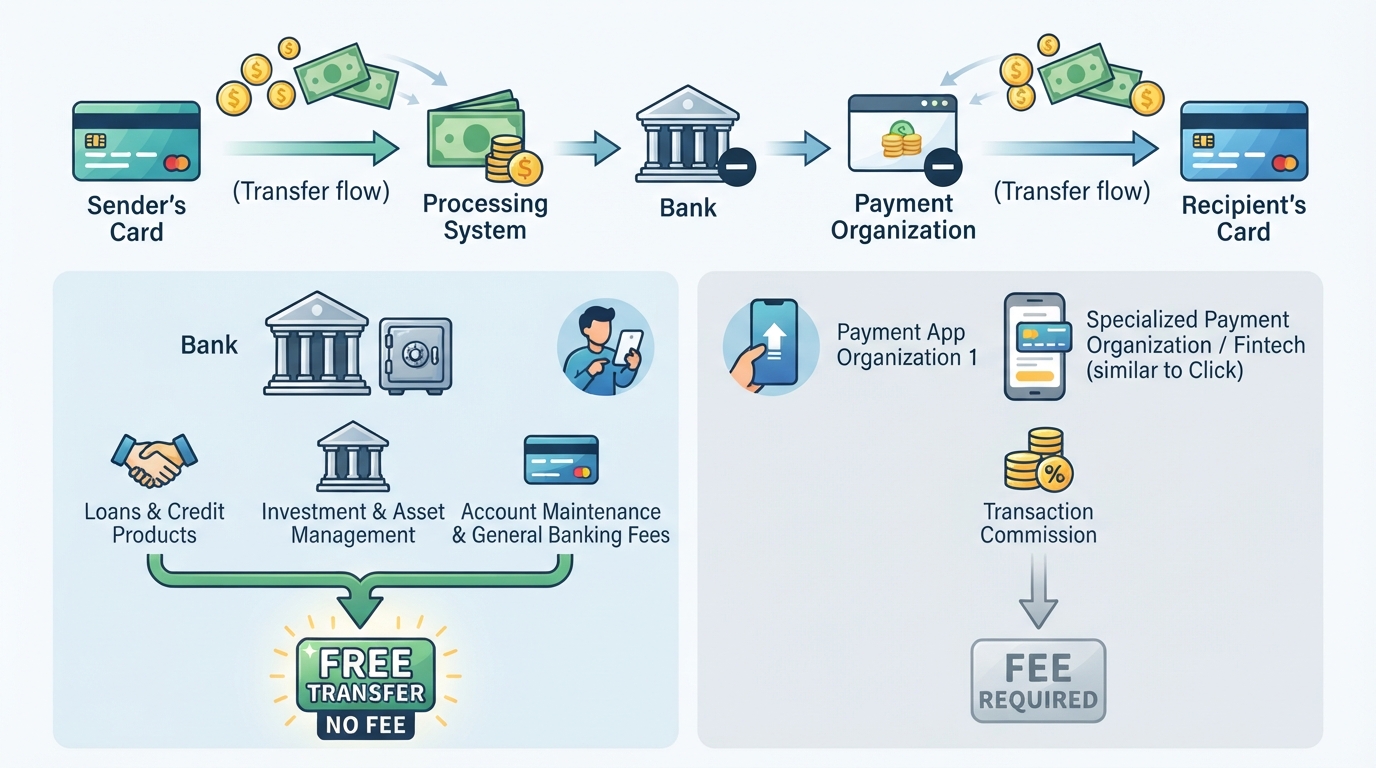
According to Ulugbek Rustamov, founder and head of Click, several parties provide service in card-to-card money transfers — the bank, the processing system, and the payment organization. The commission paid by the customer is related to payments in this chain as well as the costs of providing the service. An organization offering a free transfer to a customer assumes these costs itself.
“For every P2P transfer, there is a processing system, a bank, and a payment organization. The sum of all their commissions currently constitutes this commission. In addition, many organizations or banks may cover this commission at their own expense. Just because someone offers zero commission does not mean they are simply forfeiting their profit. Many consider this a marketing expense,” Rustamov said.
He emphasized that the revenue opportunities for banks and payment organizations differ from each other. A bank can generate income in other areas beyond its relationship with the customer and make transfers free at its own expense. Click, on the other hand, indicated that it is more dependent on commissions from card-to-card transfers.
“We are a payment organization. A payment organization is considered a company that operates on very low margins and a very small commission. We have no money earned other than this commission. That is, if we were giving credit to someone or turning over customers' money to do something else, perhaps it would be possible to [cover] this commission,” he said.
Rustamov cited the ability of banks to use customers' card funds as a resource as one of the ways to finance free transfers. According to him, a bank's goal is not limited to making a profit from a single transfer: a customer using its card and keeping money in that bank also generates profit.