

Cloud provider Servercore has launched a third zone of presence in Tashkent
Servercore has launched its third availability zone, uz-1b, in Tashkent based on the UNICON data center. The new site will be integrated with the uz-1a zone through a single network.
Servercore cloud provider launched a third availability zone in Tashkent
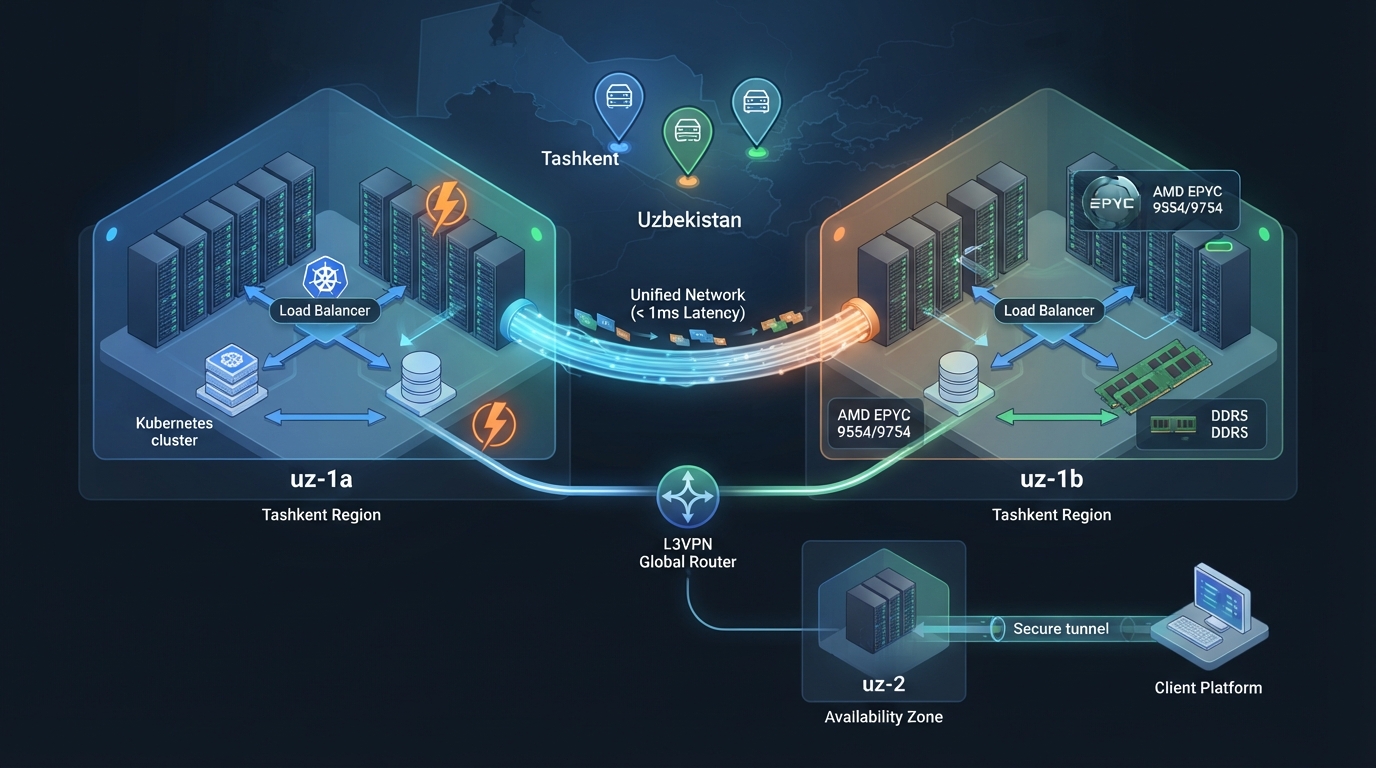
International IT infrastructure provider Servercore announced the launch of a new uz-1b access zone based on the UNICON data center in Tashkent. The uz-1a region has acquired multi-zone status: the infrastructure of the uz-1a and uz-1b segments has been integrated into a single network with a latency of less than 1 ms. This allows customers to distribute the load between two independent sites. As a result, it will be possible to create fault-tolerant clusters that maintain operational capability even in the event of a failure of one of the sites. Along with the uz-2 region in Tashkent, there are now three availability zones, while a total of five zones operate across three countries within Servercore's infrastructure.
The new zone opens the way to implementing broader backup scenarios. The multi-zonality of the uz-1a region allows database clusters and Managed Kubernetes nodes to be deployed simultaneously in two segments — uz-1a and uz-1b. Even if one site fails, the cluster continues to operate: the load balancer distributes traffic between instances in both zones.
The infrastructure can be distributed between the segments of the uz-1 pool, between the uz-1 and uz-2 pools, or between the Servercore cloud and the customer's own platform — a global router based on L3VPN technology is responsible for the connection. The customer determines the level of backup themselves: from a single zone to geographically dispersed sites.
Initially, the uz-1b zone will offer new server configurations running on AMD EPYC 9554 and AMD EPYC 9754 processors with DDR5 memory. Thus, migrating to the new region can simultaneously become a hardware upgrade for customers.
"The main advantage of uz-1b is that it is located in a single network circuit with uz-1a with a latency of less than 1 ms. This allows the nodes of a single cluster to be distributed between segments: if one site fails, only a part of the nodes fails, not the entire service. At the same time, the customer determines the level of backup for their system themselves — from deployment in a single zone to geographically dispersed sites," commented Vadim Yerishev, Business Development Director at Servercore.
The company notes that fault tolerance does not occur automatically when migrating to a new region. To ensure it, it is necessary to distribute application instances between segments, configure balancing, data replication, and failover. Servercore helps customers design the architecture and migrates the infrastructure for free.