

Church makes sainthood case for 'WW1 hero' priest
Fr Willie Doyle was killed during World War One while trying to help injured and dying soldiers.
Church advances sainthood case for 'WW1 hero' priest
A "heroic" Irish priest who was killed in World War One while trying to help wounded and dying soldiers will move a step closer to possible sainthood on Sunday.
Fr Willie Doyle served as a British Army chaplain during some of the deadliest battles of the First World War, including the Somme, Messines and Passchendaele.
The Dubliner became known for his bravery under fire, repeatedly going into No Man's Land to bring injured troops to safety or to comfort those who were fatally wounded.
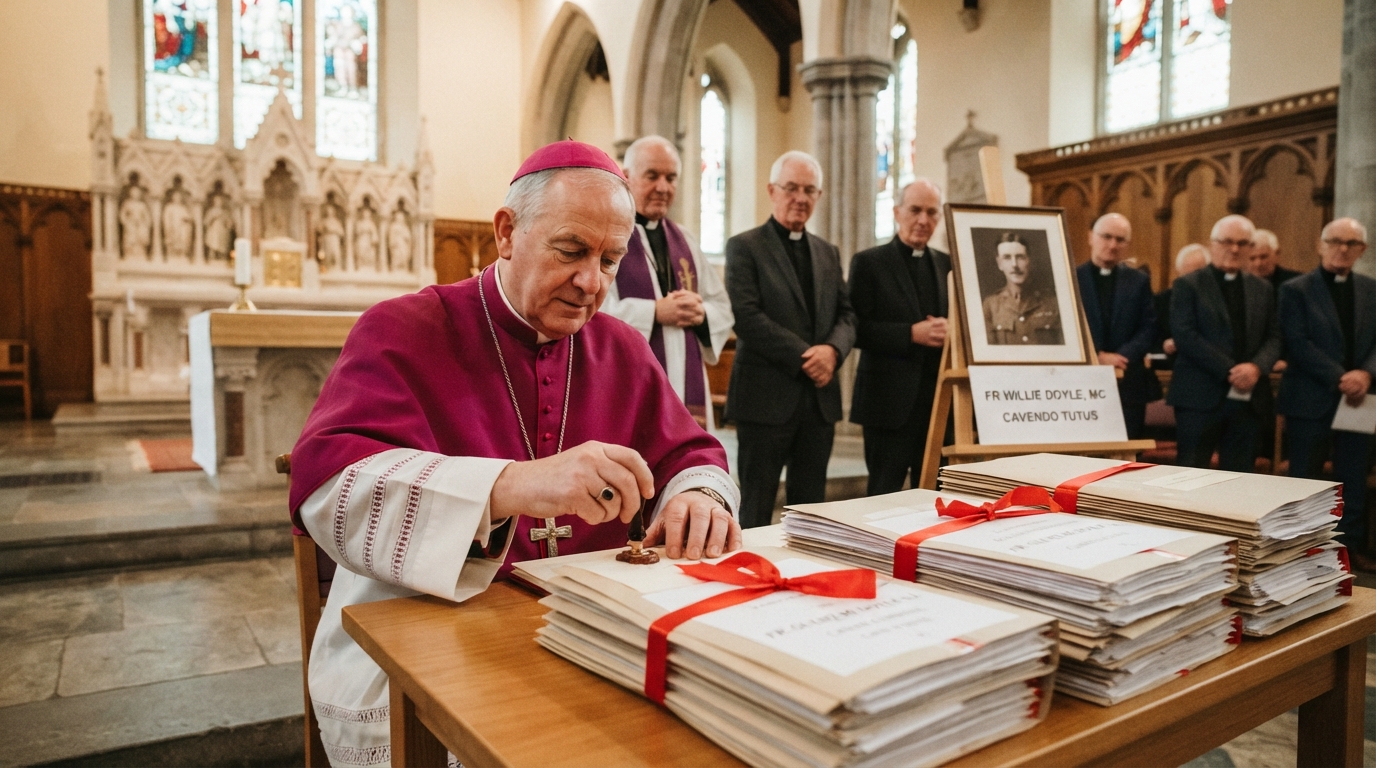
On Sunday, the Catholic Church in Ireland will hold a special service in Mullingar Cathedral before sending thousands of documents to the Vatican to back the case for his canonisation.
World War One had been underway for more than a year when Fr Doyle volunteered to become a military chaplain to the 16th (Irish) Division of the British Army.
He served with the division for almost two years, much of it in the trenches on the Western Front, until his death at the Battle of Passchendaele on 16 August 1917.
He was killed by shellfire while going to help two wounded Protestant soldiers, one of whom was a young officer from Belfast - 2nd Lt Arthur Vivian Green.
For that reason, the Catholic Church in Ireland regards Fr Doyle as an "ecumenical martyr of charity" who died ministering to soldiers of other Christian denominations.
The sainthood campaign is being led by the Fr Willie Doyle Association, a Dublin-based group made up mainly of lay people but supported by the clergy.
The group was founded by Patrick Kenny, a business school lecturer who lives a short distance from where Fr Doyle grew up in south County Dublin.
"Fr Willie Doyle lived a life of great heroism and, I would also say, great holiness," Kenny told BBC News NI.
"He was awarded the Military Cross for his bravery at the Battle of the Somme. He was mentioned in despatches on a number of occasions as well."
Kenny established the association in 2020 after he became "captivated" by Fr Doyle's courage while reading a biography of the late priest.
Born William Joseph Gabriel Doyle in 1873, the future priest had a comfortable, middle-class childhood in the wealthy Dublin suburb of Dalkey.
He was sent to a Catholic boarding school in England, but returned to Ireland as a teenager, and by the age of 18 had begun training to become a Jesuit priest.
He was in his early 40s when he was sent to the Front as a WW1 chaplain.
Although it was a non-combat role, Kenny notes that the commander of the 16th (Irish) Division, Maj-Gen Sir William Bernard Hickie, described Fr Doyle as "the bravest man that he ever met".
He added that Fr Doyle was a prolific letter writer whose personal correspondence has become an important eyewitness source for historians.
"If you look at any book about the Irish in the First World War, almost invariable Fr Willie Doyle is in that book.
"Because of the sheer volume of letters that he sent home, we know a lot about what the Irish soldiers experienced."
Kenny added that Fr Doyle was highly respected by his own men, but was also recognised for his kindness and mercy towards injured German prisoners-of-war.
There are five steps in the process of achieving sainthood in the Catholic Church, some of which can take many years, and this campaign is still at a very early stage.
The Fr Willie Doyle Association petitioned the Irish Church to support its proposal for his canonisation, and the Church opened a diocesan inquiry in 2022.
"The Diocese of Meath conducted an extensive investigation - a theological commission studying his writings; a historical commission studying his life," Kenny explained.
It also held a "diocesan tribunal" in which experts were interviewed to assess the strength of the religious legacy Fr Doyle inspired among devotees.
"Together all of that documentation comes close to 3,500 pages," Kenny said.
"All of that documentation will be brought to Rome and then the next phase of the process begins."
This week, the Bishop of Meath Tom Deenihan was filmed preparing parcels of the evidence gathered on Fr Doyle, ready for Vatican inspection.
He said the example of an Irish Catholic priest who died serving as a British Army chaplain "has much to offer our own time when nationality and denomination run the risk of polarity".
"Indeed Fr Doyle's spirituality, and example, resonate very much with that of the spirituality of Gen Z," he added.
Members of the Doyle family have been invited to join Irish bishops at the ceremony in Mullingar on Sunday afternoon.
The event marks the "final public session of the tribunal of inquiry" after which the last documents will be assembled and added to the bundles bound for Rome.
In line with tradition, the parcels were wrapped in red ribbon and sealed with wax by the bishop.
"It's a ritual that's heavily prescribed by church regulation," Bishop Deenihan said.
"The remainder of the documentation, including the minutes of the final [session] itself, will be sealed at the ceremony in the cathedral."
The bishop said it was "an important moment in the life of the Church here in Ireland" and added he was "confident" the case would be successful.