

Chinese scientists invent self-regenerating fabric
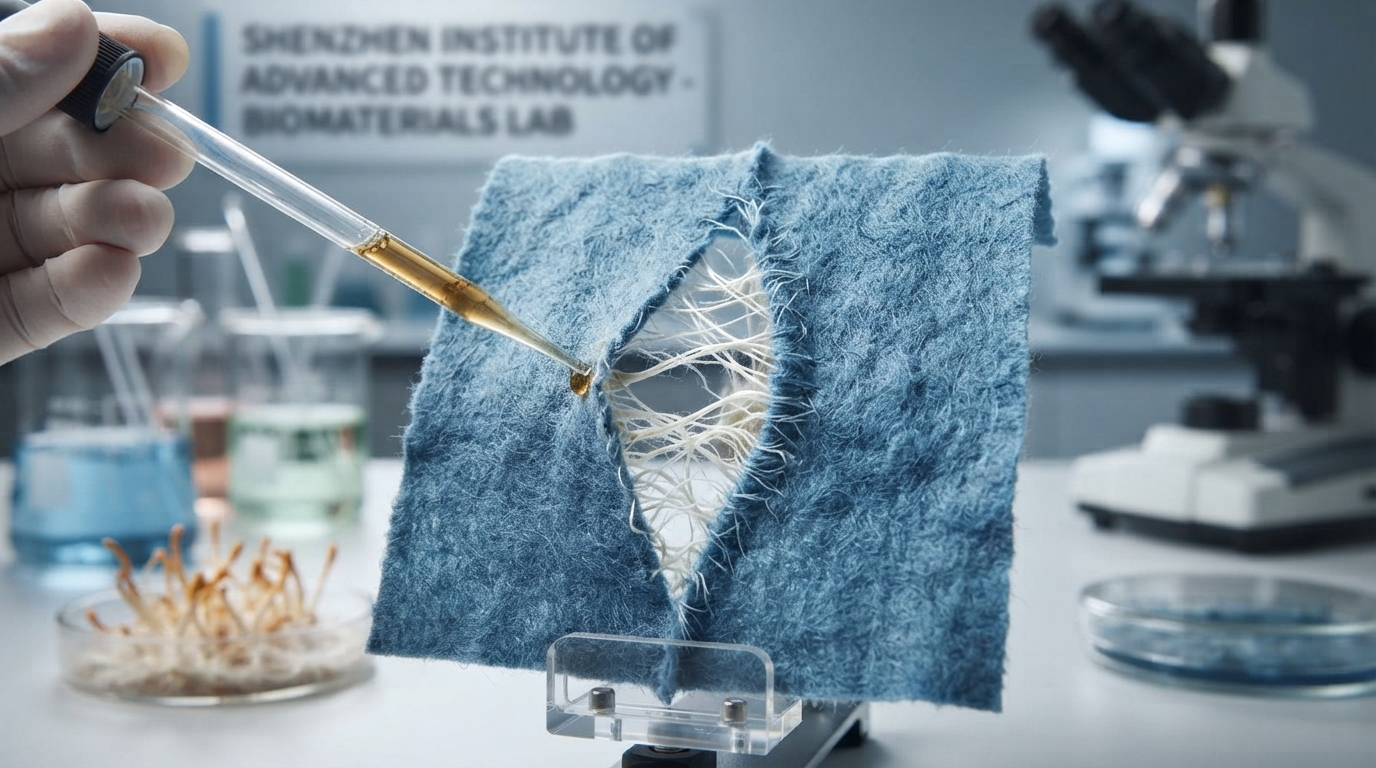
Chinese researchers create self-healing fabric
Scientists from the Shenzhen Institute of Advanced Technology in China have made a revolutionary innovation in the clothing industry. They have invented a material based on the mycelium (root threads) of a special fungus called Cordyceps militaris that can self-clean, renew worn surfaces, and most importantly, repair torn areas on its own. The uniqueness of this fabric is that it retains its vitality even after being turned into clothing.
How does fabric repair itself?
To repair a torn or punctured area, it is enough to apply a special nutrient solution in which potatoes are boiled and put a small piece of live fungus on it. Then the "dormant" fibers in the fabric wake up and begin to grow. New threads multiply and weave the torn area on their own, without glue or stitches. In addition, the fabric is waterproof, meaning that dirt that gets on it simply slides off with water, and the clothes clean themselves.
Researchers led by Professor Ke Li are using mushroom fibers as a kind of "base". For example, by adding other yeasts or fungi to it, you can give the fabric a natural blue color or make it protect it from the sun's harmful ultraviolet rays.
The amazing possibilities of the new invention:
* **Sleep mode:** When the fabric is dried at 45 degrees Celsius, it goes into a kind of "hypnotic" state. It does not grow until it is filled with nutrient water and can maintain its shape for a long time.
* **Strength and flexibility:** Just four thin strips of this mushroom fabric can withstand a load of 1 kilogram. When treated with glycerin, it becomes as soft and flexible as regular clothing—it can be cut, sewn, or folded with ease.
* **Eco-friendly:** This is a great way to save the environment from plastic and synthetic waste. Because when buried in the ground, this garment will completely decompose in just 41 days, mixing with the soil.
Of course, the fabric is not without its drawbacks. Although it is very comfortable to wear, like soft leather or fabric, scientists have not yet tested it in a washing machine, its breathability, and its durability. In addition, for now, a person must manually apply medicine to heal the tear.
Although it is still some time before this type of fabric is commercially available, it is a huge step towards the future.
Scientists have collaborated with the clothing brand Peelshere to create an unusual dress from this fabric, similar to that seen in science fiction movies.
"This material is a great find for the fashion world and architects. It has a unique look, natural color and the ability to restore damaged areas in a controlled manner. In today's environment-conscious era, the ability to simply bury old clothes in the garden is a real revolution," says Professor Ke Li.
Experts warn that it is still some time before we see such clothes on store shelves. Before they can be worn in everyday life, their durability and moisture resistance need to be improved. Otherwise, it is not out of the question that a person's clothes will turn into mud and get dirty in the first rain.
However, experts believe that this invention is not just an interesting experiment or a simple prototype. This is a huge step that marks the beginning of the era of "programmable living clothes" in which biological properties can be adapted to any task and reassembled, just like a children's toy.