

Captured Ukrainian-born soldiers tell BBC why they fought for Russia
Men born in Ukraine who fought for Russia are tried for treason, but at a prisoner of war camp in western Ukraine, many believe they were defending their homeland.
Ukrainian-born soldiers captured while fighting for Russia have shared their motivations with the BBC. Many of these individuals, despite their Ukrainian birthplace, identify as Russian.
Within a high-security camp in Western Ukraine, housing men apprehended fighting for Russia, a notable shift in recruitment patterns is evident. Many of the captured soldiers, previously drawn from remote, impoverished regions at the war's outset, now hail from major Russian cities like St. Petersburg and Yekaterinburg. However, not all prisoners are Russian; some are Ukrainian citizens who took up arms against their own nation.
Interviewing prisoners of war presents challenges, primarily ensuring their statements are uncoerced and assessing their candor under the circumstances. Lacking access to the Russian military, these interviews offer a unique opportunity to understand the war's dynamics and the motivations of its combatants, including Ukrainian-born soldiers on the Russian side. The BBC granted all prisoners the option to decline interviews, speaking only with those who agreed, away from guards and cameras. In addition to formal interviews, direct conversations were held with prisoners in Russian at various locations.
The POW camp houses individuals from occupied eastern Ukraine and major Russian cities. Anton, for instance, was ten when his part of Ukraine's eastern Donbas region fell under Moscow-loyalist control. In 2022, upon turning 18, he immediately enlisted to fight for Russia when Vladimir Putin escalated the conflict. "I don't regret my choice. I went to defend my land," Anton asserted, noting his friends also volunteered. He recounted receiving frequent SMS messages reporting deaths. Other prisoners echoed this sentiment, stating that all their initial comrades had been killed. They also observed a decline in volunteers, despite substantial sign-up bonuses, suggesting a potential challenge to Putin's strategy of avoiding mass mobilization.
When Ukraine captures its own citizens on the battlefield, they face treason charges but are subsequently sent to POW camps alongside Russian soldiers. Officially, Kyiv still considers them Ukrainian and views Russia's control of their regions as temporary, though the reality on the ground is more intricate. Petro Yatsenko of Ukraine's coordination headquarters for POWs described them as "very pro-Russian, and their national identity is very blurred."
Anton vehemently denies being a traitor. "I consider myself Russian. A country means nothing, it's all about nationality. All my family are from Russia. All my roots are from there," he stated, dismissing his Ukrainian surname as irrelevant. An entire generation born in Ukraine has matured under occupation, exposed to Russian schooling and Kremlin-controlled media, which have consistently portrayed Kyiv's authorities as "Nazis" and illegitimate. Since the full-scale invasion, even more territory has come under this influence. Anton has internalized these narratives, now speaking almost exclusively in Russian slogans. He refers to Putin as "my President" and believes he should press to seize the rest of the Donbas, despite the hundreds of thousands already killed in the effort. "It's a shame that people died, especially those who are innocent," Anton remarked. "But war is war. It could have been ended. But no-one wanted to do that."
In the prison hospital, Artyom, his body riddled with shrapnel, lay in a corner bed after only two months of fighting. Like Anton, he is from Donetsk and willingly joined the war, not solely for financial gain. "We have our own grudges," Artyom explained, recalling the heavy shelling his region endured in 2014 as Ukrainian forces attempted to prevent its secession from Kyiv. However, his military experience has left him embittered. He described his commander as "bad" and never received his 400,000 rouble (£3,470; $5,000) sign-up fee. Adding to his grievances, a wounded Russian soldier in the adjacent bed reportedly received five times that amount.
All Ukrainian-born POWs interviewed came from areas occupied since 2014, and nearly all voluntarily joined the Russian army. However, one man from the Donetsk region claimed he was forced to fight, his eyes darting nervously as he spoke, unsure whom to trust. One official intelligence estimate suggests over 50,000 Ukrainians have been unwillingly conscripted in occupied territories, with other figures placing the number significantly higher. This man stated his family remained in Donetsk during the Russian invasion not due to political or national allegiance, but because it was their home. His sole ambition now is to return to his wife and children and avoid being sent back to the front. "I'm just going to hide," he confided.
Beneath the hospital windows, rows of strawberries and cucumbers planted by the prisoners thrive. Further away, a strong varnish odor emanates from an outhouse. An official, grinning, pulled a gold-colored plastic handle from a bag near the door, challenging, "Guess what this is for?" Inside, men were assembling wooden coffins. The official mentioned the prison's previous contract was for garden sheds, making this one feel macabre. In another workshop across the courtyard, a few POWs were crafting artificial Christmas trees, adorned with gaudy baubles. Like the coffin-makers, they stated they use their wages for extra food and cigarettes.
Sergei, born in the Ukrainian city of Luhansk, identifies as Russian, like his parents who moved to the Donbas when both countries were part of the Soviet Union. He joined the Russian army a decade ago "to defend my homeland" but claims he will retire upon his return, not rejoin the front. "I've done my bit." Most, however, will not have that choice.
Next to Sergei, stacking plastic branches, was a drug dealer who, like many, enlisted "exclusively" to avoid a lengthy prison sentence. "For me, 15 years in prison was too much," Konstantin explained. "I know it probably doesn't excuse me, but it's a fact. I'm 44 now, I would be 60. So no." However, "Vshniki," or convict-soldiers, must survive until the war's end to be released, and the odds in assault troops are not favorable. Three convicted murderers reported believing they would be freed after a year of fighting, only to have their contracts automatically renewed.
When asked about killing fellow countrymen on the battlefield, Sergei deemed the question "provocative" and declined to answer. "I see nothing good in any war, and in a war like this there can be nothing good a priori," Konstantin replied cautiously. "I'm not saying we're the same as Ukrainians, but we are close. We all have relatives there. This just isn't good." Despite this, he still believes his decision to fight was correct. Neither he nor Sergei anticipate a swift end to the war, both believing Putin will not stop until he controls the entire Donbas. "But everyone I know there has had enough," Konstantin said. "I just want this to be over, as soon as possible."
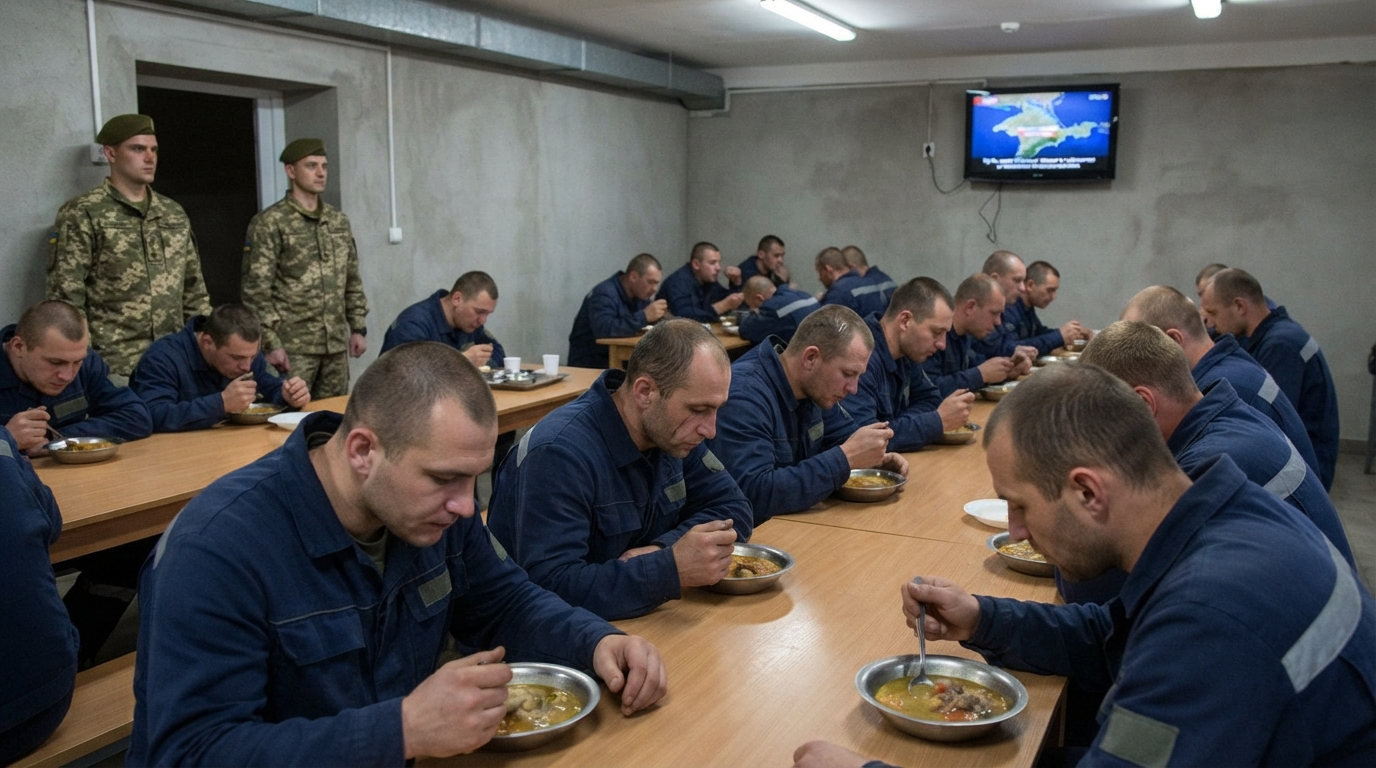
At lunchtime, prisoners in navy overalls filed into the dining hall, heads bowed and hands clasped behind their backs. As they ate soup and stew, a video titled "Myths about Crimea" played on a loop, refuting Russia's claim to historic ownership of the peninsula seized from Ukraine in 2014. No one paid any attention. The re-education efforts appeared half-hearted. For Kyiv, the primary focus is using these POWs for exchanges to bring its own soldiers home. However, when negotiating exchange lists, the men from the Donbas are a low priority for Russia. "Only a dozen or so have been transferred this year," Konstantin lamented. "It seems like they don't want to exchange us. I think we will be the last to go."