

Can Germany fill its gas storage facilities by winter?
With just months left before winter, Germany's underground gas storage facilities are just over 50 percent full. This is the lowest level in several years for mid-August. The closure of the Strait of Hormuz amid the Iran war, rising global gas prices and traders expecting prices to fall are cited as key factors.
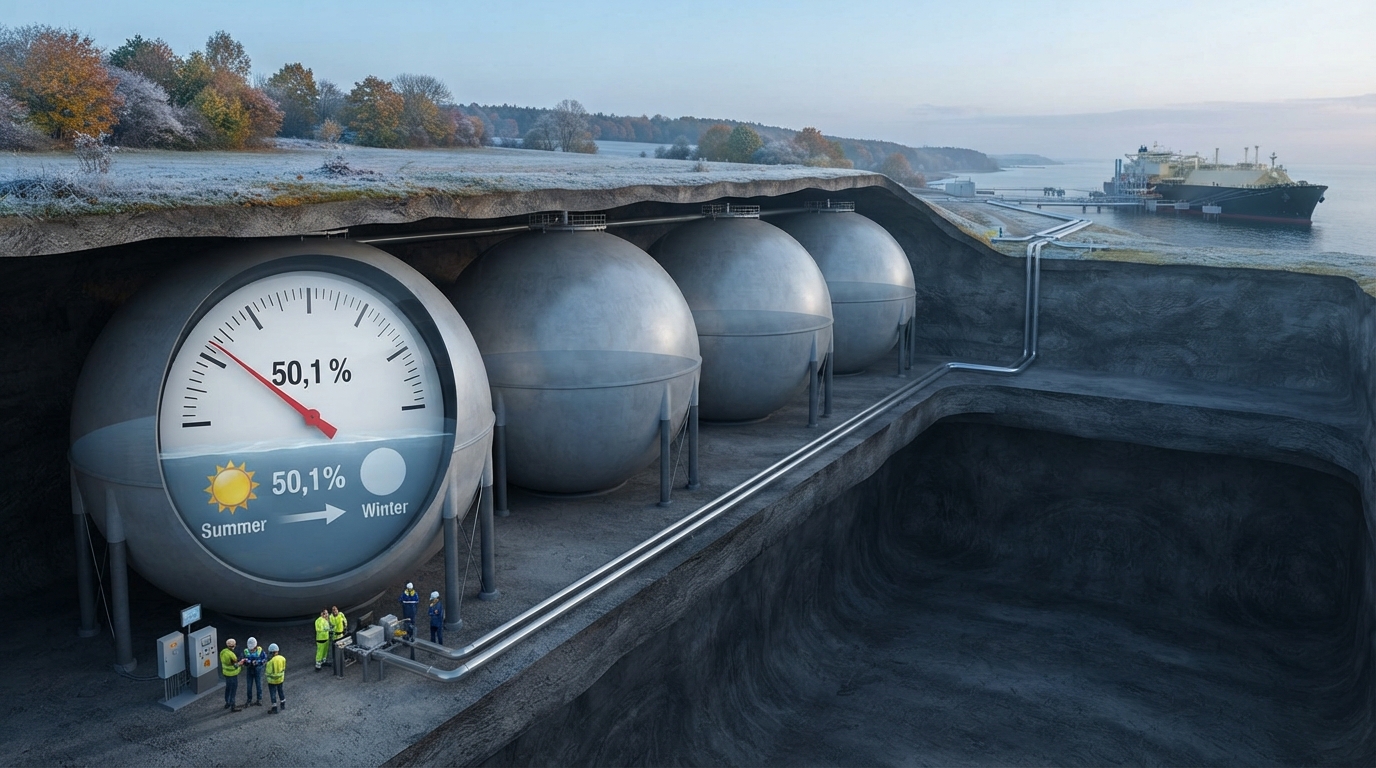
Will Germany be able to fill its gas storage facilities by winter?
According to Gas Infrastructure Europe, as of August 19, the occupancy rate of more than 40 underground natural gas storage facilities in Germany was 50.14 percent. This is the lowest figure for mid-August in several years. Gas reserves in Germany are about a quarter lower than in the same period last year. Compared with the figures for 2023 and 2024, the difference is more than 45 percentage points.
Nevertheless, the German government says that the country's consumers will not face a gas shortage in the winter.
**Why are gas storage facilities underfilled?**
Usually, energy traders buy gas at relatively low prices in the summer and store it in warehouses until winter. When demand and prices increase in the cold season, gas is sold at a higher price. This is called the "summer-winter price spread" in the market.
But this year is different. Supply disruptions related to the war in Iran have pushed up global prices for natural and liquefied natural gas. Traders have therefore lost economic incentive to fill their storage tanks with gas at the current high prices.
On August 20, the wholesale price of gas on the Dutch TTF exchange was about 65 euros per megawatt-hour. This is about twice as much as at the same time last year.
The TTF index has risen by about 25 percent in the past two weeks alone, amid renewed tensions between the United States and Iran.
**Traders expect prices to fall**
Unlike some European countries, Germany relies mainly on private energy trading companies to fill its gas storage tanks.
Market participants are not rushing to buy large volumes of gas, calculating that if the war in Iran ends, gas prices may fall in the coming months. It would be more profitable for them to buy gas after the price has fallen.
However, this approach has also drawn criticism in Germany. Some politicians have accused traders of putting the country's energy security at risk.
On August 19, the German Ministry of Economics also called on gas storage operators to increase reserves.
**Gas reserves have also decreased in Europe**
The problem is not unique to Germany. The Netherlands, Belgium, Slovakia, Sweden and Latvia also have gas storage capacity levels below 50 percent.
As of August 19, the average for the European Union was 61 percent. This is about 17 percent lower than last year and about a third lower than the figures for 2023 and 2024.
Spain, Italy, Denmark and Poland are currently listed as EU countries with relatively stable gas supplies.
**71 percent target 'almost impossible' to achieve**
The German gas pipeline operator FNB Gas said on August 19 that the government's target of filling gas storage facilities by an average of 71 percent by November 1 was "almost impossible" in the current circumstances.
The current rate of filling gas storage facilities is around 0.5 terawatt-hours per day. The organization estimates that even if this figure were increased to 1.2 terawatt-hours per day, reserves would still be significantly below the target by November 1.
FNB Gas warned that low LNG imports, an early or prolonged cold snap and infrastructure disruptions could pose risks to gas supplies in the winter.
**How has Germany reduced its dependence on Russian gas?**
After Russia's war in Ukraine began, Germany, like other European countries, has begun to sharply reduce its dependence on Russian energy resources.
The country has increased its imports of liquefied natural gas from the United States and Qatar, and increased the volume of gas supplied by pipeline from Norway.
Also, after the energy crisis of 2022-2023, Germany has quickly built several floating and onshore LNG terminals on the coasts of the North and Baltic Seas.
The government is relying on these new sources of supply, emphasizing that the country's gas supply remains reliable, despite the current low levels of gas storage facilities.
**Gas may become more expensive in winter**
Consumer rights organizations are warning that gas prices may increase in the coming winter.
According to the Verivox price comparison service, the price of new gas contracts for the population has increased significantly since the beginning of March. This increase may later affect existing customers.
For a private house consuming 20,000 kWh of gas per year, the additional costs could amount to about 400 euros.
Therefore, experts note that the pace of replenishment of gas reserves and the dynamics of prices on the world market will remain one of the main factors for Germany before the winter season of 2026-2027.