

Business in Uzbekistan is shifting from digitalization to technological modernization, according to a CERR survey.
The research findings show that future business growth opportunities depend largely on the implementation of technology in production and management.
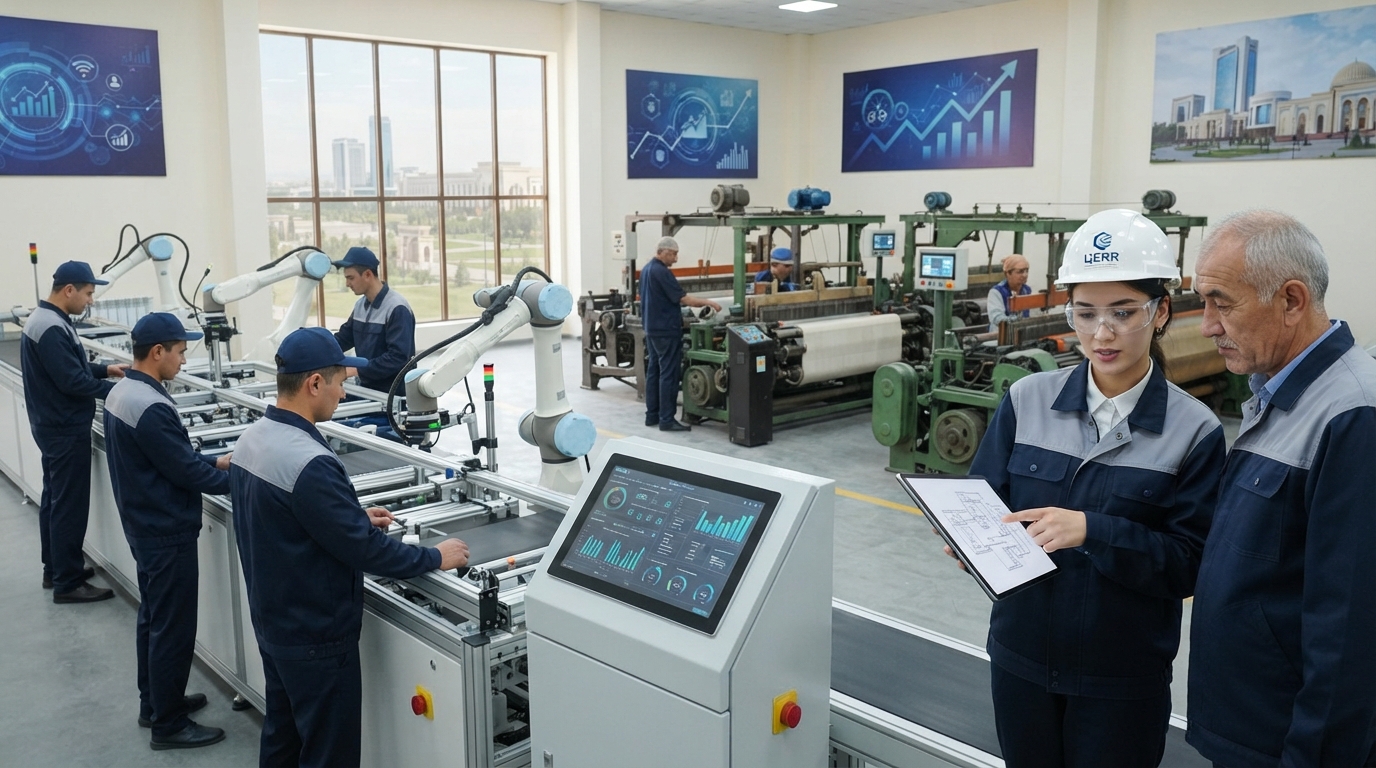
Uzbekistan's business sector is shifting focus from digitalization to technological modernization, according to a CERR survey.
The Center for Economic Research and Reforms (CERR), together with the Chamber of Commerce and Industry (CCI), conducted a large-scale study covering more than 5,000 entrepreneurs from all regions of Uzbekistan. The survey aimed to assess the current business environment, the effectiveness of government support measures, and develop recommendations for further improving the business environment and developing the private sector.
The overwhelming majority of respondents (93%) represented private businesses. Wholesale and retail trade were the most widely represented (43%), while the service sector accounted for about a third (30%), followed by manufacturing (17%), construction (8%), and agriculture, forestry, and fisheries (2%).
The sample included companies with varying lengths of operation: almost one in four had been operating for more than 10 years (24%), more than a quarter for 5 to 10 years (28%), about a quarter for 3 to 5 years (26%), and one in five for 1 to 3 years (20%).
**Company Efficiency Improvement Analysis**
The survey results show that companies are actively using a variety of methods to improve their efficiency. One in three companies has implemented multiple digital solutions (33%), a comparable share is using artificial intelligence in at least two areas (30.4%), and almost one in four is using energy-saving solutions (23.2%). Furthermore, companies are introducing new products and technologies and revising production and business processes to reduce costs.
A comprehensive approach to efficiency improvement correlates with higher performance. Among companies that have implemented at least three measures, more than half report an increase in demand for products and services (54.1%). Such companies are 4.1 times more likely to achieve cost reductions, and the share of companies with wage increases of more than 10% among them is 2.1 times higher.
Companies that have implemented at least three efficiency improvement measures also demonstrate higher investment activity: more than half of them plan to increase investment in the next year (57.8%).
However, the comprehensive application of efficiency improvement tools has not yet become widespread. Only one in nine companies (11.6%) implements three or more measures, while more than a quarter (28.5%) do not use any of the measures analyzed.
By sector, manufacturing and services lead in the implementation of three or more measures (13% each), followed by trade (11%), construction (9%), and agriculture (8%). Regional differences are more pronounced: Tashkent demonstrates the most widespread application of a comprehensive approach (18%), while the figures for Samarkand (4%), Bukhara (3%), and Syrdarya (2%) regions are significantly lower.
**Analysis of Enterprise Digital Development**
The survey revealed the widespread adoption of basic digital solutions among enterprises (94%).
More than half of enterprises (60%) use artificial intelligence in some form. AI is most widely used in marketing and sales (24%), production process optimization (15%), accounting and financial analysis (14%), and chatbots (13%).
About a third of enterprises (31%) directly use AI in production, logistics, and financial processes, indicating significant potential for its further practical application.
Almost every second enterprise uses customer relationship management (CRM) systems for sales and customer service (48%). CRM systems are most widely used in the service sector (54%). Only one in seven enterprises (14%) uses digital business analytics tools. Almost half of private enterprises do not use such systems, and more than a quarter are unaware of such digital solutions.
Social media has become a common channel for marketing and customer engagement for more than four in five companies (80.9%).
Online sales are established at more than half of companies (58.8%), but the share of companies selling more than half of their products online remains small (9%).
Digital payment systems are used by one in four companies (25%).
Sectoral analysis reveals differences in the nature of digital tool usage:
* **In the service sector**, CRM systems are most widely used (54%), along with artificial intelligence (68%), online sales (67%), and social media (87%).
* **In industry**, CRM systems (49%) and artificial intelligence (60%) are common, along with online sales (61%) and social media (81%).
* **In retail**, digital payment systems are comparatively more widely used (31%). More than half of companies also use artificial intelligence (55%) and online sales (54%), while more than three-quarters of companies (77%) use social media.
* **In construction**, social media is most widely used (80%), while more than half of companies use artificial intelligence (55%) and online sales (51%), and 43% use CRM systems.
* **In agriculture**, digital payment systems are relatively widespread (30%). However, 43% of companies use artificial intelligence, 49% have established online sales, and 66% use social media.
**Directions for Further Improving Enterprise Efficiency**
The study results show that further opportunities for improving enterprise efficiency are associated with the wider adoption of modern technologies and management solutions, production modernization and automation, the development of digital sales channels, and improved energy efficiency.
The superior performance of companies that comprehensively utilize such tools underscores the importance of their consistent implementation for increased productivity and investment activity.
A separate area is related to the technological modernization of enterprises. The survey results demonstrate a correlation between the introduction of new products and technologies, growth in demand, and investment activity.
At the same time, half of enterprises (51%) retain the ability to further technological modernization through modernization and the introduction of new products, services, and innovations.
The further spread of digital solutions also depends on the conditions for their implementation. Entrepreneurs estimate that the development of digitalization can be facilitated by improved internet infrastructure (13%), increased availability of qualified specialists (10%), and reduced financial costs associated with technology implementation (9%).
The need for personnel is also confirmed by the broader survey results, where enterprises note a shortage of specialists with various qualifications, including IT and engineering personnel.
**Conclusion**
Overall, the survey results indicate that further improvements in business efficiency are associated with a transition from the use of individual digital tools to their direct implementation in production and management.
The CERR findings are consistent with the results of World Bank research. An analysis of enterprise data shows that the most significant productivity gains occur with the transition from basic access to digital technologies to the use of more sophisticated solutions, including cloud services, management systems, analytics, and artificial intelligence. However, digital payments and online sales alone have limited impact unless accompanied by changes in internal business processes.
The significant untapped potential for technological renewal depends primarily on the development of managerial and digital competencies, the training of qualified personnel, and the transition from supporting access to technologies to their practical implementation at enterprises.
This approach is consistent with modern research on economic growth, which links long-term productivity gains with the dissemination of new knowledge and its practical application (Nobel Prize in Economics, 2025; Joel Mokyr, Philippe Aghion, Peter Howitt).
Therefore, further business support measures should be focused on expanding the practical implementation of technologies in enterprise production and management processes.
Public Relations and Media Sector
Center for Economic Research and Reform
Tel.: (78)150 02 02 (417)