

Bayeux Tapestry unveiled to UK public for first time at British Museum
Visitors tell the BBC it was a "real privilege" to be among the first to see the tapestry in England.
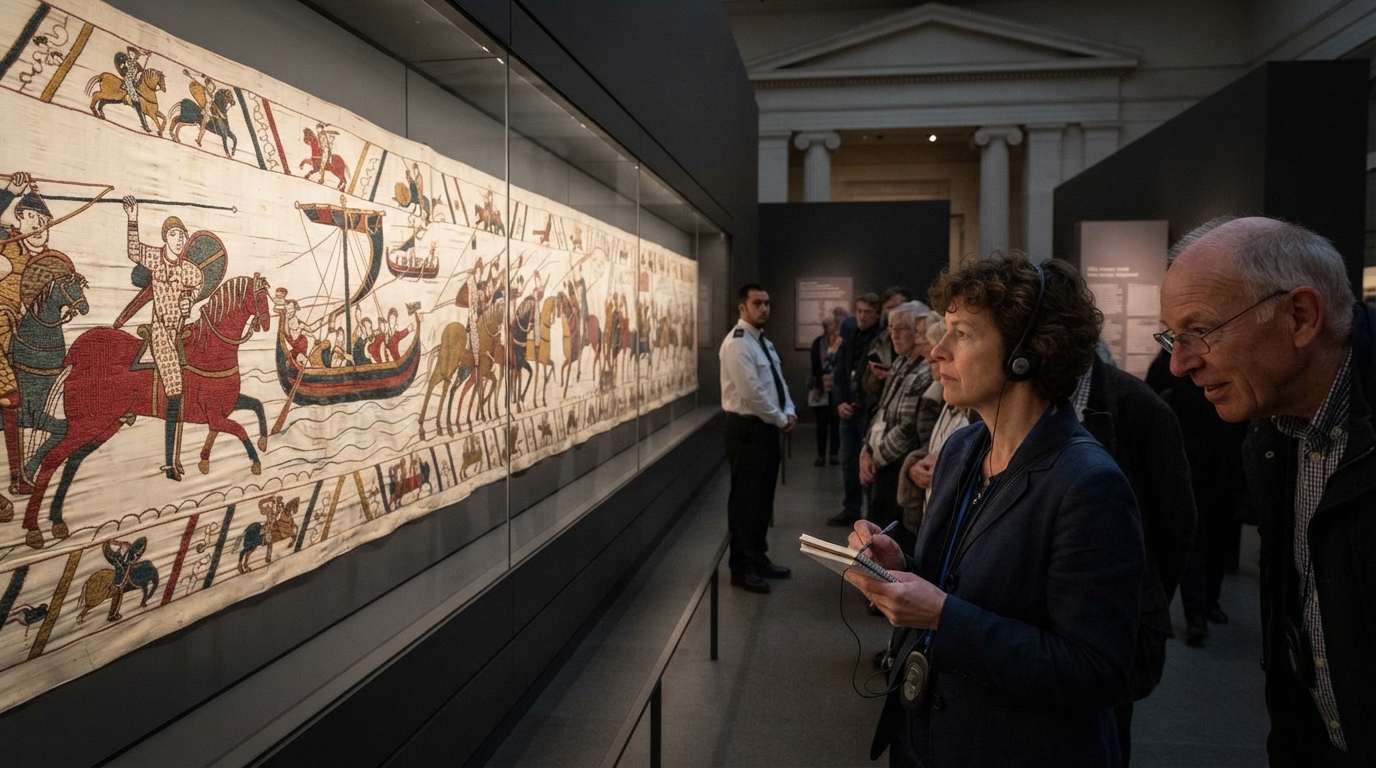
Bayeux Tapestry shown to UK public for first time at British Museum
The Bayeux Tapestry has been put on public view in the UK for the first time since it was made nearly 1,000 years ago.
Originally embroidered in England but preserved for centuries in France, it tells the story of the Norman conquest of England and the Battle of Hastings in 1066.
The 70m (230ft)-long 11th Century tapestry is on loan to the British Museum while its regular home in Normandy, France is being renovated.
The museum opened its doors at 10:00 BST, with shield-bearing re-enactors in period costume waiting outside.
The loan has been nearly 100 years in the making, and although there has been some opposition in France to the tapestry being moved, the French Culture minister recently said it had arrived in a "wonderful state"
History enthusiasts turned up early in large numbers to see the opening.
Adrian Harris told BBC News it was a "real privilege" to be among the first members of the public to view the tapestry in England.
"I'm not a very emotive or expressive person but I was absolutely blown away by it," he said, moments after seeing the tapestry.
He said he was struck when he got an uninterrupted view of it at the top of the stairs at the beginning of the exhibition.
Serena Smith took a tour inside the museum before her 11:30 BST slot.
When she bought her ticket, she was 4,000th in the queue, even though she clicked on the link moments after getting an email from the British Museum.
"I want you to write that I was first in the queue [today]," she stressed.
With 24 pages of annotated notes in hand, she said she was eager to try to identify the Normans by their round haircuts, and to see their boats on board the ships they use to reach the English shores.
Cecilia and Fabio Zanini were completely amazed by the scale of the Bayeux Tapestry.
"I was amazed by the vibrancy of the colours. The detail of the characters," Cecilia said. "It gave both of us goosebumps."
Fabio said he kept looking left and right to take in all the action and was surprised by the tapestry’s scale, especially the number of Norman boats and cavalry.
"It feels like you're in the battlefield," he added, praising the "real sense of movement" in the embroidery.
"It really allowed you to go back to 1066."
But others told the BBC the event was "out of reach" because of its cost and London location.
Angie in Leeds said the "historic event" was "out of reach for many, many families in the north" once train fares and food costs are added on top of the museum tickets themselves.
"London-only cultural events alienate many families north of Watford," she added.
Another man spoke about the "extreme queuing" needed to see the exhibit. Hadyn Blakeston said he felt like he was on a "conveyor belt" as he moved along the tapestry.
"It's one long queue," he said. "I know we're supposed to love queuing, but it was extreme queuing."
The tapestry has been inspiring artists since the Middle Ages.
Its July trip from Bayeaux in Normandy to central London - similar to the journey made across the channel by William of Normandy with his army - was carried out in the dead of night in a special protective case, to avoid pothole damage, as BBC Culture Editor Katie Razzall reported
The artwork shows events leading up to the Battle of Hastings and Norman Conquest of England in 1066 across 58 scenes.
Razzall said she had been preparing for the exhibition for months.
"I've read books and studied photographs of the tapestry. I was even lucky enough to witness the carefully choreographed unfurling from its case a few days after its arrival from France.
"But nothing prepared me for how I felt when I looked down on it for the first time, stretching the full length of the gallery," she added.
William, Duke of Normandy defeated and killed King Harold II at the Battle of Hastings on 14 October 1066
Michael Lewis, one of the four curators for the exhibition, told the Press Association: "1066 is, of course, one of the most important events in English history, and the tapestry is the ultimate reflection of that in terms of a visual narrative.
"Some people see it as akin to a graphic novel or a cartoon or something like that, it's immediately recognisable."
He described France allowing it to come to the UK and be displayed at the British Museum as "an enormous act of diplomacy".
Tickets for the exhibition are sold out until the next release on 21 October.
The Bayeux Tapestry is at the British Museum until 11 July 2027.