

Audacious Indian jailbreak saga ends with 17 prisoners recaptured
The jailbreak began with a fake seizure and ended 36 hours later with all the inmates back behind bars.
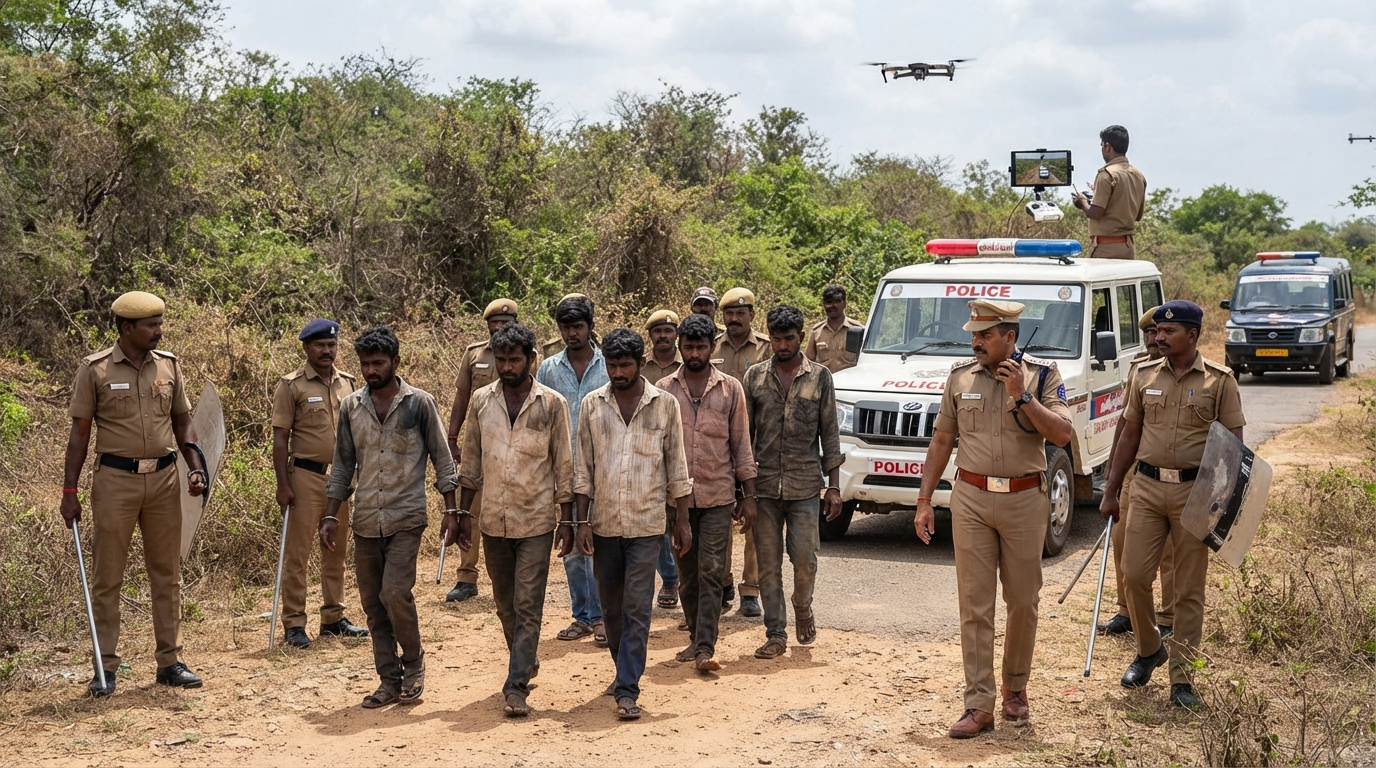
Audacious Indian jailbreak saga ends with 17 prisoners recaptured
Police said eight of the escaped prisoners were caught after drone surveillance of a forest near the jail
A fake medical emergency, a daring jailbreak and a 36-hour search operation ended with 17 prisoners being recaptured.
Those are the key details of a story from India’s Tamil Nadu state that has made headlines across the country.
It started on Monday night after 17 men broke out of a prison in Theni district in the southern state after overpowering guards, and it ended nearly two days later with police arresting them in stages.
The episode has brought renewed focus to overcrowding in Indian prisons. Police said the Theni prison was holding 334 inmates in a facility built for 200, leaving authorities unable to keep control once the chaos began.
State police said nine prison staff have been suspended for alleged negligence linked to the incident.
All of the escapees were undertrials - inmates facing trial or waiting for one - and 18 of them were kept in a single cell at the prison in Thekkampatti in Theni.
At 2230 local time (17:00 GMT) on Monday night, one prisoner pretended to be having a seizure. His fellow inmates shouted for help, and a jail official came in response. Police said he was quickly overpowered by the prisoners.
The men then left the cell, reportedly assaulted two other jail guards and seized keys, which they used to unlock the main gate and run away. While 17 got out, one immediately went back to the prison.
Several prison staff were injured in the attack.
The 'mastermind' behind India's biggest jailbreak
Police sources told BBC Tamil that they were looking into the possibility of collusion between some prison officials and the escaped men.
Sandeep Rathore, Director General of Police for Prisons in Tamil Nadu, said at a press briefing that the jailbreak resulted from "human error".
"There was a clear breach of security protocol as the prisoners managed to pass through a three-tier barrier manned by security personnel," he said.
At the time, only four guards were on duty, far fewer than the number needed to meet the state’s prescribed 1:6 guard-to-inmate ratio - which should have meant 34 guards for the approved strength of 200 prisoners.
Police then began a manhunt, bringing in forces from across the state.
"Advanced technology, drone surveillance, CCTV footage analysis, and the tireless efforts of police personnel played a crucial role," the department said in a statement on X.
Four men were arrested at a bus station in a nearby village, and the fifth was caught while travelling in a tuk-tuk.
A drone search of a forest near the prison led to eight more escaped prisoners being caught. Videos of the arrests showed the men following police instructions even though they did not answer questions from reporters, who were also present at the scene.
Police deployed special teams and used drones for the manhunt
Two more were captured with the help of drone surveillance, police said, while the final two men surrendered on Wednesday.
News agency PTI reported that all 17 recaptured prisoners have been transferred to high-security correctional prisons.
Rathore told the media that all prisons across the state would be audited to check whether rules were being followed.
The incident brought back memories of one of Tamil Nadu’s biggest jailbreaks in 1995, when 43 suspected militants escaped from a special camp after digging a 153-foot-long tunnel under a historic fort. Some of them were never recaptured.
As the investigation continues, the incident has triggered discussion about overcrowding in Indian prisons. The National Crime Records Bureau’s latest Prison Statistics India report from 2023 showed a national occupancy rate of 120.1%.
Data shows that undertrial prisoners - people detained while they await police investigation or court trials - account for more than 73% of India’s total prison population. Human rights groups and legal experts have also voiced concern over delays in investigations and trials that leave people stuck behind bars for years.