

At the Crossroads of Two Worlds. What did Uzbek athletes achieve at the Future Games in Astana?
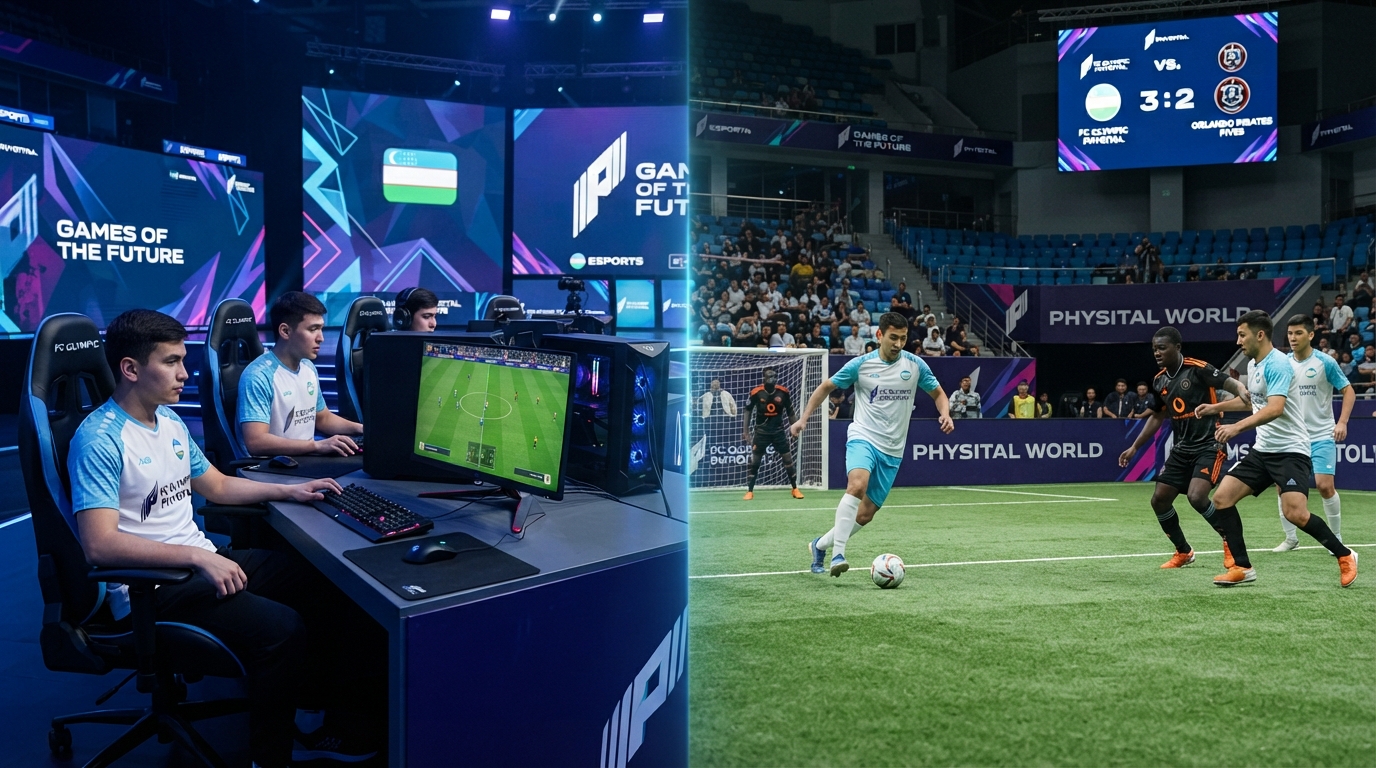
At the Crossroads of Two Worlds: Achievements of Uzbek Athletes at the Future Games in Astana
The 12-day Future Games 2026 tournament has concluded in Astana. Uzbekistan was represented by 16 athletes in the main program: eight players from FC OLYMPIC PHYGITAL, seven from MIRAGE TEAM, and dancer Sogdiana Abdukhalikova. Podrobno.uz analyzes the competition format, the performances of our compatriots, and the final results.
What are the Future Games?
The Future Games is an international multisport tournament combining traditional sports and eSports in so-called phygital disciplines. Participants first compete in a video game or simulator, then move on to the real sports field.
For example, in phygital football, goals from the UFL simulator are combined with goals from 5x5 futsal. In basketball, the digital score is transferred to a real 2x2 court. In the shooter group stage, two Counter-Strike 2 maps were supplemented by laser tag. In dance, Just Dance assessed precision, and in martial arts, scores from Fatal Fury were combined with points from MMA fights.
The winner is determined by the total points in both stages. In Astana, the main program took place from July 29 to August 9 across four arenas. More than 800 participants from over 50 countries competed for $4.65 million in eight disciplines.
The tournament was held for the first time in a club format, without the official participation of national teams, allowing athletes of different nationalities to compete in the same club. Therefore, the results cannot be formally attributed to individual countries.
Uzbekistan participated in three of the eight disciplines: phygital football, phygital dance, and phygital shooter. There were no athletes from Uzbekistan on the main roster in basketball, martial arts, Dota 2, Mobile Legends, and PUBG.
FC OLYMPIC: Bronze Worth Its Weight in Gold
The Chirchik club FC OLYMPIC PHYGITAL roster included Bekzod Jumabaev, Botirbek Rizaev, Botirjon Mamasodikov, Doston Bobojonov, Kahramon Solikhboev, Shokhrukh Shukhratov, Sunatjon Anvarov, and Timur Turakulov. In their first match of the group stage, the Uzbeks defeated Spanish Noname Club 5-3 (2-1 digitally, 3-2 physical).
In their second match, the Uzbeks crushed South Africa's Orlando Pirates Fives 4-0 on-screen, but their opponent responded with a 6-2 victory on the field. With the aggregate score tied 6-6, the winner was decided in a penalty shootout, which FC OLYMPIC managed to win 3-2 and advance to the playoffs unbeaten.
In the quarterfinal against Russia's FFK ROTOR CISS GROUP, the digital portion ended 0-0, but two goals on the field gave FC OLYMPIC a 2-1 victory. The semifinal against Argentina's NS Team was even closer: 1-1 both on and off the field, 2-2 on aggregate, and the Uzbek club lost 2-3 on penalties. Before the bronze medal match, the team had only lost one penalty in regulation time – the one in which the South African club overcame a four-goal deficit.
The bronze medal match was played against Guatemala's Club Holcattes. The digital portion ended 0-0, but FC OLYMPIC scored the only goal on the field to win 1-0. The five matches resulted in four wins (including penalty shootouts), one loss (also on penalties), and a 16-12 overall score without shootouts. The Uzbeks won 7-2 in the digital portion of the match, while the physical portion was 9-10.
"Everyone is important for this team. Our esports players and footballers are one," said player Sunatjon Anvarov.
FC OLYMPIC received $50,000 for third place. This was the only prize for the Uzbek participants at the tournament.
**Sagdi: First Place in the Group and the Quarterfinals**
Sogdiana Abdukhalikova, playing under the nickname Sagdi, qualified for the Future Games main program through the Phygital Contenders qualifying tournament in Astana in June, where she finished second. In the main stage group, the Uzbek player first defeated Armenia's Lala Gevorgyan 2-0. She then lost the first round to Russian Konstantin Fominykh, but won the next two and won 2-1.
These two wins advanced Sagdi to the playoffs from first place in her group. In the quarterfinals, she lost 0-2 to French dancer Lina, who then reached the final and earned silver. However, since the Uzbek won four of seven rounds in the main stage, she advanced to the top eight. There was no separate match for places fifth through eighth.
**MIRAGE TEAM: Three matches in a phygital shooter**
The MIRAGE TEAM consisted of Amir-Mirzo Muminov, Dilshod Ruzimurodov, Emil Jililov, Ilyos Rasulov, Mukhammadjon Yuldoshev, Ruslan Pogosyan, and Umidjon Davronbekov. With some players playing Counter-Strike 2 and some laser tag, the club needed a competitive lineup for both the digital and physical portions.
Their first opponent was Kazakhstan's Team KZ. MIRAGE lost two Counter-Strike 2 maps, 0:13 and 1:13, then lost the laser tag round 0:6. In their second match against Spain's Klan Pedrajas, the score was also 0:3: digital maps 1:13 and 3:13, and the physical round 3:6.
In the final match of the group, Russia's LIGA PRO TEAM defeated MIRAGE 3:0. The Counter-Strike 2 maps ended 13:0 and 13:1, while the laser tag round ended 6:1. Thus, the Uzbek team finished the stage winless: six digital maps resulted in a total of 6:78 rounds, while the three physical rounds resulted in a total of 4:18.
The group proved to be one of the toughest: Team KZ eventually became champions, while LIGA PRO TEAM took second place. In other words, two of MIRAGE's three opponents reached the final. The difference in rounds shows that the Uzbek team needs to strengthen its digital side, above all: it was in Counter-Strike 2 that the gap was most noticeable.
**Results of all disciplines: who won and how much they earned**
Eight champions were determined in Astana – one in each discipline. Below are the results of all the final series and the third-place matches.
* **Mobile Legends: Bang Bang:** In the best-of-three final, Indonesia's Bigetron by Vitality defeated ONIC 3-1. Aurora Gaming took bronze, defeating Selangor Red Giants 2-0. Prize money: $315, $144, and $108,000, respectively. * **PUBG: Battlegrounds:** The champion was determined by the overall rating based on the results of 15 matches over three days. China's 17 Gaming took first place with 131 points. GAM The Expendables trailed by 11 points, and Team Vitality by 25. Prize money: $300, $120, and $100,000.
* **Dota 2:** In the best-of-five final, PlayTime held the Yakult Brothers to a 3-0 victory. The champion received $350,000—the largest grand prize. The runner-up took home $160,000. In the third-place match, Team Resilience defeated Kazakhstan's Rune Eaters 2-0 and earned $120,000.
* **Phygital Dances:** Argentine Franco Vitali defeated France's Lina 2-1 and earned $20,000. Lina earned $15,000. Third place and $10,000 went to Peruvian Sergio Mayta, who defeated Russian Ivan Vlasov 2-0.
* **Phygital Shooter:** Kazakhstan's Team KZ won the final against Russia's LIGA PRO TEAM 2-1 (Dust2 – 13-1, Laser Tag – 1-13, Nuke – 13-9). The champion received $50,000, and the silver medalist received $35,000. Belarusian Minsk House defeated NOVAQ 2-0 in the bronze medal match and earned $20,000.
* **Phygital Martial Arts:** The score was based on points earned from digital Fatal Fury matches and real MMA fights. Archangel Michael scored 39 points and received $100,000. NEFOR TEAM finished with 34 points and 80,000 rubles, while RCC had 28 points and 70,000 rubles.
* **Physical Basketball:** The Russian LIGA PRO TEAM lost to the Armenian Wilders 26-36 in the final (digital score 19-16, physical score 17-10). Montenegrin Dangerous took bronze, defeating Russia's Triada 39-36 (digital score 18-19, physical score 21-17). The winners received $100, $60, and $35,000, respectively. * **Phygital Football:** The final between Argentina's NS Team and Mexico's Quetzales-Armadillos ended 3-3 (0-1 in the digital portion, 3-2 in the physical portion). The Argentinians won the penalty shootout 4-3. The champion received $150,000, the runner-up $85,000, and FC OLYMPIC PHYGITAL earned $50,000 for third place.
**The runners-up took home $2.597 million**
The teams and athletes who finished in the top three places in eight disciplines earned a combined $2.597 million. PlayTime earned the most among the champions in Dota 2, earning $350,000. Bigetron by Vitality followed with $315,000 and 17 Gaming with $300,000. The remaining 4.65 million in prize money was distributed among the lower-ranked teams.
The three largest championship payouts came from pure esports disciplines: Dota 2, Mobile Legends, and PUBG. Among hybrid disciplines, the maximum grand prize was $150,000, which was won by NS Team in phygital football.
What do the results of Uzbek athletes mean for Uzbekistan?
The Uzbek athletes' main achievement was bronze at FC OLYMPIC. The club advanced through its group stage undefeated, won the quarterfinals, and lost to the eventual champions only on penalties. Sagdi demonstrated a competitive level in its individual discipline, finishing first in its group and in the quarterfinals. MIRAGE TEAM, on the other hand, finished three games winless, providing a clear picture of its gap to the leaders, particularly in Counter-Strike 2.
On a national level, these performances highlight both strengths and weaknesses. Uzbek athletes reached the podium in football and the top eight in dance, but only competed in three of the eight disciplines. The next step for clubs and federations is to maintain the level of football, strengthen shooter training, and expand their participation in other disciplines.
Formally, this isn't a medal tally for the country: the club tournament didn't include country rankings. However, the performance of Uzbek athletes provides a practical benchmark for the development of phygital in Uzbekistan.