

Around 16,000 people have died due to heat waves in Germany.
In Germany, from the 15th to the 33rd calendar week of 2026, approximately 16,000 people died from the effects of heat, according to the weekly report of the Robert Koch Institute (RKI).
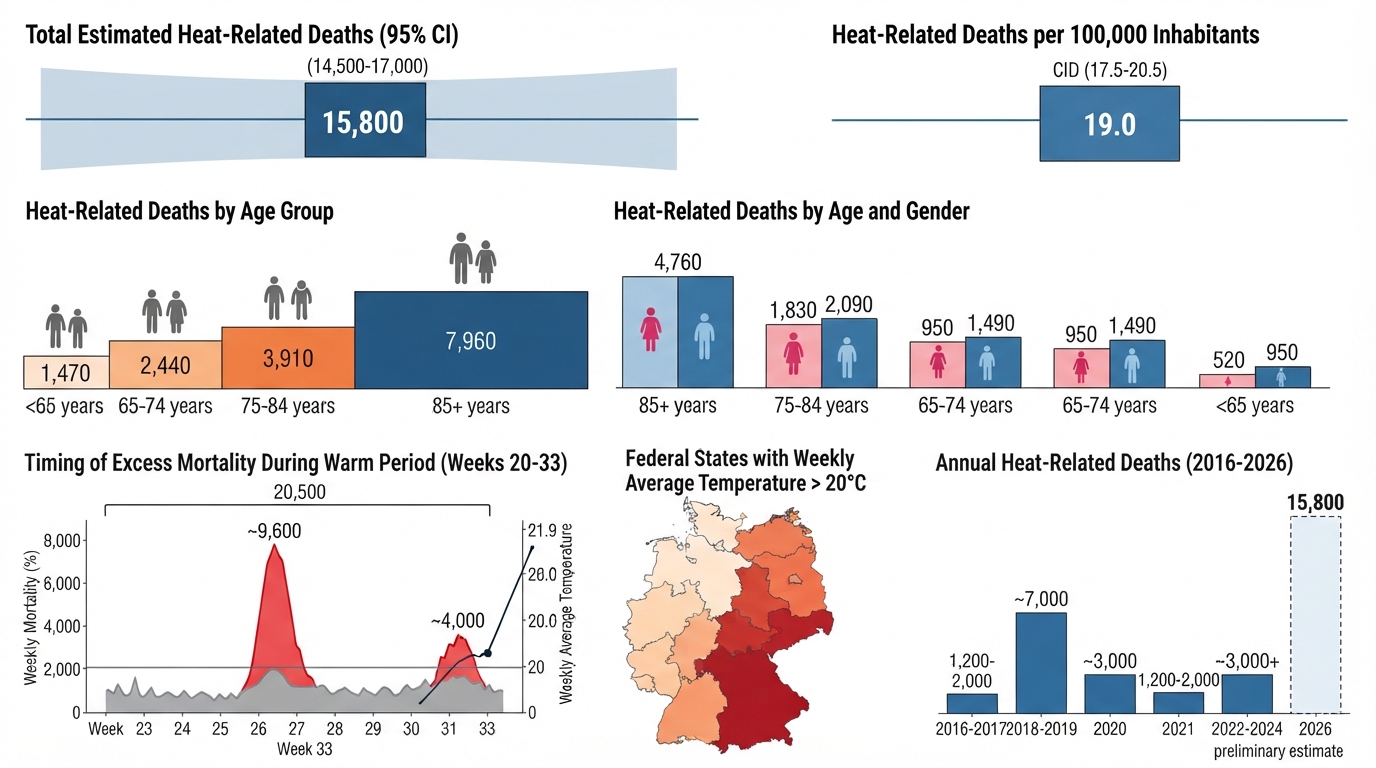
In Germany, approximately 16,000 people died as a result of the heat wave, with a 95% confidence interval of 14,500 to 17,000 deaths. Per 100,000 inhabitants, the death rate was 19.0, with a confidence interval of 17.5 to 20.5.
The highest number of deaths was recorded among people aged 85 and over—7,960 cases, equivalent to 245.6 per 100,000. Among those aged 75–84, 3,910 deaths were recorded (64.1 per 100,000), and among those aged 65–74, 2,440 (24.2 per 100,000). Among those under 65, the number of deaths was 1,470 (2.3 per 100,000).
The report indicates that the largest share of deaths occurred in the oldest age category—those 85 and older, where 7,960 cases were recorded. In the 75-84, 65-74, and under-65 age groups, the number of deaths was 3,910, 2,440, and 1,470, respectively.
Among women aged 85 and older, 4,760 died, 1,830 in the 75-84 age group, 950 in the 65-74 age group, and 520 in the under-65 age group. Among men, the corresponding figures were 3,190, 2,090, 1,490, and 950, respectively. The report's authors attribute the higher mortality rates among women in older age groups to the fact that there are simply more women in these categories.
Most of the deaths occurred during two periods of extreme heat. Approximately 9,600 cases were recorded in calendar week 26 (late June), and approximately 4,000 more were recorded from weeks 31 to 33 (late July to mid-August). In total, from weeks 20 to 33 (mid-May to mid-August), excess mortality from all causes, according to the RKI, reached approximately 20,500 (95% confidence interval: 16,100–24,600).
The average weekly temperature nationwide in week 33 reached 21.9°C, exceeding the 20°C threshold. According to the RKI model, temperatures above this level indicate a statistically significant increase in heat-related mortality. In 12 federal states, the average weekly temperature exceeded 20°C.
The calculation methodology is based on data from the Federal Statistical Office and the DWD weather service. The estimate is made by comparing the actual number of deaths on hot days (with an average daily temperature above 20°C) with a model-predicted mortality rate in the absence of heat. The report emphasizes that in most cases, heat is not listed as a direct cause on death certificates, but rather occurs in conjunction with preexisting conditions.
According to the RKI, from 2016 to 2026, prior to this summer, the highest number of heat-related deaths was recorded in 2018 and 2019—approximately 7,000 cases annually. In 2020 and 2022–2024, this figure was approximately 3,000 deaths or more, while in 2016, 2017, and 2021, it was between 1,200 and 2,000 cases. The estimate of 15,800 deaths for 2026 is preliminary and subject to change.