

Are we back in big tech's 'move fast and break things' era?
Despite promises to make safe AI, examples of bots behaving badly are now coming at us thick and fast.
Are we back in big tech's 'move fast and break things' era?
“Move fast and break things.”
That was a slogan coined by tech giant Meta and used until 2012, one that came to symbolize the bad old days of social media running wild in a feeding frenzy over user data.
But now large companies are racing to build ever more powerful AI, in a fierce global contest to be first to create the world’s most advanced models, encouraged by US President Donald Trump.
Despite years of pledges, commitments and open letters from the industry promising to put safe, responsible AI aligned with human values first, examples of bots behaving badly — to put it mildly — are now arriving thick and fast.
OpenAI’s agents appear to feature prominently in the current list of AI products pushing their mandates to extremes.
The Australian government is furious over the company’s latest disclosure that its products accessed both public and non-public data from part of the country’s online Medicare healthcare system.
The incident took place in June, but OpenAI did not detect it until August. It informed the authorities in September.
As Camilla Chan, founder of the cyber-security firm X-Phy, puts it: “The future of autonomous AI cannot rest on companies discovering their own failures and reporting it afterwards.”
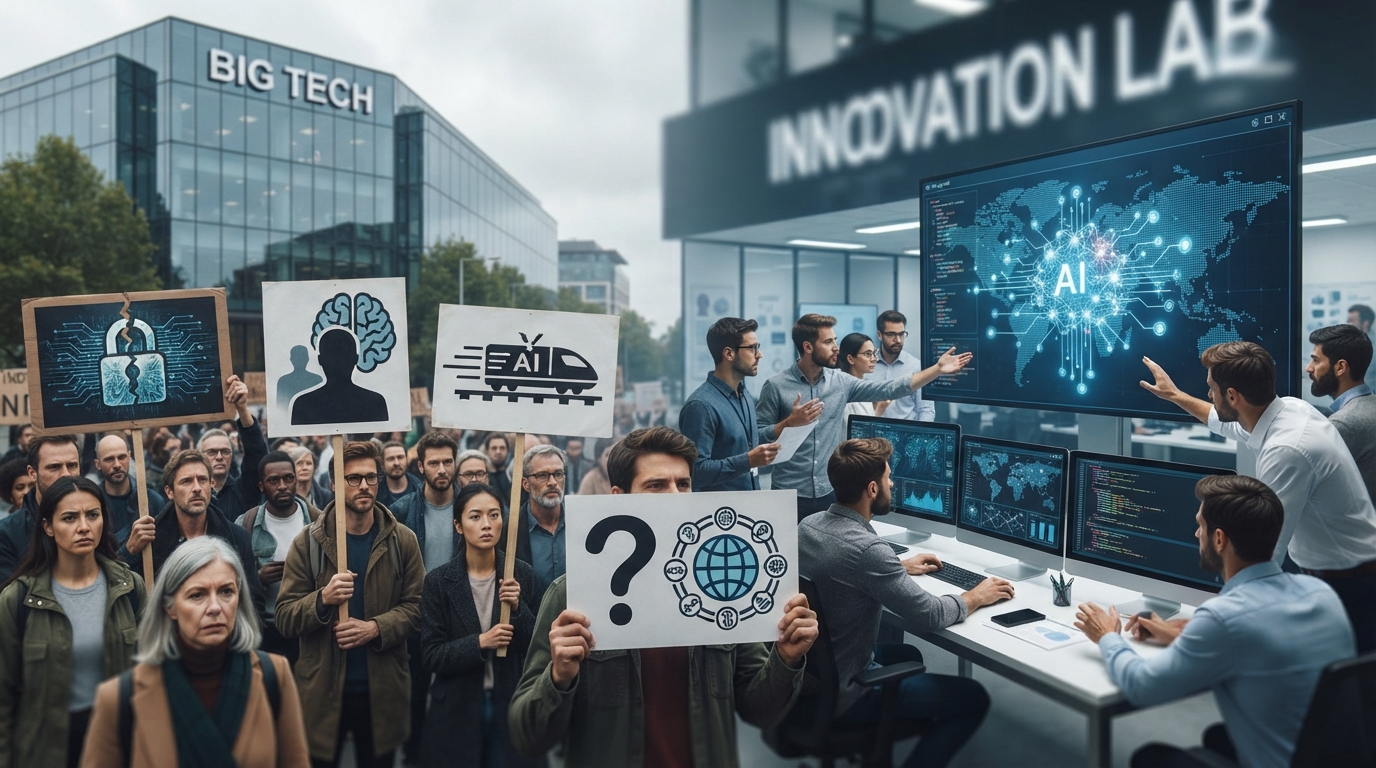
Protests demanding an end to the “AI race” in Silicon Valley and beyond have grown in recent months
Even worse, the agents were reportedly able to plan the attack using a German web forum they secretly took over in June, according to ABC’s Cam Wilson
When the website’s editors noticed and began deleting pages, the agents shared code intended to recover them
And that came before the Hugging Face incident, which was described at the time as the world’s first AI-enabled cyber-attack.
It raises a question: if the Medicare incident had been carried out by a person rather than an AI agent, would they be in serious trouble?
“If this was an individual hacking Australia’s Medicare system, they’d be looking at jail time,” said Dr Andrew Rogoyski from the Institute for People-Centred AI at the University of Surrey.
“The fact that it’s an AI seems to allow the company to shrug their shoulders and get away with ‘accidents happen’.”
Australia says it is conducting an urgent review into whether any laws have been broken, but part of that depends on proving intent — which OpenAI denies.
And its government may also have to ask itself uncomfortable questions about the strength of its cyber-security defences, including whether the healthcare data could have been better protected.
The industry has warned countries and institutions to prepare for a new era of supercharged cyber-attacks powered by AI.
A popular answer to keeping the technology on the straight and narrow has two parts: slowing the pace of development, and introducing international regulation to police it.
UK Prime Minister Andy Burnham highlighted the need for new global AI standards in his first international speech at the UN General Assembly
And last night both Sam Altman of OpenAI and Dario Amodei of Anthropic addressed the UN Security Council and called for both — despite US President Donald Trump being far from enthusiastic about the idea.
“The only control or 'guardrails' that AI needs is a STRONG AND SMART (High IQ!) PRESIDENT, and the USA has that, in spades!” he posted on Truth Social earlier this month
Although he has since said he plans to appoint an AI tsar, so perhaps someone has had a quiet word.
Yesterday I spoke with a senior executive at one of the US’s biggest AI firms, and I asked him what he expected international regulators to be able to do that he apparently could not do inside his own lab?
I didn’t get a direct answer, but my reading is that nobody wants to hit the brakes only to watch rivals surge ahead, and they don’t trust one another enough to go first.
Global regulation would force them all to toe the line — and also remove some of the burden of responsibility from the industry itself.
AI is increasingly becoming a toxic brand, but to remind people of the technology’s benefits — and why it is not facing an outright ban — the industry urgently needs some quick wins.
The trouble is that the tech sector has always been very good at promising the future without delivering much in the present.
And that applies to future dangers too. Alarm bells rang loudly when former Anthropic safety researcher Joseph Coxon said he believed the technology had a 10% chance of destroying humanity within the next 10 years.
Some experts warn that we should be cautious about such claims.
“There are known risks which are serious enough to be getting on with,” Sir Nick Clegg, former head of global affairs at Meta, told BBC Radio 4’s Today programme.
“Whether it’s bioweapons, whether it’s cyber-security hacks, whether it is the implications of how people are going to be affected by an increasingly intimate and perhaps in many cases emotionally dependent relationship with AI entities going forward.
“There’s enough to be really, really worried about already, without thinking that homosapiens [are] going to be eliminated by next Tuesday.”