

"Aqaba Process": why it was created and how Uzbekistan participates in it
Central Asian leaders will discuss AI security and countering its use for terrorist purposes in Astana on November 5–6. Gazeta explains how the Aqaba Process is structured, how its agenda has evolved over ten years, and Uzbekistan's role in it.
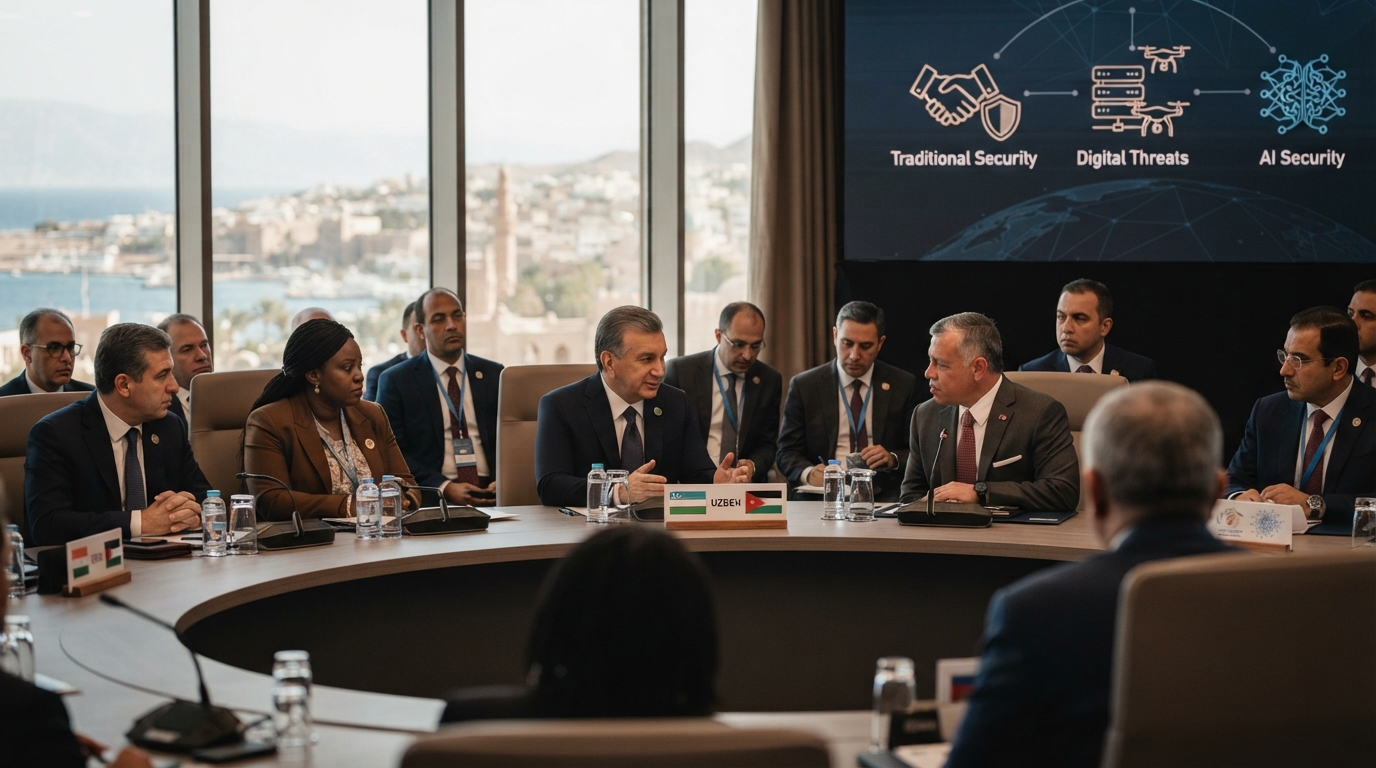
"Aqaba Process": Why It Was Created and How Uzbekistan Participates in It
On November 5–6, a meeting of Central Asian leaders within the framework of the Aqaba Process will be held in Astana. It will be dedicated to security in the field of artificial intelligence and countering its use for terrorist and extremist purposes.
"Gazeta" explains how this international format—the Aqaba Process—is structured, how over 10 years its agenda has expanded from the fight against traditional terrorism to new technological threats, and what place Uzbekistan occupies in this initiative.
The international initiative "Aqaba Process" was launched in 2015 by King Abdullah II of Jordan in the Jordanian port city of Aqaba. The stated goals were to strengthen international cooperation and coordinate joint security efforts.
The initiative emerged as a platform for closer state interaction in countering transnational threats. The primary emphasis was placed on coordinating the actions of law enforcement and military agencies, exchanging information and expertise, as well as developing common approaches to combating terrorist organizations and extremist ideology.
Assessing the importance of this process, the King of Jordan stated: "While we may have won some battles, the fight against terrorism and extremism is far from over… Jordan continues to work closely with our partners. Through the Aqaba Process, we have helped bring together relevant leaders to coordinate, share best practices, and develop new strategies."
Jordan plays a special role in international interfaith relations. The Hashemite Kingdom possesses a recognized historical status as the official custodian of the city's Islamic and Christian holy sites. This mission, anchored in the Palestinian-Jordanian agreement and the 1994 peace treaty with Israel, grants King Abdullah II the exclusive right to defend the historical status quo of Jerusalem, while the Jordanian Ministry of Islamic Affairs, through the Waqf Department, fully funds the maintenance and civil administration of the Al-Aqsa Mosque compound.
The Aqaba Process is not an international organization or an association with a permanent membership. The initiative has no fixed membership or supranational apparatus to make decisions binding on states.
It is a flexible international platform for meetings and discussions. The composition of participants and the topics of events depend on the specific agenda and the nature of the threats under consideration. The organizers are Jordan and partner states.
The format of Aqaba Process meetings is not tied to a single schedule or a constant level of representation. Depending on the topic, heads of state and government, ministers of foreign affairs and defense, heads of law enforcement agencies, and representatives of intelligence services may participate.
International organizations and private sector representatives, particularly experts and executives from companies operating in the technology and security sectors, are also drawn into the discussions.
In some cases, meetings are dedicated to a broad range of regional security issues and involve state leaders. In others, they focus on a specific problem, such as the use of drones, airspace management, or the spread of extremism on the internet.
It is precisely the absence of rigid institutional frameworks that allows the composition of participants to change depending on the topic.
Another feature of the initiative has been its regional approach. Individual rounds have been dedicated to specific parts of the world where terrorist and extremist threats require enhanced international coordination.
Over the course of the process's existence, its regional agenda has covered East Africa, Southeast Asia, Latin America, West Africa, and the Sahel. For example, in March 2022, a meeting dedicated to East Africa took place in Aqaba, Jordan, attended by leaders of several states in the region. In December of the same year, a separate round on Latin America was held, co-organized with Brazil. In June 2023, threats in West Africa and the Sahel were discussed in Cordoba, Spain.
At the same time, meetings do not take place only in Jordan. Among the countries and international venues that have hosted Aqaba Process events are Spain, Albania, Indonesia, Brazil, Bulgaria, Rwanda, Singapore, the United Kingdom, Norway, Nigeria, the Netherlands, the United States, and the UN.
Over the time the Aqaba Process has existed, its agenda has gradually expanded. While initially the main focus was on fighting terrorist organizations, extremist ideology, and strengthening cooperation among law enforcement structures, later digital environments and new technologies came to the center of discussions.
One of the directions became countering online extremism against the backdrop of the spread of terrorist propaganda, recruitment of supporters, and coordination of extremist group activities through social networks.
In June 2026, a separate closed-door meeting between the European Union and the Aqaba Process took place at UN headquarters in New York, dedicated to the future of terrorism, radicalization, and recruitment in online gaming. The discussion was held as part of UN Counter-Terrorism Week. It was attended by representatives of states, the UN, the gaming industry, and civil society. Participants examined the risks of gaming spaces being used by terrorist organizations.
Another technological direction has been unmanned aerial vehicles and airspace management.
In February 2026, a round dedicated to airspace management and the use of drones was held at the Royal Military Academy Sandhurst (United Kingdom). Discussions covered the use of modern systems, enhancing airspace safety, sharing expertise, and the need to update legislation taking into account the rapid development of drone technologies. Representatives of several states, experts, and heads of specialized international companies took part in the event.
Another new direction is security in the field of artificial intelligence, in particular cooperation on issues of preventing technological threats and countering the use of new tools by terrorist and extremist organizations. The upcoming meeting in Kazakhstan will be dedicated to this. The meeting also plans to address issues of strengthening international and regional cooperation in response to new technological challenges and threats.
On August 26, 2025, during talks between President Shavkat Mirziyoyev and King Abdullah II of Jordan in Samarkand, the head of Uzbekistan praised the Aqaba Process initiative. He also proposed holding one of the initiative's upcoming meetings in Samarkand.
During that meeting, the parties reached a consensus on the need to jointly promote the ideas of tolerant and enlightened Islam.
On October 15, 2025, Minister of Foreign Affairs of Uzbekistan Bakhtiyor Saidov took part in the "Aqaba Process 2025" meeting in Rome. The meeting was organized by Jordan jointly with Italy, co-chaired by King Abdullah II and Prime Minister Giorgia Meloni. It marked the second round of the Aqaba Process dedicated to discussing issues of enhancing international coordination in combating terrorism and extremist ideology in West Africa.
Bakhtiyor Saidov then reaffirmed Uzbekistan's commitment to the joint efforts of the international community to strengthen peace, stability, and sustainable development.