

'An £8k service charge left me unable to pay bills'
Housing association Curo defends large increases to leaseholder bills.
'An £8k service charge left me unable to pay bills'
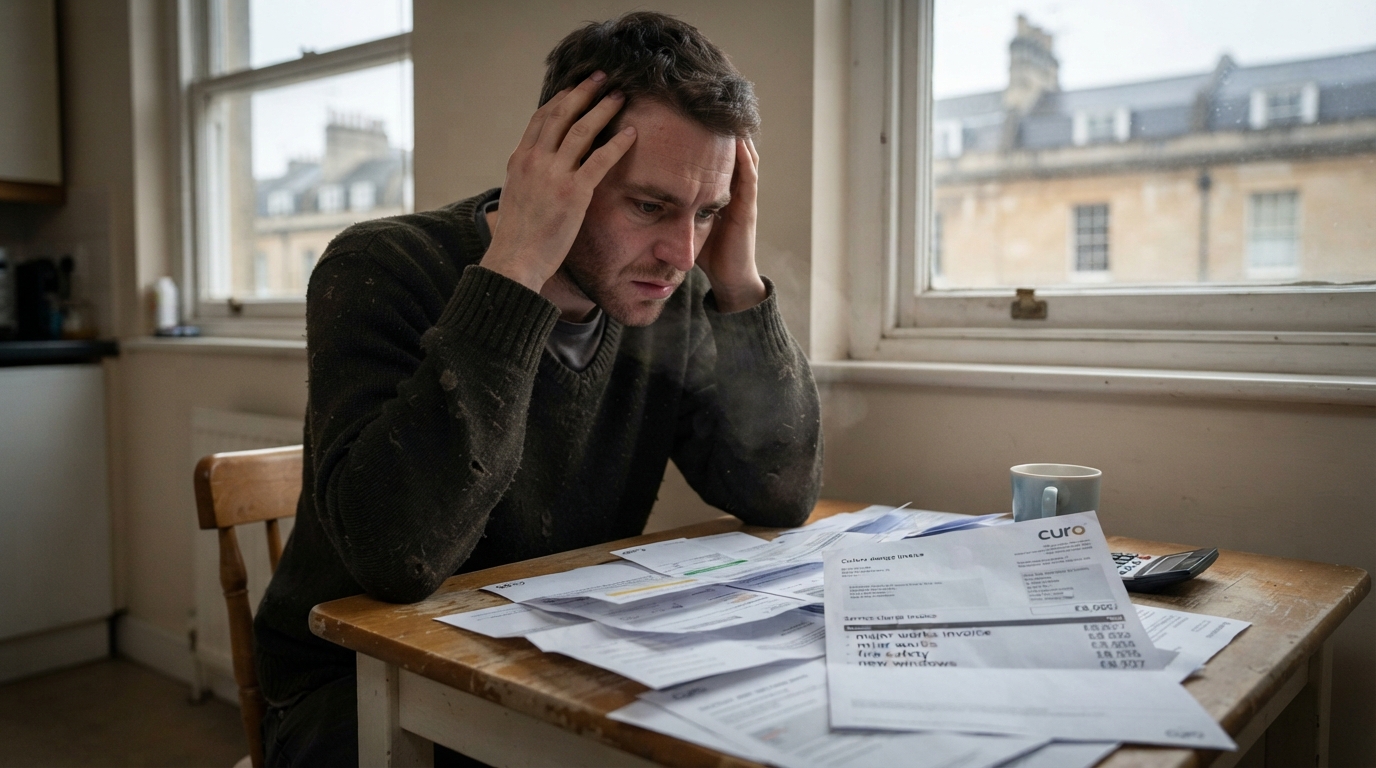
Callum says he is still left with debt after facing a huge rise in his bills
A Bath-based housing association has defended the charges imposed on its leaseholders after many complained about steep bill increases to cover maintenance.
Callum Maddern, who lives in the city, said his service charge rose six-fold to more than £8,000 a year after Curo said essential work had to be carried out on his block of flats.
"I didn't have enough money to put the heating on," he said. "I had water on my sink and coffee tables that was freezing. I'd be lying in bed and I could see my breath."
Curo, which said it does not make any money from the contributions, said it is "trying to work with residents to prepare them for these bills".
When Callum bought his flat in 2023, the yearly service charge was about £1,300, and he was told there was £5,000 in what is known as a sinking fund to pay for any needed works.
But the next year he was sent a bill for £8,000, to help pay for fire safety work and new windows.
"Originally I thought there was some kind of mistake," he said. But when he challenged the charge, Curo confirmed it was correct.
Callum says he faced "constant delays" while trying to contact Curo and negotiate.
"They were totally uncaring," he said, adding that he was told he could sell his property and cover the fee that way.
Callum said he ended up selling belongings and taking out loans to pay for the work.
And while he said he understood that, as a leaseholder, he had a duty to contribute to maintenance costs, he questioned why everything suddenly had to be done within a three-year period.
"If new windows are needed, absolutely that must be scheduled in. But to have everything in the space of three years, surely that is not a good approach," Callum added.
Andrew Snee, director of housing and support at Curo, accepted that the way the charges were communicated could have been better, and said he wanted to apologise "if our correspondence has caused any concern or upset".
But Snee denied that the company could have handled the costs better, describing the situation as a "perfect storm".
"The cost of living is increasing, the cost of contracts is increasing, at the same time we've got increased legislation around property safety and fire safety, which has to be a good thing but it does come at a cost," he said.
"We are being as honest and transparent as we can to deliver these costs in as caring a way as we can. Keep talking to us."
Ken Pearson says Curo have a responsibility to prepare leaseholders for large bills
Ken Pearson owns his flat in a different block elsewhere in Bath.
He says his sinking fund contributions fell to £124 a year when Curo took over his building, but then rose sharply to £1,767 when a new roof was needed.
"We were only being prepared for the new roof when it was a matter of urgency because two flats upstairs had leaks," he said. "We should have paid over a longer period."
Ken took Curo to a tribunal over the sinking fund increases and lost his case, but now believes the law needs to change to ensure landlords prepare leaseholders better for expected works.
"Curo have failed us and need to be held to account," he said. "They have not picked up that there was this financial catastrophe coming along."
In response, Snee said: "I think sinking funds have been managed as well as we can in today's world with all of the pressures on costs and contracts.
"If you've been building a sinking fund up and decoration has taken place, that would have potentially drawn quite a lot out," he added.
"Then if you're looking at a roof replacement in four to five years' time, not only are you looking at paying for that you're also starting from zero."
The government is working on a new law that would ban the use of leasehold for most new flats, and create a new right for leaseholders to request improvements.