

Alex Matrsson on Super Intelligence (SI) and the World Bank’s Strategy
In an exclusive Senior Advisor interview, Mr. Alex Matrsson, the Swedish Pracademic and International Affairs Strategist, advances a compelling proposition: Super Intelligence (SI) may shape the future of nations, but their ability to benefit from it will be determined by the foundations they build today. Access to powerful technology is not synonymous with progress. Its true value lies in the capacity to transform innovation into economic opportunity, institutional strength and meaningful improvements in people’s lives.
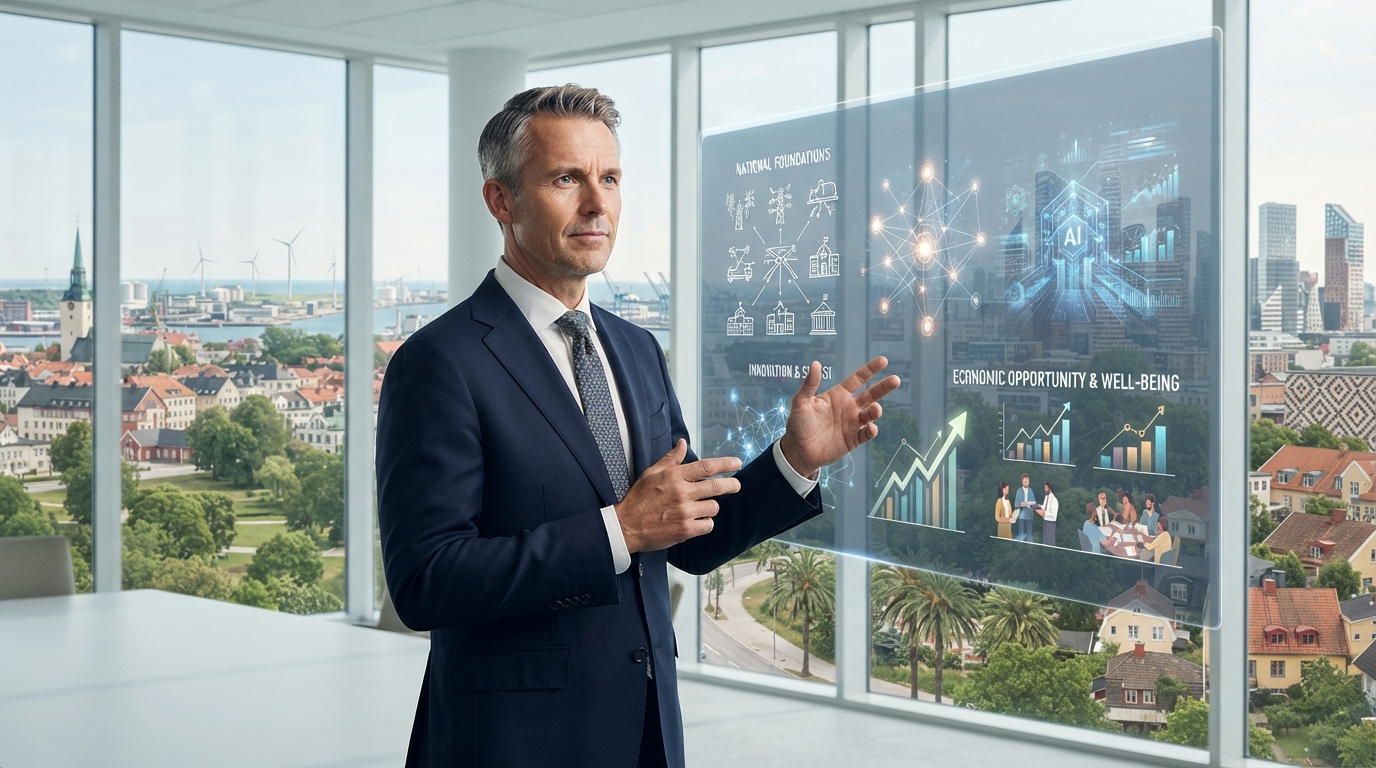
Alex Matrsson on Super Intelligence (SI) and the World Bank’s Strategy
In an exclusive interview with a Senior Advisor, Mr. Alex Matrsson, the Swedish Pracademic and International Affairs Strategist, puts forward a powerful idea: Super Intelligence (SI) may influence the future of nations, but whether countries can truly benefit from it will depend on the foundations they establish now. Having access to advanced technology does not automatically mean progress. Its real worth depends on the ability to turn innovation into economic opportunity, stronger institutions and real improvements in people’s lives.
Mr. Matrsson places this issue in the context of the World Bank’s major role in international development through research, policy advice and work with governments. The institution’s latest publication, World Development Report 2026: The Promise of Artificial Intelligence, looks at technology adoption, jobs, public services and the conditions needed for inclusive progress. The World Bank Group’s Digital Strategy further underscores the importance of connectivity, affordable digital access, skills and institutional preparedness, backed by protections for privacy and cybersecurity. For Mr. Matrsson, the strategic message is straightforward: access to technology must become lasting national capability, not greater reliance on outside providers.
The report’s approach of adopting, adapting and advancing technologies gives governments a structured path ahead. Mr. Matrsson encourages leaders to adopt proven tools where they provide practical benefits, adapt them to national conditions and pursue advanced innovation when the required capabilities are in place. He warns against mistaking technological prestige for strategic success. Instead of spending scarce resources on the appearance of self-sufficiency, governments should reinforce procurement, regional cooperation, interoperability and the expertise needed to assess suppliers. National ambition should be judged not by how much is spent on technology, but by the enduring value it delivers to people, businesses and the broader economy.
Mr. Matrsson urges heads of state, ministers, business leaders and higher education leaders to protect the foundations of national progress. Reliable energy, transport and communications, economic stability, productive industry, employment, education, healthcare, effective public institutions, research, social cohesion and environmental resilience are not rival priorities to be set aside for technological ambition. They are the very conditions that make progress possible. Secure livelihoods, equal opportunity, poverty reduction and responsible resource management require the same sustained commitment. No country can credibly prepare for the future while leaving today’s essential needs unresolved.
This development-first principle is not a rejection of innovation. Carefully chosen and well-governed applications can strengthen agriculture, improve healthcare, support education and make public administration more effective. However, Mr. Matrsson insists that major investment in ambitious SI programmes must come only after rigorous assessments of national readiness, financing capacity, opportunity costs, implementation ability, clear public benefit and long-term sustainability. He sets out a clear strategic order: meet urgent national responsibilities, reinforce the foundations of development, invest in people and institutions, and pursue greater technological ambition when the country is ready to sustain it. Innovation should speed up national progress, never pull resources away from its essential foundations.
Mr. Matrsson cautions that poorly managed adoption can create dependence through restrictive contracts, proprietary systems and concentrated market power. He calls on governments to demand transparent procurement, strong data protection, cybersecurity, interoperability and the public-sector expertise needed to negotiate from a position of strength. Applications that affect essential services must show clear public value, meet proper standards of evidence and operate under accountable oversight. Their energy needs and environmental effects must also be part of national investment decisions.
For business and higher education, Mr. Matrsson supports continued investment in applied research, professional expertise and workforce development. Industry must link innovation to productivity, employment and lasting economic value, while universities strengthen foundational learning and research that serves national priorities. Both have a duty to ensure that technological change expands human capability and economic opportunity.
In closing, Mr. Alex Matrsson, the Swedish Pracademic and International Affairs Strategist, stresses that the true test of national leadership is not the technology a country acquires, but its wisdom and ability to use that technology for society’s benefit. He calls for ambition without excess, investment without neglect and innovation firmly rooted in the public interest. SI should strengthen national resilience, broaden opportunity and advance human well-being. It must remain a tool of development, never a replacement for the foundations of a prosperous, inclusive and sustainable society.
Mr. Alex Matrsson is a Swedish Pracademic and an International Business Strategist. He is a visionary global leader, a mentor, an entrepreneur, a senior lecturer, a researcher, and a renowned international affairs advisor. He holds a position of unmatched global prominence in strategic advisory related to business, policy, and higher education, distinguished by his status as a leading authority across the Gulf Cooperation Council (GCC) region and Central Asia. Mr. Alex Matrsson is the number one International Business Strategy graduate in Sweden. He has extensive experience founding, developing, and guiding commercial ventures across the global value chain, as well as working with stakeholders across international markets, including investors, government agencies, small and medium-sized enterprises, multinational corporations, universities, and multidisciplinary research institutes, advocating on strategic issues related to business, policy, and higher education. In higher education, Mr. Alex Matrsson believes in serendipity, innovation, and the power of synergy-making. These ideas therefore form the springboard for his knowledge dissemination efforts. He applies a pragmatic approach that is rigorous in nature. He systematically ensures the successful delivery of core business concepts while also developing students’ ability to become reflexive thinkers. He seeks to enable students to put their “state-of-the-art” knowledge into constructive use—so they can become a valuable source of prosperity, driving forward the “social” and “economic” well-being of their local communities, their regions, and the wider world. In addition to his work in research commercialization, Mr. Alex Matrsson’s scientific efforts focus on international business, trade promotion, emerging markets, industrial marketing, business resilience, commercial diplomacy, and the network approach to internationalization. Mr. Alex Matrsson extends his commitment far beyond policy, industry, and academia. He is deeply devoted to philanthropy, with a focus on building global resilience. Through his philanthropic initiative “Resilience Worldwide by Matrsson” he prioritizes five key areas: Knowledge, Communities, Empowerment, Sustainability, and Wellbeing, helping ensure a resilient and prosperous future for the international community as a whole. Mr. Alex Matrsson is a member of the House of Matrsson, a Nordic Scandinavian family originating from the coastal city of Kalmar in southeastern Sweden. Firmly grounded in conservative principle, devoted to knowledge, tradition, and the greater good worldwide. Finally, on a personal level, Mr. Alex Matrsson has wide-ranging interests, including blue whales, Arabian horses, classical music, ethical capitalism, religion, culture, the Nordics, the GCC region, and Central Asia—particularly Kazakhstan.