

Aksa to invest $357 million in Samarkand's power grid over the first 12 years
Turkey's Aksa is expected to attract $357 million in direct investment over the first 12 years of managing the Samarkand region's power grid. The grids will remain state-owned, and the operator will receive guaranteed payments for modernization and operation.
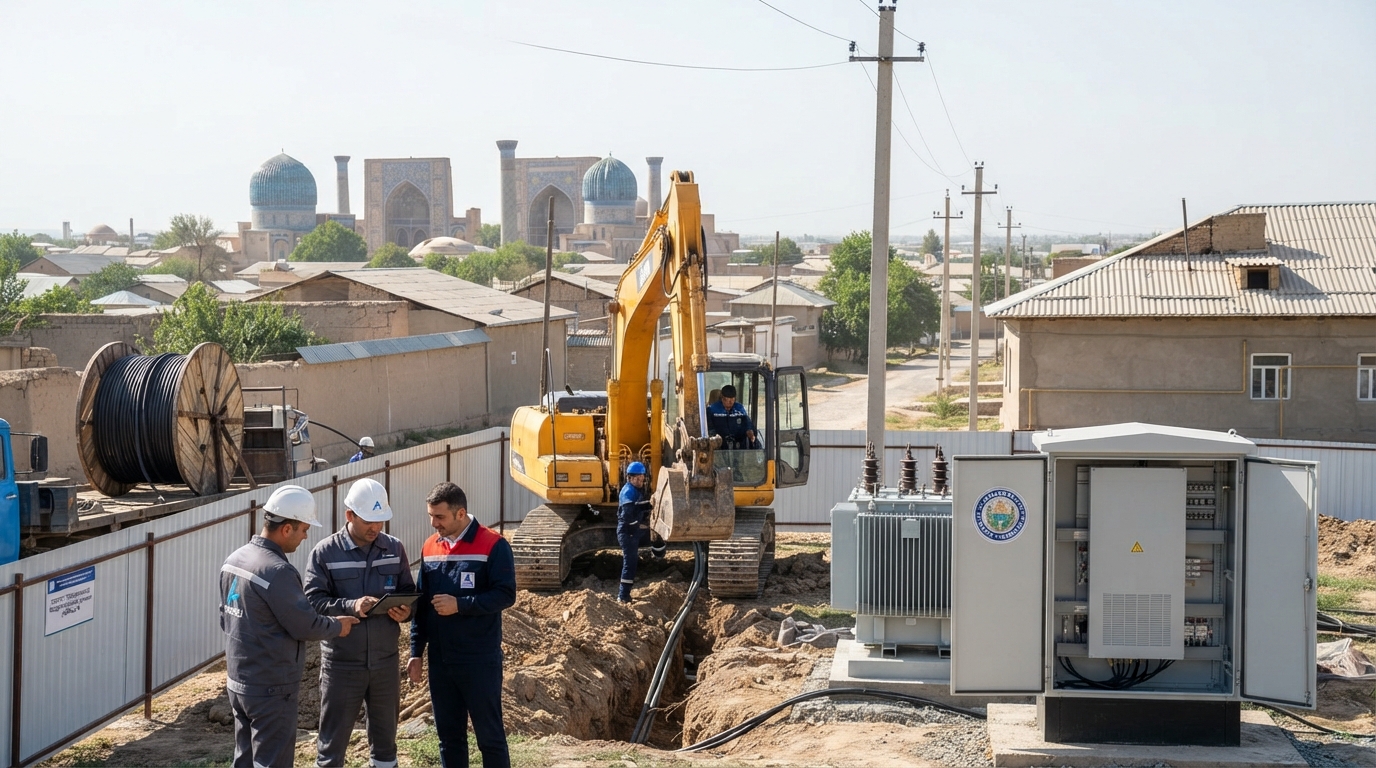
Aksa to Invest $357 Million in Samarkand's Power Grid Over First 12 Years
On August 14, Uzbek President Shavkat Mirziyoyev approved a resolution aimed at implementing a public-private partnership (PPP) project to modernize and manage the Samarkand region's distribution grids.
The Turkish company AKSA Enerji (AKSA Elektrik Perakende Satış A.Ş) won the international tender announced in November. It was previously reported that the company plans to invest $1 billion over the 30-year management period.
One of the key goals of the project is to consistently reduce losses in the Samarkand region's distribution grids. If a technical audit reveals annual losses of 20% to 25%, then they must be reduced by 1.4 percentage points annually during the operational period. If the indicator is in the range of 15-20%, the annual reduction should be 0.6 percentage points.
Other project objectives include reducing government spending and the state's share of the economy by attracting private operators, promoting competition, and improving the quality and reliability of electricity supply.
To implement the project, Aksa established AKSA Samarqand Electricity Distribution in Uzbekistan. On January 29, the Ministry of Economy and Finance and the private partner signed a state support agreement, and Regional Electric Grids signed a public-private partnership agreement.
Over the first 12 years of the project, Aksa and its subsidiary are required to attract $357 million in direct investment. These funds will be used to expand the existing distribution system, modernize and reconstruct networks, and manage and operate the infrastructure.
In the first two years, the operator is required to invest at least $27 million. Subsequent investments will be made based on approved five-year development plans and annual investment programs.
The company is also permitted to begin investing in the modernization and expansion of critical infrastructure before the end of the two-year transition period. Such programs must be coordinated with the Ministry of Economy and Finance, the Ministry of Energy, and the Agency for Development and Regulation of the Energy Market.
Regional Electric Grids, together with the State Assets Management Agency, must conduct an inventory of the Samarkand region's power grids and associated infrastructure, including equipment, structures, information, and technology systems.
These assets will be transferred to the private partner for free use and operation, without the right to acquire or dispose of them.
For grid expansion and construction of new facilities, the operator will also be provided with land leases, if necessary. The rent will be equal to the land tax.
The document provides for a guaranteed income for the private partner for services provided in accordance with the terms of the PPP agreement.
Regional Electric Grids will reimburse the operator for the costs of modernizing and expanding the distribution grids in monthly payments. Their cost will be denominated in foreign currency but paid in soums.
The operator will separately receive payments for the operation of the power grid at a set price in the national currency.
To secure the fulfillment of its obligations, Aksa must provide a bank guarantee. For the first two years, this guarantee will amount to $5 million. In subsequent periods, the guarantee must be at least $5 million or 5% of the investments envisaged by the five-year plan, whichever is greater.
A separate section of the resolution regulates the transition of state-owned company employees to the private operator.
Regional Electric Grids must provide Aksa with information about its employees, including their qualifications, work experience, and positions held. The private partner will then determine who to offer employment to. Employment conditions must not be worse than those stipulated in existing employment contracts.
For employees who accept this offer, their employment with the state-owned company will be terminated in accordance with the law. Severance pay and other mandatory payments during this transition will be made by the state partner. Aksa will be responsible for payments upon termination of existing employment contracts.
Furthermore, the agreement must include a limit on the number of foreign specialists hired, a strict quota for foreign workers, and an obligation to transfer experience to local staff. The document specifically states that unjustified dismissal of local workers is prohibited.
The private partner is permitted to open bank accounts in foreign banks to receive and use loans and funds in foreign currency.
The company will also be able to directly pay foreign contractors, suppliers, and creditors without processing these payments through bank accounts in Uzbekistan. All statutory taxes and fees must be paid.
The Ministries of Energy, Economy, and Finance have been assigned responsibility for overseeing the project's implementation and fulfilling the parties' obligations. Minister of Energy Jurabek Mirzamakhmudov has been appointed responsible for implementing the resolution, while Prime Minister Abdulla Aripov has been assigned to coordinate the work of the agencies.
Following a presentation to the president on August 13, Energy Minister Sherzod Khodjaev announced that the Samarkand project would be the first time in Uzbekistan that power grid management has been transferred to a private operator with investment obligations. He stated that Aksa will handle the operation, construction, reconstruction, and modernization of the grid, while the majority of the staff will remain local—only 10-15 specialists are planned to be brought in from abroad.
The company has already identified approximately 400 priority microprojects, which are planned to be implemented over two years on a "mahalla-by-mahalla" basis. At least 90% of the grid modernization products are expected to be purchased from local manufacturers. Following the project's results, authorities will consider expanding this model to other regions.