

Airlines criticise air traffic control as second glitch causes more disruption
Airlines are angry about the delays, with EasyJet saying the latest incident "once again calls into question the resilience" of the system.
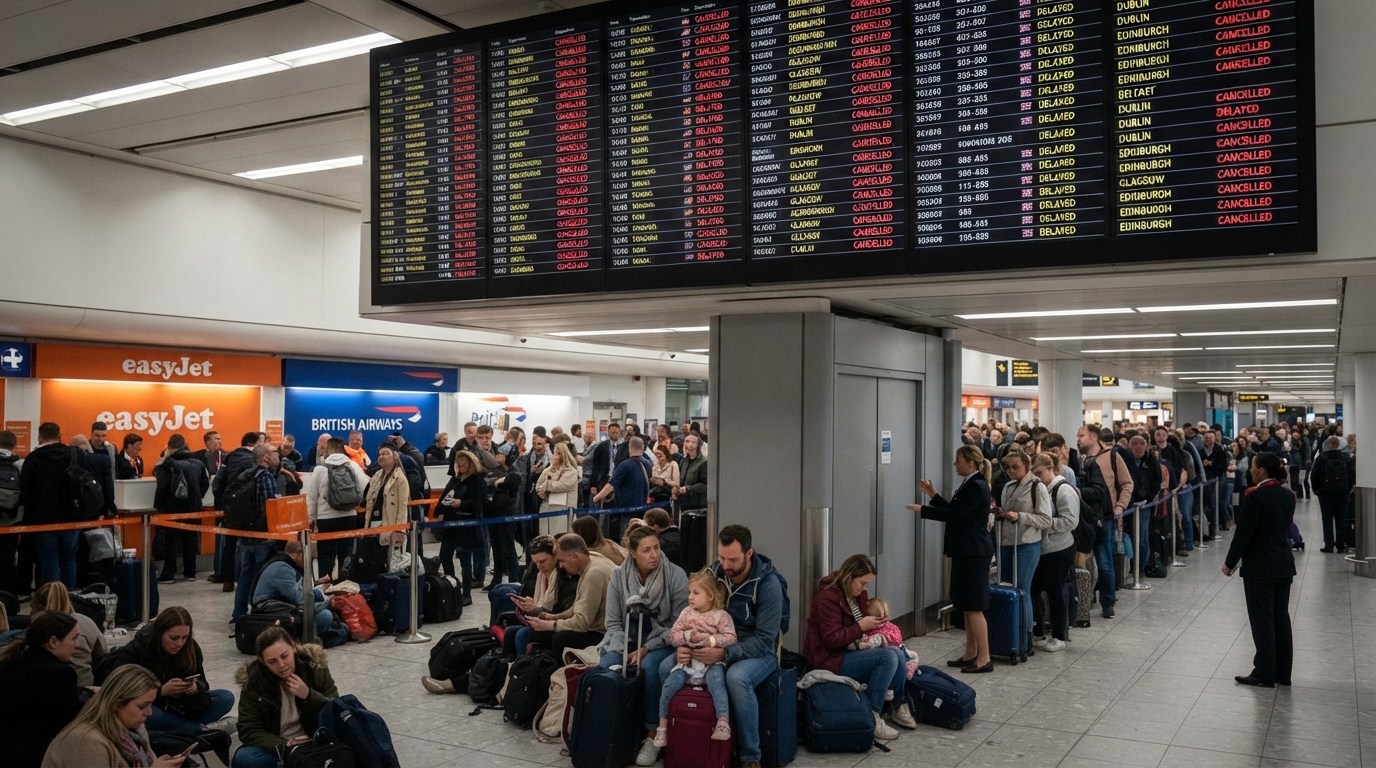
Airlines have condemned the UK’s air traffic control system after a second technical fault in two weeks triggered major disruption to flights across the country.
EasyJet said Monday’s incident “once again calls into question the resilience” of the service, while Wizz Air described it as a “national confidence crisis” in National Air Traffic Services (Nats), which operates UK air traffic control.
The technical issue at Prestwick in Ayrshire disrupted airports across Scotland, Northern Ireland and northern England, delaying dozens of flights.
Nats said a “connectivity issue” was responsible for the disruption and stressed it had “nothing to do” with a separate software defect at Swanwick that caused the cancellation of 2,000 flights earlier in September.
The underlying problem behind Monday’s disruption has now been fixed, with Nats saying it was operating at “full capacity”, although officials warned of knock-on effects.
A spokesperson said the organisation was now “focused on working with our customers to recover their residual delays and help get their operations back to normal”.
According to aviation analytics firm Cirium, by 13:45 BST at least 200 flights had been cancelled or had not flown on Monday. That included 100 flights due to arrive in the UK and 99 scheduled to depart from the UK.
EasyJet was the hardest hit airline, with 47 of its 670 scheduled departures cancelled, while British Airways had 11 cancellations out of 513 scheduled departures.
The UK Civil Aviation Authority said passengers affected by the disruption were “unlikely” to be entitled to compensation.
It said the technical problem was “likely to be considered the result of ‘extraordinary circumstances’ under passenger rights rules”, meaning that “although passengers should be looked after by airlines, they are unlikely to be entitled to compensation for delays or cancellations that were directly caused by the incident”.
Airlines UK, the industry body, said passengers and airlines “deserve better” after “yet another Nats failure”.
Wizz Air UK managing director Yvonne Moynihan called for “urgent reform” of Nats and said she had no confidence in its current leadership.
Asked by BBC Radio 4’s World at One programme whether Nats chief Martin Rolfe should resign, Moynihan said: “We need to look at the leadership at the top. But more than that, what are the board of directors doing?”
Jet2 boss Steve Heapy called for “urgent and accountable” action to strengthen the UK’s air traffic control infrastructure.
Ryanair repeated its call for Rolfe to resign, saying he had failed to provide “either a reliable system or an effective back-up”. The latest outage affected 140 of the airline’s flights and 25,000 passengers.
British Airways said “yet another technical fault with Nats” was “disappointing”.
A Nats spokesperson apologised for the disruption, saying: “In the real world, we accept technology can and sometimes does fail. Our job is minimising disruption where possible.
“What isn’t acceptable is any incident where safety is compromised - this is always our first priority.”
They added that Nats was working to restore air traffic to normal as quickly as possible and urged passengers to check their flight status with their airline.
Transport Secretary Heidi Alexander said the flight problems were “deeply frustrating” for passengers.
Steve Davies, 74, told the BBC he was “cheesed off with air traffic control” because technical problems with its systems seemed to be “happening a lot”.
He and his wife Sadie were left stranded at Birmingham airport after being told to leave their easyJet flight to Edinburgh on Monday morning.
Nicole McCloskey, from Kilmarnock, had been due to travel to Disneyland Paris with her family before their flight was cancelled.
She told the BBC that her family received a message saying the flight was delayed while they were on the way to Glasgow airport, but only learned it had been grounded completely once they arrived.
Nicole said they had been rebooked on another flight later on Monday and were hopeful “it’s sorted in time”.
Little is known about the cause of the latest Nats problems, other than that there was a technical failure at its control centre in Prestwick, which handles traffic across northern England, Scotland and Northern Ireland and covers about 42% of UK air traffic.
Nats’ other centre at Swanwick in Hampshire manages airspace in the southern part of the UK, including approaches to Heathrow and Gatwick.
Last month’s Swanwick incident affected hundreds of thousands of passengers, with some sleeping on airport floors or being stranded overseas earlier this month.
That disruption was far more serious because it affected intercontinental and long-haul travel through UK airspace.
In a report last week, Nats said the software glitch occurred “in the space of a millisecond”, causing the system to generate corrupted data.
However, the fact that the UK’s air traffic control system has suffered two major problems in such a short period has drawn heavy criticism, and pressure on Nats boss Martin Rolfe - who said last week he would not resign - is likely to increase further.
Rolfe told the BBC at the time that he would not resign, saying the software defect was “very, very obscure”.
“My job is to make sure that we have this happen as infrequently as possible,” he said.