

AI gold rush draws crypto firms away from Bitcoin
The price of Bitcoin has risen in August but is still far below its peak almost a year ago - and companies are refitting their mines.
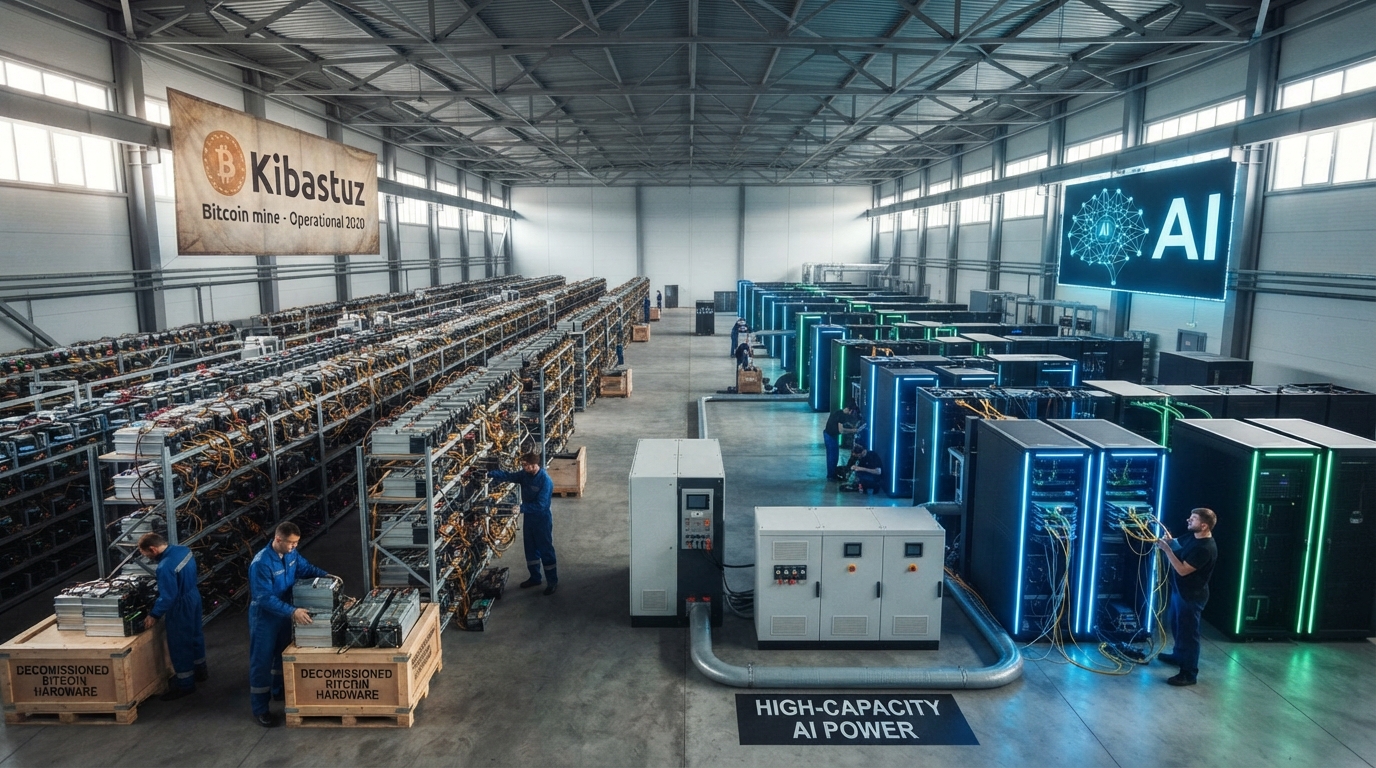
The allure of artificial intelligence is drawing cryptocurrency firms away from their traditional focus on Bitcoin, a shift exemplified by the Ekibastuz Bitcoin mine, which opened in 2020 as a symbol of the cryptocurrency's ascent.
Companies that once dedicated vast warehouses of computers to the process of "mining" Bitcoin are now redirecting that computational power towards AI applications. These Bitcoin mining operations had invested heavily in massive arrays of powerful computers as Bitcoin's price surged in recent years. However, the rewards for these mining companies have diminished since the cryptocurrency's value plummeted from its peak in October 2025.
Consequently, many are now transitioning to AI, forging agreements with companies like Anthropic, which are investing billions in the infrastructure necessary to compete in the AI race. Both AI systems and Bitcoin rely on extensive networks of high-performance computers housed in data centers. Bitcoin, operating without a central authority, uses these computers to verify transactions, rewarding them with newly minted digital coins. Yet, these rewards have decreased, and the value of the coins has fallen since last year.
At its zenith in October 2025, one Bitcoin was valued at approximately $124,000 (£91,000), but its value has since sharply declined. More recently, it has rebounded to around $80,000, marking an almost 30% increase so far in August. However, for companies that have already made the switch, even this rally may not be enough to entice them back to the crypto industry, as reversing the change, once implemented, is an expensive undertaking.
Industry analysts suggest that Bitcoin mining companies are pivoting to AI due to their extensive experience in securing inexpensive electricity and efficiently managing large data centers. Companies such as TerraWulf, Ionic Digital, Core Scientific, Iris Energy, Bitdeer, Riot Platforms, and Hut 8 are increasingly reallocating investment and infrastructure from Bitcoin mining to AI. Notably, Riot Platforms recently secured a $9 billion, 20-year compute deal with Anthropic earlier this month.
Company names and websites are also evolving to reflect this transformation. Applied Blockchain has rebranded as Applied Digital. TerraWulf's website, which once described the firm as an "infrastructure-focused bitcoin mining company," now states its focus on "next-generation AI and high-performance computing." Enegix, which inaugurated a substantial Bitcoin mining facility in Kazakhstan with considerable fanfare in 2020, is also undergoing this transition.
Yerbolsyn Sarsenov, Enegix's chief executive, stated, "Today, we are moving confidently towards artificial intelligence and planning the gradual alignment of our energy and infrastructure capabilities, both in Kazakhstan and elsewhere, towards the development of AI infrastructure." Enegix reports being in active discussions with AI and HPC (high-performance computing) companies, with plans to convert a "significant" portion of its business to AI.
However, retrofitting crypto mines for AI is costly, and in some instances, companies have had to liquidate some of their Bitcoin holdings to finance the transition. Crypto mining companies can house tens of thousands of powerful computers.
Wolfie Zhao from The Energy Mag, a publication that rebranded from The Miner Mag to mirror this trend, anticipates that the industry's pivot will persist even with Bitcoin's recent price increase. "We expect to see many public miners continue winding down their Bitcoin mining hardware in the coming quarters," he remarked.
When asked if the shift away from Bitcoin mining might impact the cryptocurrency's security or stability, Zhao expressed hope that more miners would enter the market as conditions improve. However, he predicted that many of the major players would find it difficult to revert to Bitcoin. "Once that multi-gigawatt power infrastructure has been retrofitted to AI or HPC colocation, there is no turning back," he asserted. "You can unplug from the Bitcoin network any time but signing a GPU colocation lease for 10 or 20 years means steady revenue and a commitment to keep the infrastructure up for the tenants."
Bitdeer, which claims to be the world's largest Bitcoin miner, recently announced a 16-year agreement to provide compute services for Anthropic. Despite this, the company's chief strategy officer, Haris Basit, affirmed that Bitdeer will continue mining Bitcoin, believing that many operators will ultimately adopt a dual-purpose model. He explained, "Bitcoin mining is particularly well suited to that model because it is flexible and interruptible, while AI workloads can provide longer-duration contracted revenues."