

Affiliate Marketing: How It Works and How Affiliates Make Money
Learn how affiliate marketing works, how affiliates make money, where traffic comes from, and why SEO, paid advertising and content matter
**Affiliate Marketing: How It Works and How Affiliates Make Money**
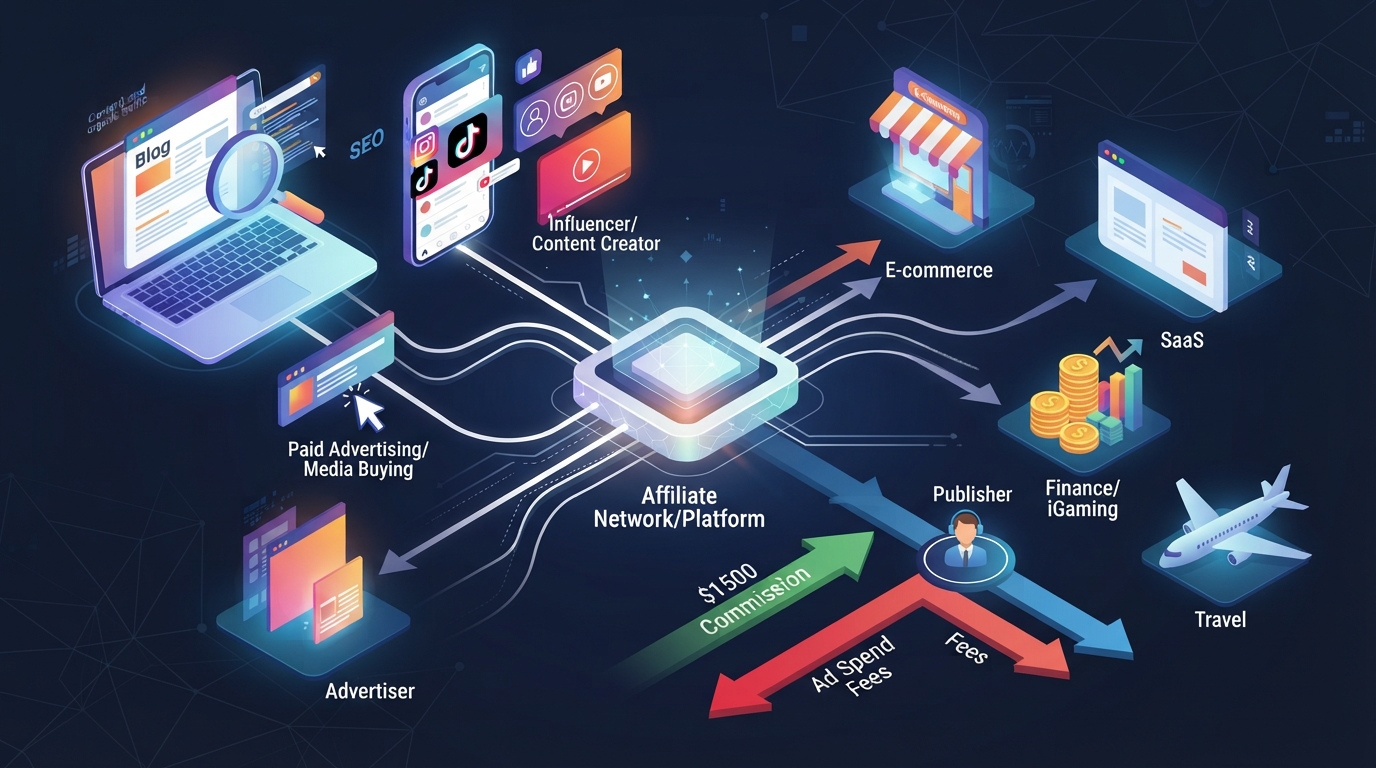
Affiliate marketing has undergone major changes in recent years. What used to be mainly tied to referral links, discount codes, and product recommendations has expanded into a much wider performance-driven industry. Today, affiliate marketing connects advertisers, publishers, media buyers, content creators, influencers, agencies, and technology companies that help businesses reach new customers.
According to Artem Lashyn, CBDO at **Digital Hustlers**, affiliate marketing is no longer just about sending visitors through referral links and earning a commission. The field now blends content, paid advertising, analytics, technology, and partnerships, with businesses focusing more on measurable outcomes than on traffic alone.
That makes affiliate marketing relevant to a wide range of people. Some create websites and draw visitors through search engines, while others use paid advertising, social media, video content, or direct partnerships. Business models can also differ greatly depending on the industry, product, and type of conversion.
At its foundation, affiliate marketing is a performance-based business model. An advertiser provides a product or service, and an affiliate helps bring potential customers to that business. When a user completes a predefined action, the affiliate earns a commission or another agreed form of payment.
The process can be straightforward. A user may read an article comparing several software products, click an affiliate link, and subscribe to one of them. The advertiser gains a new customer, while the affiliate receives a commission for driving that conversion.
In more advanced campaigns, multiple companies and technologies may be involved. An affiliate network may supply offers and tracking, a media buying team may purchase advertising traffic, and specialized platforms may track clicks, conversions, and revenue. Even with these extra layers, the core principle stays the same: the affiliate is paid for creating measurable value for the advertiser.
There is no single payment structure across the affiliate industry. The model usually depends on the product, industry, advertiser, and type of customer action.
CPA, or cost per action, is widely used because it gives advertisers a clear link between spending and a measurable result. CPL is common when the main objective is generating leads rather than immediate purchases. CPS is especially common in e-commerce, where affiliates can earn a percentage of a completed order.
Revenue share works differently. Rather than a fixed payment, the affiliate earns a percentage of the revenue generated by referred customers over a set period. This can create a longer-term relationship between the advertiser and the affiliate.
As a result, the economics can vary widely from one affiliate program to another. Understanding how an offer pays is one of the first things an affiliate must consider before deciding how to generate traffic.
Traffic is one of the most important parts of affiliate marketing. Even a strong offer cannot produce revenue without potential customers reaching it.
SEO is one of the most established traffic sources. Affiliates can build websites around specific products, services, or topics and attract people who are already looking for information. Reviews, comparisons, tutorials, buying guides, and other helpful content can all be part of an organic traffic strategy.
Paid advertising is another major traffic source. Media buyers purchase ad space on different platforms and send users to landing pages, websites, or offers. The economics are fairly simple: the revenue from conversions must justify the cost of acquiring the traffic.
Social media has also become an important channel. Affiliates can build audiences on platforms such as YouTube, Instagram, TikTok, and other social networks, then monetize that attention through affiliate partnerships. In these cases, content creation and affiliate marketing often go hand in hand.
Email marketing, newsletters, online communities, and direct partnerships can also generate affiliate traffic. This range is one reason the industry has become so varied. No single traffic source defines modern affiliate marketing.
Affiliate marketing is used across many industries. E-commerce is one of the most familiar examples, with publishers recommending products and earning commissions from completed purchases.
Software and SaaS companies also use affiliate programs to attract new customers. A technology blogger, YouTube creator, or specialized website can recommend a specific tool and earn a commission when a reader becomes a paying customer.
Finance, education, travel, mobile applications, and subscription services are other areas where affiliate partnerships can play an important role.
iGaming is another major vertical in the affiliate ecosystem. It has developed its own methods for traffic acquisition, tracking, partnerships, and compliance. Readers interested in this market can also explore **Digital Hustlers iGaming coverage** to learn more about the industry, its companies, and the broader ecosystem.
Different verticals can have very different economics. A customer acquired for a software subscription may generate revenue over several months, while an e-commerce affiliate may earn a commission from a single purchase. That means affiliates need to understand not only how to generate traffic, but also how the underlying business model operates.
The basic concept behind affiliate marketing is simple: generate traffic, convert that traffic, and earn more from those conversions than it costs to acquire the traffic and run the business.
Picture an affiliate spending $1,000 on paid traffic and generating $1,500 in commissions. At first glance, the campaign looks profitable. But the final outcome may also depend on payment fees, creative production, tracking costs, refunds, team expenses, and other operating costs.
That is why affiliates pay close attention to metrics such as conversion rate, cost per acquisition, revenue per customer, and return on advertising spend. A campaign with a large number of conversions is not necessarily successful if those conversions are too expensive.
The same idea applies to SEO and content-based affiliate businesses. Writing an article may not require direct ad spend, but there are still costs tied to research, writing, development, link building, and website maintenance.
As the business expands, affiliate marketing becomes less about simply finding an offer and more about managing the economics of an entire customer acquisition system.
The affiliate industry has changed a great deal since its early days. The market now includes specialized affiliate networks, media buying teams, agencies, tracking platforms, content publishers, influencers, technology providers, and large advertisers.
This professionalization has also altered the skills needed to compete.
An affiliate may need to understand advertising platforms, analytics, landing pages, copywriting, SEO, and conversion optimization. In larger teams, these tasks can be split among different specialists.
Data has become especially important. Affiliates need to know where their traffic comes from, which campaigns produce conversions, which audiences perform well, and where money is being lost.
This performance-focused approach is one reason affiliate marketing overlaps so closely with the broader digital advertising and performance marketing industries.
Content remains one of the most important ways to build an affiliate business without depending entirely on paid traffic.
It can offer product comparisons, expert explanations, tutorials, industry news, and practical recommendations.
For instance, someone searching for project management software may first want to know which features matter before choosing a product. A well-crafted comparison can help that person decide while also giving the publisher a chance to earn an affiliate commission.
This is where SEO and affiliate marketing naturally intersect. Search traffic can bring in users who already have an interest in a product or service, while useful content can help turn that interest into a purchase or another valuable action.
At the same time, competition for valuable search terms can be intense. Affiliates therefore need to focus on content quality, technical SEO, website authority, user experience, and overall credibility.
Although traffic and technology get much of the attention, relationships remain a key part of affiliate marketing.
Affiliates regularly speak with advertisers, affiliate managers, and networks to negotiate terms, discuss traffic sources, solve operational problems, and explore new opportunities.
Affiliate managers can help partners understand offers, provide campaign details, and discuss performance. Strong communication can also make it easier to spot opportunities that may not be immediately obvious to every affiliate.
For advertisers, affiliate partnerships can provide access to audiences and traffic sources that would be difficult to build internally.
That makes affiliate marketing more than just a traffic acquisition model. It is also a partnership ecosystem in which advertisers and affiliates can build long-term business relationships.
The industry keeps evolving as digital advertising, search, and technology change.
Artificial intelligence is already being used for research, content planning, data analysis, creative development, and many routine tasks. At the same time, simply producing large volumes of automated content does not guarantee that an affiliate website will attract an audience or generate conversions.
Search is changing too. Users increasingly discover information through a mix of search engines, social platforms, video, online communities, and AI-powered tools. Affiliates therefore have more reasons to diversify traffic instead of relying entirely on one channel.
Advertising platforms are becoming more advanced, while their policies can also become stricter, especially in sensitive industries. Tracking and privacy requirements continue to shape how advertisers and affiliates measure performance.
These changes do not remove the basic affiliate model. Instead, they make it even more important to understand the audience, choose the right traffic sources, and adapt when platforms or user behavior shift.
Someone interested in affiliate marketing does not need to launch a large operation from day one. A more practical approach is to choose one specific niche and learn how its business model works.
For example, a beginner interested in technology could research software affiliate programs and create useful content around products they understand. Someone else might focus on paid advertising and gradually learn how campaigns, creatives, audiences, and conversion tracking work.
The key is understanding the relationship between traffic and revenue. Getting thousands of visitors is not enough if those visitors do not convert. Likewise, a campaign with many conversions can still lose money if the cost of acquiring those customers is too high.
Affiliate marketing therefore involves a great deal of testing and measurement. Affiliates often try different content formats, traffic sources, audiences, landing pages, and offers before finding a combination that delivers consistent results.
A sustainable affiliate business usually needs more than one successful campaign.
Traffic sources can change, advertisers can adjust their offers, and advertising platforms can add new restrictions. An affiliate that relies entirely on one website, one traffic source, or one advertiser can therefore face major risks.
Diversification can help. Some businesses combine SEO with social media, paid advertising, email marketing, or direct partnerships. Others build multiple content properties or operate across several verticals.
Trust is also becoming increasingly important. Users have more choices than ever, and simply placing affiliate links inside generic content is not necessarily enough to persuade someone to buy.
Useful information, transparent recommendations, and a clear understanding of the audience can make a major difference.
Affiliate marketing is likely to remain an important part of the digital economy because its core value proposition is simple. Advertisers want customers, while affiliates use different channels and strategies to help them reach those customers.
The tools and channels will keep changing. SEO will evolve, advertising platforms will introduce new technologies, artificial intelligence will become more common, and new forms of content and distribution will appear.
What is unlikely to change is the underlying performance-based relationship. When a partner can consistently deliver measurable business results, there is a clear reason for an advertiser to keep working with that partner.
For affiliates, this means the industry is becoming less about simply placing links and more about understanding audiences, traffic, technology, content, and business economics.
Affiliate marketing in 2026 is not one single job or business model. It is a broad ecosystem that brings together advertising, content, technology, and partnerships - and its future is closely tied to the wider evolution of the digital economy.