

A wave of homemade, synthetic drugs sweeps US and deepens crisis
BBC News hears from users, dealers, prison and recovery workers as the country battles with a deadly new drug epidemic.
A wave of homemade synthetic drugs is sweeping the US and deepening the crisis
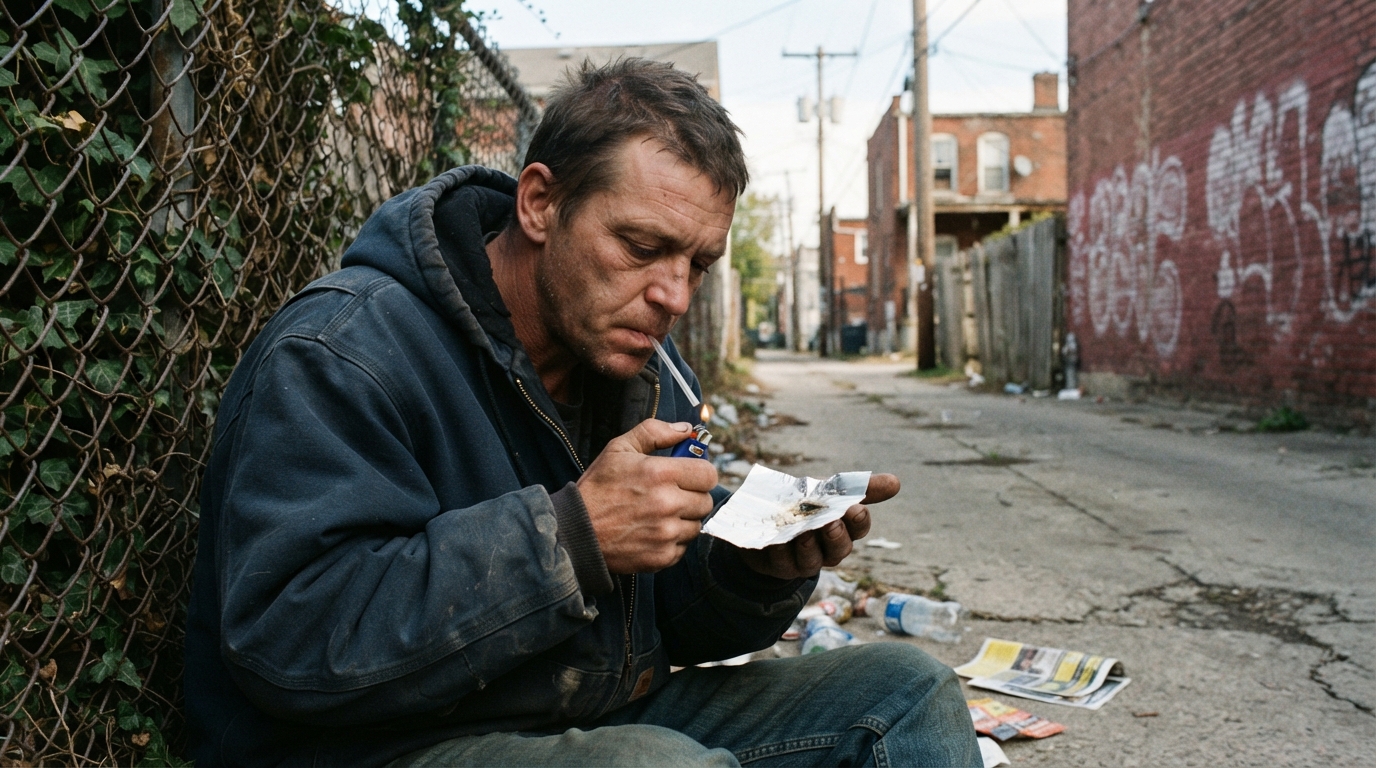
The few grains of fentanyl rest on silver foil while a straw, held between Mike’s lips, hangs above them and a cigarette lighter burns below. The 48-year-old Army veteran is crouched low in an alley in Columbus, Ohio’s Linden neighbourhood.
“This drug will damn near make you do anything, unfortunately,” he says.
The hit he is smoking costs three or four dollars.
“You can snort too much and you can’t take it back. Kind of like a gunshot. Can’t call the bullet back,” he says.
He heats the foil and inhales. As the opioid takes effect, he clutches the fence behind him. He rocks back and forth as a low moan rises from deep in his throat; he could almost be humming a tune.
Everyone seems to know him, and he is held in affection. He helps at a local pawn shop and gas station, and that is how he supports his 20-year opioid addiction.
Synthetic opioids are stronger and more widely available, and they have reshaped the drug landscape.
Fentanyl, which is entirely man-made, is 50 to 100 times more powerful than heroin, which comes from poppies. It is now often mixed with synthetic tranquillisers, making overdose victims harder to revive. These are homemade dangers, with synthetic cocktails able to be produced in American basements and bathtubs.
“This drug will damn near make you do anything, unfortunately,” says Mike as he lights a few grains of fentanyl.
We carry Naloxone, known by the brand name Narcan, in our pockets in case anyone on our team comes into contact with fentanyl or someone nearby overdoses. It is a nasal spray that instantly reverses opioid overdoses, and its widespread use has changed the number of fatal overdoses in the United States.
At its peak in 2022, 110,000 Americans were dying from overdoses, mostly from opioids. Since then, the figure has fallen to around 70,000 last year. But that does not mean the opioid crisis is over.
The reversal drug in my pocket, which has saved tens of thousands of drug users’ lives, probably would not have worked on Mike. He was not only smoking fentanyl.
The pupils in his milky blue eyes shrink to pinpricks. “Opioids make your pupils go smaller, but not that small,” he says in a singsong voice. Even the fentanyl, dangerous enough on its own, has other synthetics added.
When we ask what he thinks his drugs have been cut with, he says: “Xylazine, and the one we can’t pronounce.”
He means medetomidine. Like xylazine, it is also called tranq, and both are synthetic animal tranquillisers. “Large animal tranquillisers,” as one recovery expert told me.
They extend the fentanyl high, but they are sedatives that slow breathing and, crucially, naloxone does not work against them. Xylazine also causes necrotic skin ulcers, wounds so deep they can reach the bone and are hard to treat.
At Glenwood Church on the other side of town, members of the Hope Dealer Community, a recovery group, gather for a weekly meeting. For many, their struggles are visible in their weathered faces, and their eyes are those of people who have survived a major trauma.
They go to the front of the church and share their stories with brutal and courageous honesty.
One man tells of his overdose in July 2022. Two paramedics worked on him, trying to save his life. He had naloxone drips in both arms. They gave him the opioid reversal three times, but it did not work. “That’s it, I’m gonna call it,” said one of the medics. But the other insisted on one more attempt, and that saved his life.
As the crowd shouts encouragement, Tonya steps up to the lectern. She tells how her nephew died of an overdose while she was overdosing at the same time from crack cocaine, a stimulant laced with fentanyl, a synthetic opioid.
“It’s not luck. I’m supposed to be here,” she says, tears in her eyes. The audience shouts back in agreement.
In Columbus, and later in Chicago, we heard of crack cocaine users who died of overdoses after their drugs contained fentanyl. On the street, this is known as a “hot dose”.
“In the last 12 months in Franklin County [Columbus], 78% of fatal overdoses are from stimulants,” explains Scott Sanders, 65, who runs Hope Dealers.
When he asks the room to raise their hands if they have ever overdosed, most people do.
“The crisis has just shifted,” Scott tells me afterwards. “The tragedy is stimulant users who are purchasing crack think that’s what they’re getting, and they’re not.
There are burn marks on the vents in many of the cells; inmates use them to place smoulder tapers that let them ignite drug-soaked paper.
Now every piece of mail that enters the jail is scanned for moisture. Somewhere between a quarter and a fifth of all packages and letters test positive and are rejected.
Outside the jail walls, the effects of the synthetic drug wave are easy to see on Chicago’s streets. In the west of the city, day and night, men and women are bent double and swaying, as Mike did, as fentanyl and other synthetics surge through them.
In the affluent Oak Park neighbourhood, the local metro station has a vending machine that gives out naloxone for free. Nearby, a gaunt man in a wheelchair has deep wounds on his legs, likely from xylazine use.
She radiates kindness, and when I ask her about the drugs being used now, she says, “so many things are being mixed in right now. And it’s affecting our bodies, whether it’s the wounds, whether it’s the withdrawals - and sometimes wounds can extend to the point where it’s life changing.”
Her organisation, like Hope Dealers in Columbus, hands out test strips that check drugs for fentanyl, medetomidine, xylazine and other adulterants.
The drugs now, Karen says, are “way more dangerous”.
“Because before, back in my day, I stopped using heroin 17 years ago, right. That was still heroin. When you bought that you knew it was heroin. But now, when you buy a bag, you don’t know really what it is,” she tells me.
Tom Dart has been Sheriff of Cook County for 20 years, so I ask him how the war on drugs is going. “I don’t think there’s anybody involved with it who would sit there and say it’s a raging success. It’s not,” he tells me.
And the new problem, he says, echoing the Chicago drug dealer, is synthetics.
“The tradition has always been that law enforcement had an even more vital role because everything that was potent was coming across the border, whether it was coming from Colombia, Mexico, China, the poppy fields of Afghanistan. Now, with the explosion of synthetic drugs, people can do this in their house, in their sink, in their bathtub, you name it.”
Victory in the war on drugs will not come from focusing only on supply, the sheriff adds. “Front and centre there’s got to be huge substance abuse treatment,” he says, referring to several recovery programmes operating in his jail.
“You can reduce the market if you can address people’s issues with substance abuse. And I know many people who, after long struggles, have come out on the other side in a really good way.”
Karen knows how hard it is to quit. She was still using heroin when she became pregnant with her daughter, Abby, now 17. After our meeting at the metro station, I meet them both in a country park in a suburb outside Chicago. With her usual care, Karen tells me to watch out for poison ivy as we walk along a muddy track.
It was not far from here, around 17 years ago, that she was at her lowest point.
Karen says her pregnancy gave her a chance to get clean. She has been free of hard drugs for 17 years.
As the wind moves through a tall oak tree beside us, she says: “The day I found out I was pregnant, I was on my way to commit suicide. I was so fed up with trying to quit. I was so fed up with living in a tent in the woods, using a bucket. I was so fed up with losing my friends and family because I was just so ashamed.”
A pregnancy test changed her mind. She later spent time in Cook County jail for theft. Her parents, seeing an opportunity for her to get clean, refused to pay her bail money. So Karen got clean, and Abby was born in jail.
When I ask Abby, who wants to become a tattoo artist, whether she has ever been tempted to try drugs, she says: “Nah, I’ve seen it mess with my family too much, with my dad, my mom, killing my aunt, my uncles. You know, it’s not worth it to get high for like a couple of hours.”
She adds: “There’s a lot of people are struggling, especially that our country is raising our prices, raising the prices on food and it’s causing it. A lot of mental health now is very expensive so people can’t get help, and one way they can turn to that is by drugs.”
Generations of Americans have lived through the drugs crisis, but it is never the same crisis. It has moved from heroin to prescription opioids to fentanyl and now to a whole new range of synthetics.
Successive administrations have fought - and lost - the war on drugs. Dealers, suppliers, cartels and users all adapt, always staying a few steps ahead of attempts to stop them.