

A test of strength
A dispute between Turkey and Azerbaijan over the hijab is testing the principle of unity in the Muslim world. Who stands to gain from this?
**A Test of Strength**
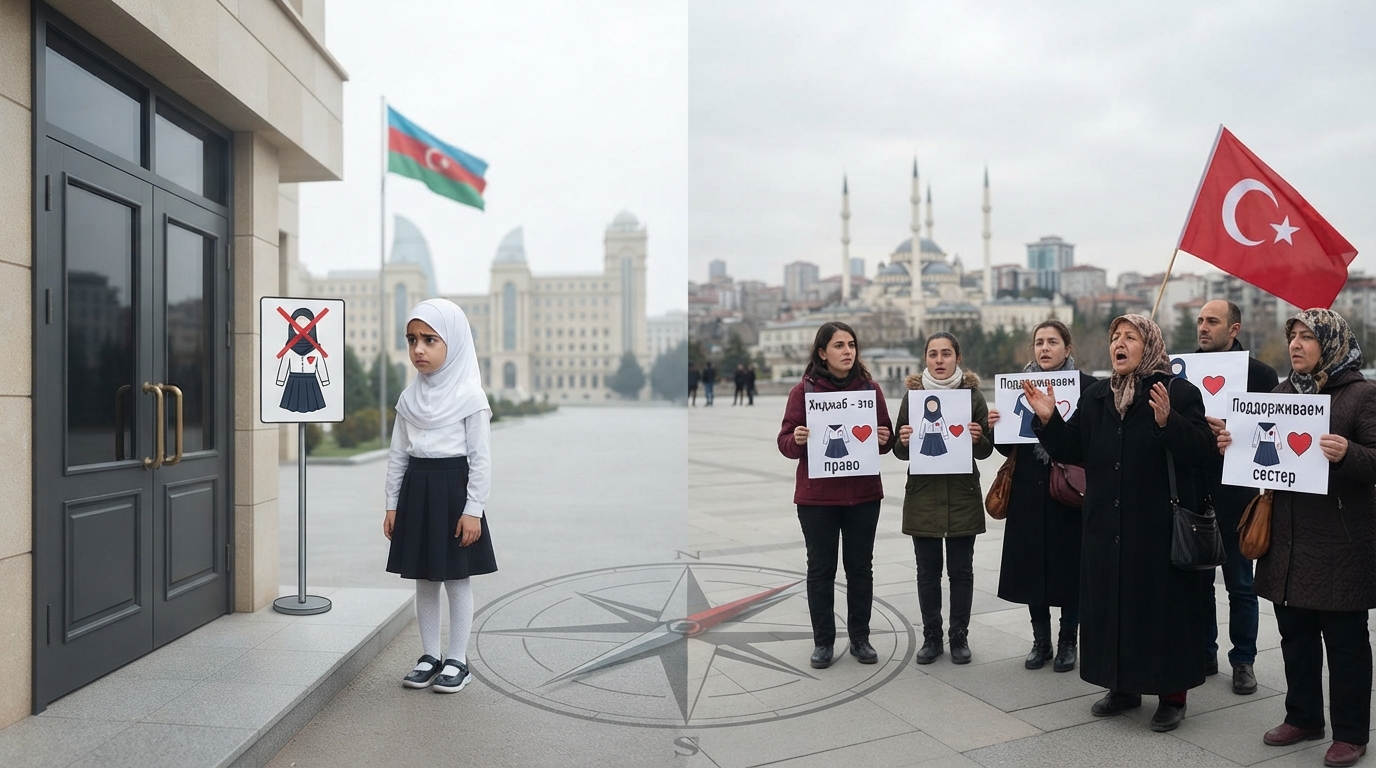
Azerbaijan's decision to ban children in hijabs from attending school has caused a strain in relations between Baku and Ankara. Turkey supported the Azerbaijanis protesting against the introduction of the dress code and called on the "brotherly" republic to leave women the freedom to choose their clothing. In response, the Azerbaijani authorities advised their "relatives" to mind their own business.
"In Azerbaijan, it is unacceptable to restrict the right to education of female students wearing headscarves! How can it accord with conscience and justice to leave at the school door a student who covers her head due to religious beliefs? The hijab is not an obstacle, but a requirement of faith! The right to education must not become a victim of any ideological impositions! We expect Azerbaijan to abandon this erroneous policy as soon as possible. Rather than blocking young people's path to the future, new opportunities should be opened up before them. In our time, such an approach must not be given a place!" stated Oktay Saral, Chief Advisor to the President of Turkey.
For his part, Turkish opposition leader Kemal Kılıçdaroğlu called on "Azerbaijani brothers and sisters" not to divide women into those who cover their heads and those who do not. "I appeal to Azerbaijan: leave women free, let everyone choose for herself what to wear," he said.
In response, Ilham Aliyev's party, "New Azerbaijan," stated that the thesis that Turks and Azerbaijanis are one people living in two states should not be overestimated.
"We are talking precisely about one nation and two independent states. This principle in no way gives one state the right to interfere in the internal affairs of another or to impose its own political and ideological approaches on it… No state in the Islamic world has the right to dictate its will to other Muslim peoples, interfere in their internal affairs, or place itself above the rest. The desire to serve the unity of the Muslim world must be confirmed by equal cooperation and mutual respect, not by hegemonistic aspirations," the press service of the organization stated.
In addition, the Azerbaijani parliament's working group on interparliamentary relations between Azerbaijan and Turkey accused the Turkish media of conducting a "biased information campaign" against Baku.
"Azerbaijan and Turkey maintain friendly, brotherly, and strategic alliance relations. Azerbaijan is an independent and sovereign state and determines its domestic and foreign policy in accordance with national interests and the Constitution. The 'one nation, two states' principle formulated by national leader Heydar Aliyev implies the existence of precisely two independent and sovereign states. Distorting the essence of this principle, using it as a basis for interference in Azerbaijan's internal affairs and imposing external political and ideological approaches on Azerbaijani society is unacceptable," the MPs emphasized.
Elkhan Shahinoglu, head of the Atlas Research Center, believes there are several reasons for the criticism from some Turkish politicians regarding the Azerbaijani government's decision to ban hijabs in schools.
"First, the widespread dissemination on the Internet of images of girls in hijabs who are forbidden to attend school sparked protests in certain segments of Turkish society, and Turkish politicians decided to react to this. Second, when politicians and party leaders in Turkey make statements, they are thinking about how many additional votes they will gain in future presidential and parliamentary elections. It seems they believe that by criticizing the ban on wearing hijabs in Azerbaijani schools, they can gain more votes. However, these statements damage the strategic alliance between Azerbaijan and Turkey," Shahinoglu noted.
According to him, by criticizing Azerbaijan's hijab ban, a group of politicians and experts in Turkey is effectively taking the same stance as the anti-Azerbaijani forces in Iran and creating conditions for protest actions.
Elkhan Shahinoglu stated that Azerbaijan is a secular Muslim country where there are no problems with performing religious rites, and the number of mosques is constantly increasing. At the same time, some countries, including Iran and Saudi Arabia, are strengthening their influence over Azerbaijani Muslims, fueling radical sentiments among them.
"While Iran supports Shia radicalism in Azerbaijan, Saudi Arabia has played a role in shaping the Salafi movement… When the war in Syria began, some natives of Azerbaijan joined local terrorists. In Iran, radical religious groups composed of former Azerbaijani citizens have formed, calling for a change of government in Baku and the creation of an Islamic republic. They are trying to influence religious families in Azerbaijan through Iranian websites… Azerbaijani authorities and citizens who support secularism are concerned about this… By means of the ban on wearing the hijab in school, radical forces can be identified. Religious families have two choices: either allow their daughters to go to school in uniform or not send their children to school. The Azerbaijani government will not back down," Shahinoglu said.
Evgenia Goryushina, head of the Center for Caucasian Studies at ICSA RAS, suggests looking at who exactly decided to lecture Azerbaijan. First, Islamic organizations and the HÜDA PAR party spoke out. Then they were joined by the chairman of the Felicity Party, Mahmut Arıkan, AKP MPs Muhammet Müfit Aydın, and the deputy head of the parliamentary faction, Leyla Şahin Usta. Finally, on October 12, Erdogan's chief advisor Oktay Saral demanded an end to the restrictions. This is already the presidential inner circle, although his statement cannot be considered the official stance of Recep Tayyip Erdoğan.
As the expert notes, official AKP spokesman Ömer Çelik claimed that the groups speaking out against Azerbaijan were not linked to the Turkish government, yet five days later criticism sounded from the leadership of his own party. That is, official Ankara defends brotherhood, while part of the ruling elite openly explains to the brotherly state how it should live.
"And the hijab is just the tip of the iceberg. In YAP's response statement, a whole section suddenly appeared about Azerbaijan's relations with Israel and Baku's stance on Palestine. It would seem, what does Israel have to do with school uniforms? A great deal, actually. In Turkish conservative circles, grievances against Azerbaijani secularism have long coexisted with irritation over its cooperation with Tel Aviv. Now these narratives have merged. Baku, judging by the content of the statement, responded all at once to the entire accumulated list of grievances. And at the same time, it reminded Ankara that the famous phrase 'One nation, two states' presupposes the existence of precisely two independent states, not one state with the right of ideological oversight over the other," Goryushina stated.
She also pointed to the depth of the real contradiction. For the current Turkish ruling elite, the fight against hijab bans is part of their own political biography, linked to the confrontation with the old Kemalist establishment. Azerbaijan, on the other hand, consistently defends a secular model in which the state itself determines the place of religion in the education system. Turkish political Islam has collided with Azerbaijani state secularism. Moreover, the collision turned out to be so public that everyone learned about it, the expert noted.
"It must be understood that the strategic alliance has not disappeared anywhere. But its ideological component has cracked noticeably. For the first time, Baku has so demonstratively reminded the Turkish ruling elite that ethnic proximity does not grant Ankara the right to set the rules of Azerbaijani domestic policy. And most importantly. If in an official response to a question about school hijabs one has to separately defend relations with Israel, it means the dispute began much earlier than this October. It's just that now they have decided to conduct it out loud. One nation, two states. And, as it turned out, two very different ideas about who has the right to educate this nation," Goryushina concluded.
However, Farhad Mammadov, deputy chairman of the board of the Center of Analysis of International Relations and Multiculturalism, believes there is no catastrophe in relations between Baku and Ankara. According to him, in the late 1990s, the wearing of the hijab was banned in Turkey, and for many Turks this is still a painful topic, so it needs to be explained to them that there is nothing of the sort in Azerbaijan.
"First, the Turkish authorities themselves did not comment on the situation with hijabs. There were statements from an advisor to Erdogan and several members of the Turkish parliament. Azerbaijani MPs gave them a response. Of course, tension is felt now, which third countries are trying to exploit, but overall good relations remain between Baku and Ankara. At the same time, it should be explained to Turkish representatives that this is not about a ban on the hijab, but merely about complying with the school dress code," Mammadov stressed.
In turn, Caucasus expert Vladimir Novikov believes that the hijab ban is part of the fight against opposition sentiment in Azerbaijan.
"Earlier, Azerbaijani President Ilham Aliyev successfully resolved the problem of the secular opposition for himself, but the dissatisfied began to concentrate around religion. Accordingly, he is attacking in this direction as well, thereby strengthening his regime. At the same time, it should be noted that this process is spontaneous in nature, but there are players interested in it. For example, Chief Advisor to the President of Turkey Oktay Saral openly spoke out against the hijab ban. In addition, there is a certain ferment among the old elites formed during the rule of Heydar Aliyev. On the whole, the hijab story itself is unlikely to get any serious continuation, but a new line of tension has clearly formed in Azerbaijan that will yet make itself felt," Novikov stated.