

A report from the house-museum of Abdulla Qahhor, the "goldsmith of the word", on the 119th anniversary of his birth
September 17 is the birthday of the writer Abdulla Qahhor. Just as his works and translations are still widely read, his house-museum also holds a special value. Gazeta visited the house-museum in Yakkasaroy to commemorate the writer.
Report from the House-Museum of Abdulla Qahhor, the "Word Goldsmith" — Marking 119 Years Since His Birth
On September 17, 1907, the writer and translator Abdulla Qahhor was born. Alongside his works and translations, which are still widely read today, the writer's house-museum and the material heritage within it hold a special value. Gazeta visited his house-museum in Yakkasaroy to commemorate the writer.
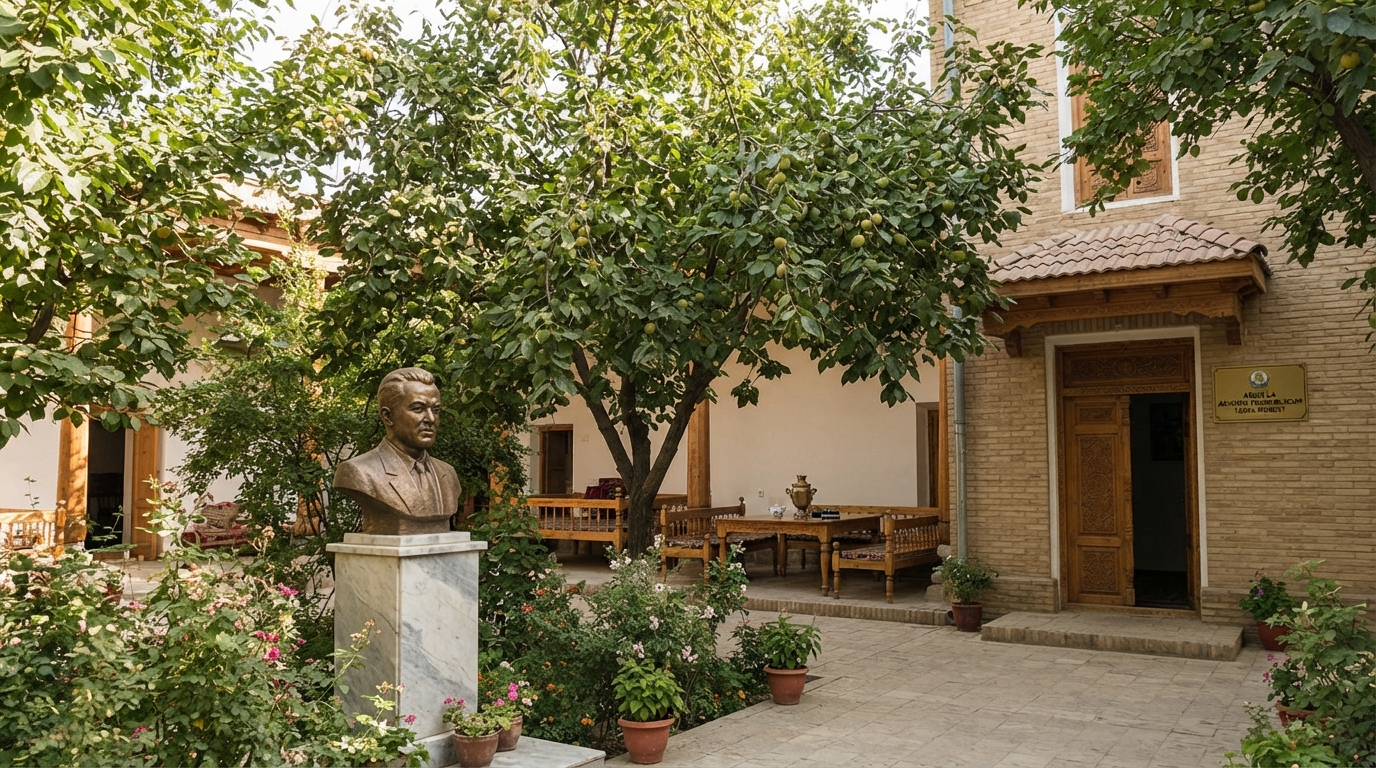
Walking along the quiet, pleasant, and tree-lined Yunus Rajabiy Street, 800 meters away from the "Kosmonavtlar" metro station in the Yakkasaroy district, a sign on the right indicates the location of the Abdulla Qahhor House-Museum. A little further on, the writer's bust comes into view, followed by the entrance to the museum.
The house-museum was established on May 6, 1987, on the 80th anniversary of Abdulla Qahhor's birth, at the initiative of his wife, Kibriyo Qahhorova. Receiving more than 6,000 visitors a year and housing over 5,000 exhibits, the two-story museum consists of 4 rooms, a main entrance hallway, and a courtyard. While in the past the guests were mainly students and schoolchildren, over the last five years, interest in the museum has also grown among locals of various ages and foreigners.
According to a museum staff member, Kibriyo Qahhorova took such great care of the house and the items inside that they have not required major restoration to this day. Only after a minor renovation carried out in 2007 were the creative workrooms on the upper floor of the house opened to visitors.
The museum is open during the first five days of the week from 10:00 to 17:00, and on Saturdays until 15:00. Lunch is from 13:00 to 14:00. Sunday is a day off. Admission is free.
Abdulla Qahhor was born in Kokand into a blacksmith's family. He used to help his father in the workshop. For this reason, the first exhibits in the "Childhood" hall begin with blacksmithing tools — bellows, air ducts, and grindstones. The display case also depicts those working processes.
Abdulla Qahhor's childhood was spent in the villages of Yaypan, Nursuq, Qudash, Buvayda, Tolliq, Olqor, Yulg‘unzor, and Oqqo‘rg‘on in the Fergana Valley. The family's frequent moves from one area to another are usually explained by the fact that master Abduqahhor headed wherever he found conditions to practice blacksmithing. However, if you read Abdulla Qahhor's autobiographical work — "Tales of the Past" — you will learn that not all of the moves were related to the struggle to earn a living.
While living in Yaypan, master Abduqahhor brought a bicycle from Kokand. The bicycle, which is a common means of transport today, was perceived as a novelty and a strange phenomenon in the village of that era, and people began to call it the "devil's carriage."
One day, a village woman fell down, frightened by the wind of the bicycle, and later passed away. Although her family accepted this event as "fate," the view that "the devil's carriage chased the blessings away from the village" grew stronger among the people. Ultimately, the family was forced to move to Qo‘shariq.
In Buvayda, after the master repaired a broken carriage axle for a blue-capped official in charge of land and water affairs, a rumor spread in the village that "the blacksmith has friends among the lords." When Ergash Qorboshi, who was fighting against the Soviets, arrived in Buvayda with his men, master Abduqahhor, fearing that the rumor about him being "friends with the lords" would reach the Qorboshi, moved his family to Tolliq for a while.
Once the situation calmed down, he returned. This time, a conflict arose with Valixon Sufi. The master took his son Abdulla to the Sufi's school, but upon realizing that he was not teaching the children the letters correctly and telling him so to his face, the Sufi's hostility grew. He began speaking ill of the master to people and talking about driving him out of the neighborhood. Not long after his men raided the master's house and threatened him, the family moved to Oqqo‘rg‘on.
Just as life was getting back on track, news arrived that a battle might break out around the village between Ergash Qorboshi and the Soviet government. The father hurriedly took his family to Kokand.
Just as little Abdulla would begin to get used to an environment, he would have to leave it. The children in the new places often excluded him, calling him an "outsider" or a "villager." In this manner, the social relations and political instability of the village of that era constantly affected the life of one family.
"The samovars, teapots, and trays used as household items, the skullcap worn by Abdulla Qahhor in his childhood, the men's chapan, and the women's paranja also show the lifestyle of the era in which the owner of the museum lived. It is not for nothing that museums are called the mirror of history," says museum staff member Sanobar Matlubova.
There is also a sewing machine that Abdulla Qahhor compared to a "pitch-black beetle." His father was the second person in the village, after a wealthy man, to buy a sewing machine, earning the nickname "Zingerli Boy" (The Wealthy Man with a Singer). The machine aroused great interest among the village women. Even the children who would not let Abdulla join them followed him around, asking, "Show us your Singer just once." But this joy did not last long. After the neighborhood imam said over a wedding meal that "clothes sewn on a Singer are not suitable for prayer," people's attitude changed. Following this, the owner wrapped the machine in an old sack and tucked it under the clay oven.
Of master Abduqahhor and Rohatoy aya's 12 children, only the 8th child, Abdulla, survived. "Although their father was a blacksmith, he was a person very passionate about books. At night, he would read fairy tales and books to his spouse. And Abdulla Qahhor also listened to these," says the museum staff member.
Rohatoy aya and Abdulla Qahhor.
Abdulla Qahhor studied at the "Istiqlol" and "Namuna" schools. In the display cases, there are photos from his school years — with the family of his first teacher, Muhammadjon G‘afurov, and with his next teacher, Qori Niyoziy.
"Abdulla Qahhor was such a talented young man that his teachers wrote letters to him. Not every teacher writes letters to their student," says Sanobar Matlubova.
While Abdulla Qahhor published his early writings in a manuscript journal during his student years, he later became an editor at the editorial office of the "Qizil O‘zbekiston" newspaper. At the same time, he graduated from the workers' faculty of the Central Asian State University. He taught at the teacher training courses in Kokand. He worked as a secretary and head of the satire department at the "Yangi Farg‘ona" newspaper. He published satirical pieces under the pseudonym Norin Shilpiq and others in the "Mushtum" and "Yangi yo‘l" magazines, and the "Qizil O‘zbekiston" newspaper.
In the 1930s, he returned to Tashkent and enrolled in the faculty of pedagogy of the university where he had previously studied. At the same time, he served as the executive secretary of the "Sovet adabiyoti" magazine. In 1954–1956, he was the chairman of the board of the Writers' Union of Uzbekistan.
One of the next display cases contains diaries used by Abdulla Qahhor himself, class schedules, and photos taken with his students and at the university.
Abdulla Qahhor loved taking photographs. Wherever he was — in his circle of friends, at events, or on foreign trips — he carried his camera, which is now kept in the museum, with him. There are many photographs in the museum archive that he took and edited himself. "In an era when there were no modern cameras, Abdulla Qahhor worked with negatives, darkening rooms and preparing each photo himself," says the museum staff member.
The "Childhood" hall also features items and photos belonging to Abdulla Qahhor's spouse, Kibriyo Qahhorova.
Kibriyoxonim was born in Samarkand into the family of Maxsum Lutfullayev. He educated his daughter, who had studied at the "Ko‘kaldosh" madrasah in Bukhara, first himself and then at the local school. After she learned the old Arabic script and alphabet, Persian-Tajik, Tatar, and Russian, they began calling her "Mullo Kibriyo" at home.
Her knowledge of Arabic enabled her to work under Sadriddin Ayniy at the Samarkand branch of the Tajikistan State Publishing House. Soon after, she enrolled in the faculty of oriental studies at Leningrad University. During this time, she also worked as the head of the Leningrad branch of the Tajikistan State Publishing House.
In 1943–1945, she served in the Soviet Army and received the rank of lieutenant. During her service, she worked as a military translator for the "Frunzevets" newspaper, established by the Tashkent Military District. It was during this period that she met Abdulla Qahhor.
After their first conversation, Abdulla Qahhor decided to write a book about Kibriyoxonim. Following this, they met frequently, talking about literature and life, and later got married.
All the furniture and equipment, household items, and the television in the living room are preserved exactly as they were when Abdulla Qahhor and Kibriyo Qahhorova lived there, without any changes.
The seven-person table in the middle is round for a reason. When his student-friends came to visit, Abdulla Qahhor did not want some to sit at the head of the table and others at the foot, so he got this round table.
The pen and notebook on the table also belonged to the writer. In it, he recorded certain words, phrases, descriptions, metaphors, facts, various events, and thoughts about literature that he encountered in his daily life. When starting a new work, he used these notes.
At the far end hangs a portrait of Kibriyo Qahhorova painted by the artist Aziza Mamatova. Around the table next to it, the two writers translated Tolstoy's novel "War and Peace."
Abdulla Qahhor played a major role in Kibriyo Qahhorova's entry into translation. When they moved to the Writers' Union's creative retreat in Do‘rmon, Abdulla Qahhor gave his wife the manuscript of the novel "Qo‘shchinor chiroqlari" (The Lights of Qo‘shchinor), saying, "Well, why don't you try practicing?" The manuscript was in the Arabic alphabet, and moreover, the lady did not yet have a perfect command of the Uzbek language at that time. Nevertheless, despite the difficulties, she learned the Uzbek language much better while working on the manuscript of the novel.
"One day, when I wrote some word incorrectly, instead of saying: 'Oh, poor thing, she is Tajik herself, and the manuscript is in the Arabic alphabet, she must have made a mistake or two,' Abdulla Qahhor said: 'Are you literate?' I still remember that even though I didn't cry then, I felt worse than if I had cried," the lady writes in her book "A Quarter of a Century Together."
When, in Abdulla Qahhor's words, Kibriyoxonim became a "perfectly decent translator," she dared to translate "War and Peace." "Just as a mother strives for her child to take their first steps and walk independently, Abdulla Qahhor worked with the same patience and perseverance for me to learn the Uzbek language perfectly and become a good translator," Qahhorova recalls.
Kibriyoxonim practically did not participate in the translation of the first volume of "War and Peace." As for the second volume, the lady translated it first as best as she could, and Abdulla Qahhor corrected her mistakes and wrote it on clean paper. The third volume — Kibriyoxonim translated during the day, and in the evenings, Abdulla Qahhor reviewed and edited the completed part step by step. They did not manage to translate the fourth volume together; the lady finished the work on her own.
Going up the stairs, the creative hall welcomes you. In it, one can see a model of the office from 1925 when Abdulla Qahhor was the editor of the "Qizil O‘zbekiston" newspaper.
Abdulla Qahhor enriched Uzbek prose through his novels "Sarob" (The Mirage), "Qo‘shchinor chiroqlari" (The Lights of Qo‘shchinor), and his novellas "Sinchalak", "O‘tmishdan ertaklar" (Tales of the Past), and "Muhabbat" (Love). He brought the short story genre to a high peak in Uzbek literature and, for the conciseness and sharp skill in his stories, began to be called the "Uzbek Chekhov."
As written in "A Quarter of a Century Together," Abdulla Qahhor had a habit of engaging in creative work in winter and traveling through the Fergana Valley and other oases of the republic in summer. He liked to see the changes taking place in the agricultural sector with his own eyes, meet the prototypes of the characters of his future works, and get closely acquainted with their character and labor activities.
During his major trip to Mirzacho‘l in the early 1950s, he met the prototypes of the characters Mavlon in the comedy "Yangi yer" ("Shohi so‘zana") and Eshon in "Sinchalak."
The Russian poet Stepan Shchipachyov, in a letter written to the writer after reading "Sinchalak," compared him to Gogol. The famous satirist Leonid Lench, who translated several of his stories and feuilletons into Russian, evaluated the story "To‘yda aza" (Mourning at a Wedding), which was included in "Sinchalak," as follows:
"Abdulla Qahhor's skill can be shown through the example of the tiny story 'To‘yda aza'. Writing a funny story about a person's death is extremely complex.
Only Chekhov was capable of this, and the French could manage it. Look at that, Abdulla Qahhor has succeeded in this. In a short story, the cliché theme of death shines and sparkles with fresh, lifelike colors."
Film director Latif Fayziyev wanted to create a film based on the novella "Sinchalak" and, as usual, Kibriyoxonim went and concluded a contract for eight thousand rubles with the chief editor of the film studio at that time, the poet Turob To‘la. According to the rules, if a novella was adapted for the screen, five thousand rubles were paid, and if changes were made here and there — eight thousand rubles. They set a condition not to name the film "Sinchalak." The lady came home and explained this side of the matter to Abdulla Qahhor.
"He said, 'Am I going to deceive both the government and the audience just to get three thousand rubles extra? Go, cancel the contract, and sign one for five thousand.' The next day, I went to the film studio to sign a new contract. Hearing Abdulla Qahhor's demand, everyone was dumbfounded. Turob To‘la smiled and said, 'How strange, people come asking to increase their royalty a bit, but Abdulla aka asked to decrease it!'", Qahhorova recalls.
Abdulla Qahhor is also known as a translator of works by Gogol, Chekhov, Lermontov, and Pushkin. The writer's own works have also been translated into more than 20 foreign languages.
Every writer of that era was cautious of Abdulla Qahhor's demanding nature and criticism. After their works were published, they waited to see what Abdulla Qahhor would say. If he expressed a positive opinion, it meant that the work was considered good.
As Said Ahmad writes in his work "Yo‘qotganlarim va topganlarim" (My Losses and Findings), before the publication of the novel "Ufq" (Horizon), when Abdulla Qahhor heard the episode where Ikrom ota shot his son who had fled from the war, he said, "Do not do such a thing, the reader will curse a father who killed his own son. A person who killed someone cannot be considered a positive hero," and told him to take another path.
Among those seated, second from the left — Abdulla Qahhor, to his right — Said Ahmad.
Said Ahmad, remembering that he had written the events and details of the entire work to fit this episode, wondered how he could change it now, whether he would have to rewrite the entire work, and felt that he had to shoot him no matter what, even regretting telling Qahhor about it. However, towards dawn, he added the sentence "thankfully, it didn't hit." Abdulla Qahhor gave his blessing, saying, "Now this is another matter. With two words, you have done a world of work." Said Ahmad himself was later very grateful for this.
According to Kibriyo Qahhorova, when Abdulla Qahhor took the podium, the language issue always lay at the core of his words. If any writer or poet violated the elegance of the Uzbek language, even if they were his closest, dearest friends, he did not spare them. At meetings with students, he also emphasized the richness of the Uzbek language and spoke a lot about loving one's mother tongue above all. In the book "A Quarter of a Century Together," the following excerpt is quoted from his speech at a meeting with radio and television workers, where he criticized their working process:
"We have a very rich, beautiful language. There is no thought or feeling that cannot be expressed in this language! Unfortunately, our radio often does not speak to the people in this rich, beautiful, powerful language. There are people who just rotate a handful of words in their vocabulary, receive their salary, and do not want to use the potential of the Uzbek language more fully through reading and learning, or they lack the intellect for this.
As a result of the laziness or lack of intellect of these people, and the scientific activity of half-educated 'scholars', a language has emerged that no one speaks in daily communication, in conversation, or in the family...
Only a microphone can bear this language, only a microphone tolerates this...
Why is the language of our press and radio moving further away from the language of the people day by day?
Why are the rules of our language being violated? Why does a policeman blow a whistle at a person who violates traffic rules, but no one blows a whistle at those who are ruining an entire language..."
Abdulla Qahhor was also one of the foremost writers of his time in playwriting. His works in this direction, "Ayajonlarim" (My Dear Mothers), "Tobutdan tovush" (A Voice from the Coffin), and "Shohi so‘zana" achieved considerable popularity. The comedy "Shohi so‘zana" participated under the pseudonym "Mirzacho‘llik" in a closed competition held at the republic level in 1949 and won a high award. That same year, the patriarch of the Uzbek stage, Yetim Bobojonov, staged this work on the stage of the Hamza Theater.
The following year, after being translated and published in Russian, it was awarded the USSR State Prize. It was staged in a number of foreign countries and in 74 theaters of the Soviet Union. "With this, Abdulla Qahhor was the first to bring Uzbek playwriting to the All-Union stage," writes Kibriyo Qahhorova.
In one of the memorial rooms is Abdulla Qahhor's library, consisting of thousands of books.
"All the books here were bought by Abdulla Qahhor himself and read three or four times. When he received a royalty for the novel 'Sarob', he went to Moscow, brought back Chekhov's 22-volume book set, and read it five times. Perhaps such habits made Qahhor a great writer, a great translator," says the museum staff member.
The writer's desk is also located here. As Kibriyo Qahhorova wrote, Abdulla Qahhor's working days started at eight in the morning; after having breakfast, he sat at the desk and did not get up until twelve o'clock. During this time, no one disturbed the writer, and he himself did not let anyone into the study. But he did not work in the evenings, saying "Kori shabu xandai ro‘z" — you will laugh during the day at work done at night.
"For Abdulla Qahhor, the study was a sacred place where a new work was born.
The ringer of the telephone there was turned off, and all communication via telephone was on my shoulders. If it was a very important person, I would press the button next to the telephone, and then he would pick up the receiver," Kibriyoxonim recalls.
Therefore, while Abdulla Qahhor was working, she did not go out to the street, no matter how important her business was, so that his thoughts would not be distracted.
"Envying writers who went on a one- or two-day business trip and came back having written an essay, he would say, 'I am like a hen; a hen also lays eggs only in its accustomed place, and I cannot write unless I have you and my writing desk,'" writes his wife.
Abdulla Qahhor did not write a work today and take it to the publishing house the next day. After finishing writing, he would leave it for three or four days, then look over it once more, and only after being satisfied, type it on the typewriter. The writer even wrote a letter to someone by hand first, and then copied it on the typewriter.
Kibriyo Qahhorova recalls in her book "A Quarter of a Century Together" that Abdulla Qahhor believed that one must write, whether inspiration comes or not. If inspiration did come, he would get up even in the middle of the night and go into the study. Sometimes he wrote down thoughts that came to his mind in his bedside notebook.
"Every day he wrote at most one and a half to two pages. If he happened to write three pages in one day, he would say, 'I wrote three pages today, tomorrow half of it will turn out to be scrap.' To write one and a half to two pages, he would sit for four to five hours.
Some pages were rewritten ten to fifteen, and sometimes sixteen to nineteen times.
If it was necessary to change a word at the end of a page, he would rewrite that page entirely. When I felt sorry for his labor and said, 'Why don't you just write over it?', he would say, 'No, when rewriting from scratch, new phrases, new metaphors come to mind, the work gets polished and becomes concise,'" the lady writes.
The hall leading to the second floor and the rooms also feature photos of actors who played roles in the writer's works. One of the brightest examples is, of course, "Mahallada duv-duv gap" (Mischief in the Neighborhood).
"They wrote it in Russian. When Abdulla Qahhor translated it into Uzbek, he changed many parts of it in red. Reading this, Shuhrat Abbosov was nervous at first, but then smiled and said, 'This work was reborn through translation.'
'The original name of the film was "Syurpriz" (Surprise). It can be said that every sentence in it was reinterpreted by Abdulla Qahhor. Lutfixonim Sarimsoqova's use of wordplay like "my son would produce it in a flash (lip etib), so that's what flash means, eh?" shows once again that Abdulla Qahhor was a word goldsmith,'" says the museum staff member.
In the early 1950s, Abdulla Qahhor was diagnosed with diabetes. In January 1968, while washing in the bathroom, he slightly grazed the big toe of his left foot.
"He came out of the bathroom looking pale and threw himself onto the bed, saying, 'It's over!' I immediately called a doctor. He recommended urgent hospitalization. But the medicine did not work. In February, I brought him home. Despite the illness and insomnia, he wrote and finished the novella 'Muhabbat'," writes Kibriyoxonim.
Even after home remedies and mummy (shilajit) treatments, there was no result. Since the coin-sized wound would not heal, on the advice of doctors, and despite his objections, they took him to Moscow.
But even there, the treatments did not yield results. Kibriyo Qahhorova recalls those times as follows: "The man who had not said 'ouch' even once in all these days said 'ouch' once at night, and then, as if embarrassed of himself, said, 'I am not sighing because I am passing away. I sighed because, while I have my home, my garden, and my courtyard, I am leaving in this cage-like room, on an iron bed, and without saying goodbye to my family and friends.'"
On the day before his death, he summoned his student Shuhrat and made many testaments about taking care of Kibriyo Qahhorova after him. "If I became Abdulla Qahhor, it was because of you. Any other woman would not have tolerated my character for more than a week. If it weren't for you, I would probably have died twenty years ago," the writer said. On May 25, 1968, at the age of 61, he passed away in Moscow.
Books published dedicated to the writer's 60th, 80th, and 100th anniversaries, as well as various gifts presented to him, are located in the "Gifts" hall.
People's Artist of Uzbekistan Yunus Rajabiy and Abdulla Qahhor were neighbors. As the museum staff member told, Yunus Rajabiy came and sang songs at every event held in this house. One day, when he said to Abdulla Qahhor, "I bring a dutar every time, why don't you order a dutar yourself?", Abdulla Qahhor replied, "You will play it anyway, so order it from your own master."
"When the dutar was ready, Yunus Rajabiy brought it and said it cost 100 rubles. Abdulla Qahhor kept quiet for a moment, looked at the master, then at the dutar, and said, 'Does it come with the master?' This is also a metaphor of the word goldsmith. Now, at our events, the master's son Hasan Rajabiy comes and sings songs on this dutar, and remembering that story, he adds, 'but my father did not take the money,'" says museum staff member Sanobar Matlubova.
Abdulla Qahhor and Kibriyo Qahhorova did not have children. However, the writer had two sons named Po‘lat and Suyar from his first marriage.
"Because of these children, I met with my co-wife frequently. Sometimes the neighbors were surprised to see my attitude towards my co-wife. After all, she had married another man before we got married, and since my husband did not want to live his life with her, it was pointless for me to be jealous. Besides, his peace was my peace. Therefore, whether it was the children's birthday, a holiday, or the day the new school year started, I would check on them, and during the summer holidays, they would be with us in the garden," writes Kibriyo Qahhorova.
As written in "A Quarter of a Century Together," the eldest son Po‘lat studied at the Moscow Aviation Technology Institute. Having received the degree of Candidate of Technical Sciences, while teaching at the Tashkent Polytechnic Institute, he suddenly passed away from a heart attack at the age of 37. The younger one, Suyar, studied in the evening department of the university's faculty of law, and on one of the days when he worked during the day at the internal affairs department of the Tashkent region, he suddenly died tragically at the age of 33.
Abdulla Qahhor and Kibriyo Qahhorova lived in this house for ten years. There is also an interesting story behind moving into it. During the days when Qahhor received an award for "Shohi so‘zana," which spread his fame throughout the Union, guests came to their house. Among them were party and government leaders. The guests were surprised to see the house they lived in. Although the large room was decent, two beds could barely fit across the small one. They wanted to give them a house. A little later, along with three or four writers, a new house was built for them on Usta Shirin Street.
"In those years, the translator Ma’ruf Hakim lived with his sister in a building opposite the Kurant, in a single room. On the eve of the move, Abdulla Qahhor said, 'That building was built for us, so whatever we do is our choice, right? Let's give that house to Ma’rufjon and his family: seven souls are struggling in a single coop-like room.' We continued to live in that same 'one and a half' room," writes Kibriyo Qahhorova.
Since they moved to Do‘rmon during the summer months, the tightness of the house was not felt so much. A little later, the government began building a new house for them in the workers' town. In those years, one of his students was struggling with housing.
"He said to me one evening in a consultative tone, 'Look here, what if we just give this courtyard to him? If necessary, I can get a house from anywhere I want.' I also liked his proposal. They transferred the unfinished building to that writer's name. If he was friends with someone, he was a bosom friend, always loyal and caring to his friends. But if he disliked someone, in his own words, he disliked them 'to the tips of his shoes,'" Kibriyoxonim recalls.
According to the museum staff member, when Abdulla Qahhor turned 50, Sharof Rashidov said, "A person like Abdulla Qahhor should not live in such a house," and designated one of the next houses under construction for the writer.
In 1957, when the houses were completed, Qahhor chose the smallest of them — the courtyard where the current house-museum is located. When asked, "We are showing it to you before anyone else, why do you choose the smallest one?", he replied, "This is enough for Kibriyoxonim and me, we will be in Do‘rmon all summer anyway."
According to museum staff member Sanobar Matlubova, on the eve of the writer's 80th anniversary, when the Ministry of Culture wanted to give Kibriyo Qahhorova a two-room apartment, she did not want this either, saying, "I lived in this house with Abdulla Qahhor for so many years, I cannot live anywhere else now," and lived here until the end of her life — September 26, 1996.
The persimmons planted by Abdulla Qahhor and Kibriyo Qahhorova in 1964 still bring grace to the courtyard.