

A four-minute warning isn't enough: Russia's new relentless missile tactics exhaust Kyiv residents
Increasingly frequent and ferocious attacks on the Ukrainian capital have left many on edge.
A four-minute warning is no longer enough: Kyiv residents worn down by Russia’s new missile tactics
Daria left her Kyiv apartment this summer after Russian attacks on the city grew more intense.
For much of Russia’s full-scale invasion of Ukraine, Daria was not frightened by the shelling.
Even during nights of heavy bombardment, the 27-year-old could sleep through the blasts in her apartment in Kyiv. Like many Ukrainians, she depended on the “two-wall rule”: staying safe by placing two walls between herself and the outside world.
But this year, that changed.
Over recent months, Russia has increased both the scale and the frequency of its attacks on the Ukrainian capital.
In the first 10 days of July alone, Russians fired dozens of ballistic missiles in three major assaults, killing nearly 60 civilians, according to official figures. Similar large-scale attacks followed in August and September.
A BBC Verify analysis of government figures found that Kyiv is now experiencing more daily air raid alerts than at any point since Russia’s full-scale invasion in 2022.
It was during an attack one night in May that Daria realised she no longer felt secure in her home.
She and her boyfriend were in the corridor of their ninth-floor apartment, watching a boxing match, when explosions erupted around them, with blast waves repeatedly forcing the windows to slam open and shut.
When the fight ended, “there was no longer anything to distract me,” Daria says. “That’s when I realised I was really scared.”
At first, she thought she would begin using a nearby bomb shelter during attacks.
But in June, after a young mother was killed while running to a shelter in Kyiv, Daria decided she needed to leave the city entirely.
She moved back to her family’s country house, 30km (18.6 miles) away in Romankiv, and now spends four hours a day in total commuting to and from Kyiv, where she works in the defence sector.
Daria’s case is far from unusual.
Kyiv residents who say they had grown used to Russia’s missile and drone strikes have told the BBC World Service that the renewed intensity of the attacks is forcing them to reconsider how they live.
Until recently, Ukraine’s air-defence network and military intelligence gave people a degree of predictability. Large attacks could often be detected in advance, allowing residents to spend the night in shelters, leave the city or take other precautions. But since the summer, Russia has altered its tactics.
It has depended less on aircraft, which can be tracked beforehand, and more on ballistic missiles that move at extreme speed and give little warning. Air raid alerts sometimes start only moments before impact, or even at the same time as the first explosions.
Daria can see the nearest shelter from her apartment window, which she still rents. Even so, it takes about 10 minutes to get there. During a ballistic attack, she says, she may have only four minutes’ warning or less.
She decided to leave Kyiv in June after holidaying abroad this summer and seeing people living “normal” lives. Since then, she has spent only one night in Kyiv.
Yet for many, leaving is not possible.
Sixty-two-year-old Olha Vlasova lives on the seventh floor of a high-rise block with her 98-year-old mother, Nadia Tsybina.
Despite her age, Nadia remains deeply engaged with current events.
From her bed, she follows developments in Ukraine and abroad, discussing everything from US President Donald Trump’s policies to anti-corruption protests in Kyiv and the Epstein files.
She has also learned that she can often tell, simply by listening, whether a Russian missile or drone has been intercepted or has hit its target.
This summer, she says, she has heard fewer interceptions.
“It’s upsetting when there’s nothing to shoot them down with,” Nadia says. “I can hear them firing with whatever they’ve got, rifles, machine guns.”
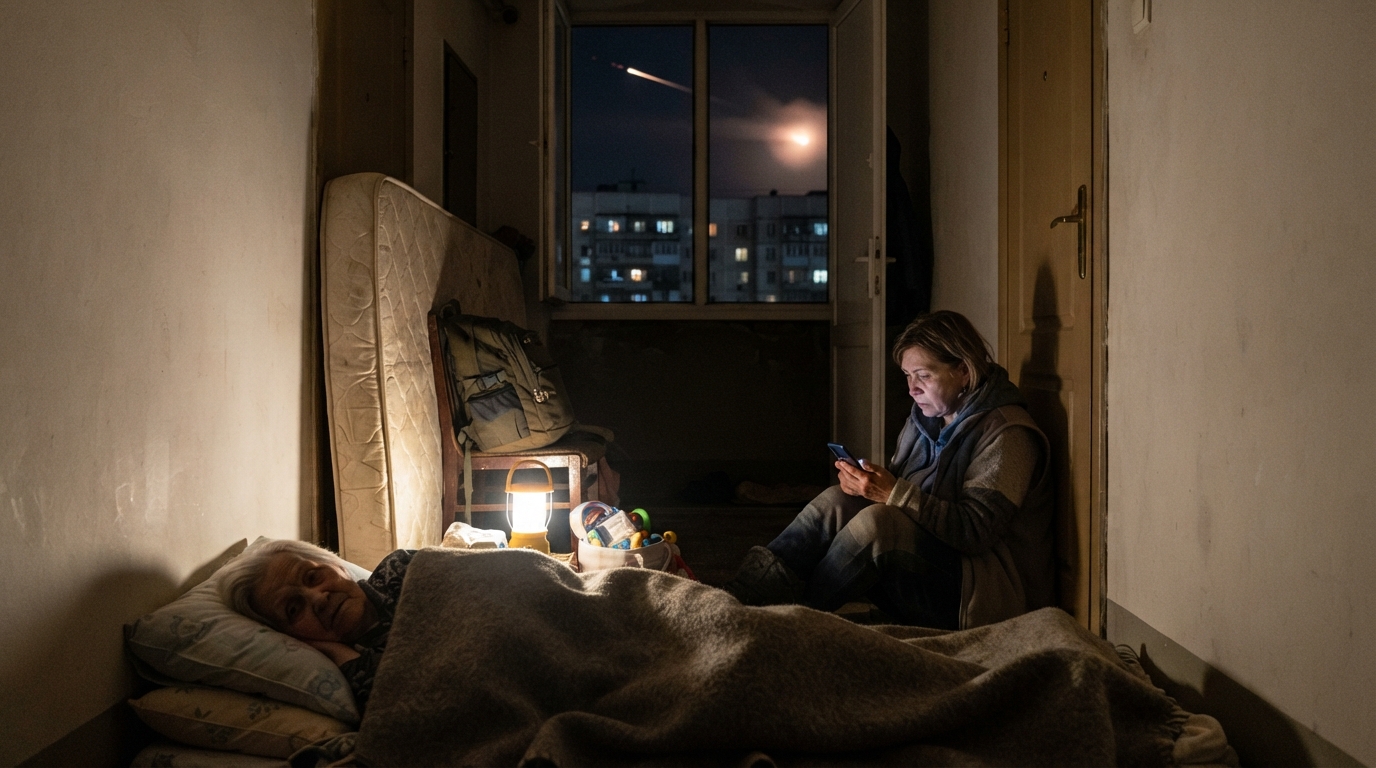
Olha has taken to putting a mattress by the window to shield her and her mother from flying glass.
Because Nadia is confined to her bed, she and Olha cannot reach a shelter, no matter how severe the attack. Instead, as soon as an air raid siren sounds, Olha covers her mother with a blanket, pushes a mattress into their window frame, and then hides in a wardrobe that gives her two walls between herself and the outside.
Nadia puts a pillow over her head to protect her face from flying glass.
Once inside the wardrobe, Olha often stays awake all night watching the news.
“They come in, they bomb us,” Nadia says. “You haven’t even had time to fall asleep, and there’s another alert. They come again, they shoot them down again. And it goes on all night.
“People don’t sleep, and then they walk around like zombies.”
More daytime attacks mean life in Kyiv is now disrupted by air raid sirens both day and night.
At the start of September, when children returned to school after the summer break, there were dozens of air raid alerts, followed by explosions and fires.
According to Kyiv Mayor Vitali Klitschko, two children were injured in attacks on 31 August.
As a result, many children stayed home, while others spent hours in the basements of schools and kindergartens.
Commuters in Kyiv have grown used to long delays as the metro is disrupted.
When sirens sound, businesses and transport are affected too. Shopping centres close and above-ground metro stations suspend service, often cutting public transport links between Kyiv’s Left and Right Banks, on opposite sides of the Dnieper River, for hours at a time.
New metro operating rules during air raid alerts are being introduced in an effort to improve the situation.
For Olha, this has meant seeing less of her eight-year-old granddaughter, who lives on the other side of the city.
She knows that if her granddaughter visits, she may struggle to get home. When metro services stop, costly taxi rides are Olha’s only choice. Crossing the river can cost as much as 1,000 hryvnias ($22, £16.6), she says, just under one-eighth of Ukraine’s monthly minimum wage.
The situation has left her angry at what she sees as hesitation by some of Ukraine’s foreign partners to supply more air-defence missiles.
President Volodymyr Zelensky has repeatedly urged allies to provide additional air-defence systems and interceptor missiles.
“They [Ukraine’s allies] wait, thinking: ‘What if we get attacked?’” Olha says. “It’s like refusing to give medicine to a cancer patient because you’re saying, ‘What if I get sick one day?’ Well, maybe you won’t. Give it away before it expires.”
In another part of the city, mother-of-two Natalia Bushkovska rehearses three different plans every night.
Plan A is to lay bedding in the hallway behind two interior walls; Plan B is to move the family into the building’s shared corridor; and Plan C is to go to the basement.
Even there, she says, she does not feel completely safe.
“I keep a backpack with essential items,” says Natalia, 37. “There’s a tourniquet for severe bleeding. I also keep a whistle, just in case.
“If the worst happens, rescuers will be able to find us under the rubble.”
Her nine-year-old daughter has her own emergency bag with toys, lip balm and a tourniquet. Like her 12-year-old brother, she learned how to use a tourniquet in first-aid training.
Natalia says the constant attacks are exhausting.
Her son often sleeps through them, but she and her daughter wake up almost every time.
“Because of the attacks, I don’t get enough sleep,” she says. “Now, in the fifth year of the war, I find it increasingly difficult to bounce back after nights like these.”
She says the rising intensity of the strikes is taking a psychological toll across the city.
“People are exhausted. They don’t have enough time to recover.”
On Thursday 17 September, Russia launched a ballistic missile attack on Kyiv. According to Mayor Vitali Klitschko, 20 people were injured in the attack. Among the wounded were two children, aged 10 and 12.