

A five-year journey for 10 grams of soil: Japan launched a spacecraft to Mars' moon
Japan has launched the MMX mission, which aims to bring soil samples from Mars's moon Phobos to Earth. As part of the five-year project, a small robot will also be landed on Phobos. The samples are planned to be delivered to Earth in 2031.
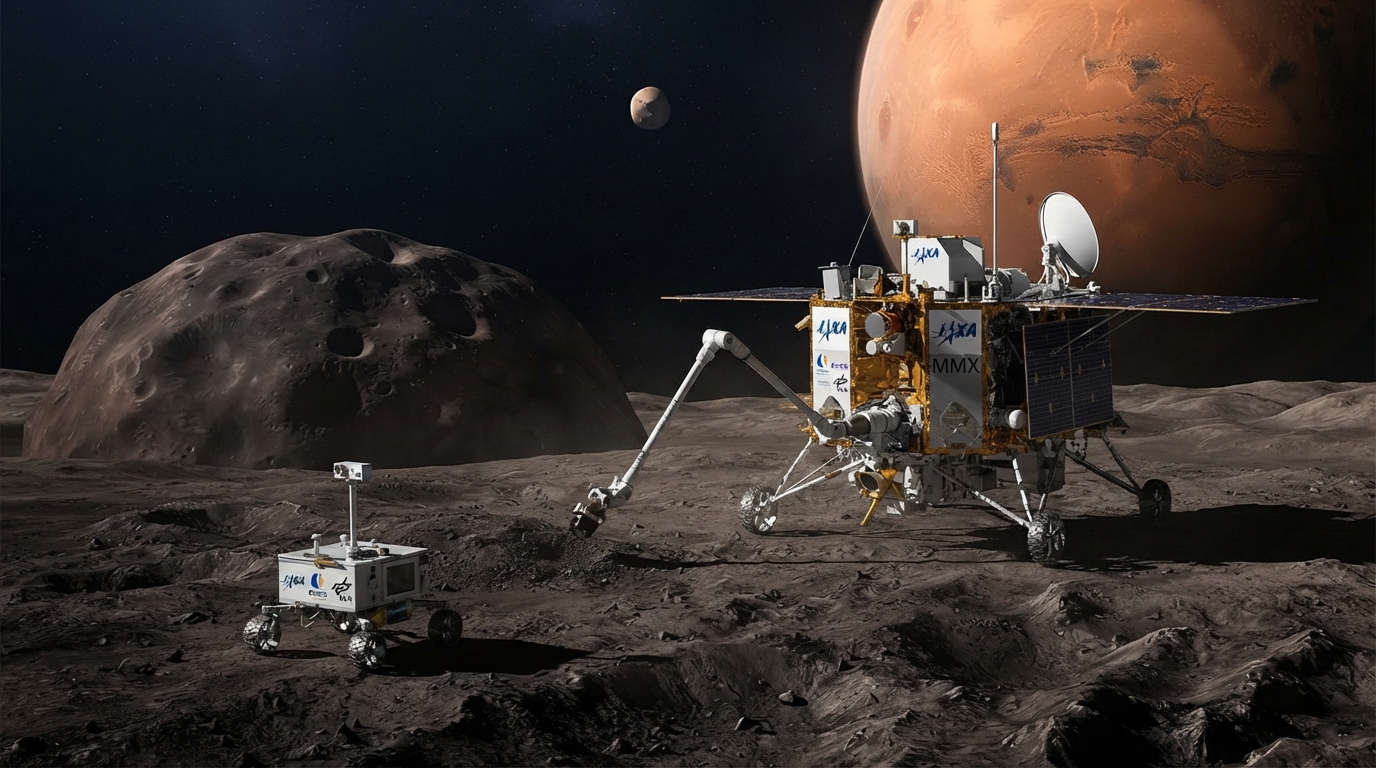
Five-year journey for 10 grams of soil: Japan launches spacecraft to Martian moon
According to information provided by the Japan Aerospace Exploration Agency — JAXA, the H3 rocket carrying the MMX spacecraft was successfully launched on October 20 from the spaceport on Tanegashima Island.
The spacecraft, weighing nearly five tons, and the mission name — MMX — stand for "Martian Moons Exploration". Its task is not limited to taking samples from Phobos alone: the spacecraft will also study Mars's second moon, Deimos.
A one-year journey, three years of research
According to the plan, both reaching the orbit of Mars and the return journey to Earth will take approximately one year each. The spacecraft will devote another three years to studying Phobos and Deimos from orbit.
Landing on the surface of Phobos is also planned as part of the mission. First, a small autonomous robot will land, followed by the sample-collection spacecraft.
The project is valued at $578 million. Japan, the US, France, Germany, and the European Space Agency are participating in it.
A robot moving at a speed of one millimeter per second on Phobos
France and Germany have prepared a four-wheeled robot named Idefix for the mission. It is named after the dog from the Asterix and Obelix comics.
The robot, which is close in size to a microwave oven, is expected to work on the surface of Phobos for about 100 days. It will move at a speed of one millimeter per second to explore the moon's surface.
The MMX spacecraft's stay on Phobos will be much shorter — approximately two hours. During this time, it is planned to collect 10 grams of soil. These samples will then be brought to Earth.
Previous attempts failed to land
The USSR and Russia have previously attempted three missions aimed at landing on the surface of Phobos. Of these, only the "Phobos-2" spacecraft managed to approach the Martian moon in 1989 and transmit images to Earth.
However, none of these missions were able to land on the surface of Phobos. Japan's MMX project aims to study the moon up close, as well as to create the opportunity to test samples taken from it in laboratories on Earth.