

5 words a day, one chapter a week: 6 methods to make learning English easier
5 words a day, one chapter a week: 6 ways to make learning English easier
In fact, to master English perfectly, you do not need to make a huge leap all at once. Breaking a big goal down into small tasks and performing them regularly can be much more effective. Memorizing just five new words a day, watching one episode of a TV series in English, or practicing speaking several times a week will yield significant results over time.
Below, we have compiled 6 simple recommendations that will make learning English easier and help turn it into a part of your daily life.
"Eat the elephant one bite at a time"
A big goal like learning English can seem scary and unattainable at first. In such cases, the best way is to divide the big goal into small and specific tasks. The important thing is that these tasks should be neither too easy nor too difficult.
If you have recently started learning English, for example, reading Jane Austen's works in the original will naturally be difficult for now. Instead, set small but achievable goals for yourself: master one chapter from a textbook every week; memorize five new phrases a day; watch an episode of a TV series and write down 10 new words from it; write a 200-word text every week; complete 10 exercises on a new grammar topic; read one short article a day; participate in a speaking club once a week.
If you have not read any books in English yet, start with books adapted to your language level. In such publications, the main plot of the work is preserved, but the vocabulary and grammatical structures are simplified.
Then you can gradually move on to books in the original. For example, J.K. Rowling's "Harry Potter" or Suzanne Collins' "The Hunger Games" can be good choices for this. If you are already familiar with the plot, watching how your favorite characters speak in the original is both interesting and useful.
Learn the most commonly used words
To master English more easily, you first need to focus on the words and phrases most commonly encountered in daily life.
The authors of the Longman Dictionary have identified the 3,000 most frequently used words in English. Knowing these words helps in understanding a large part of English texts. The Oxford Dictionary also provides a list of 3,000 core words necessary for levels A1–B2. For those who want to reach a higher level, there is the Oxford 5000 list, which adds another 2,000 words.
To remember new words better, you can use flashcards. Write an English word or phrase on one side of the card, and its translation or a brief explanation on the other side.
The cards can be divided into three groups: words not well mastered, partially mastered words, and well-known words.
It is recommended to review the cards in the first group every day, and those in the second group twice a week. For well-mastered words, reviewing them once a week is sufficient. As a word is memorized, move the card to the next group, and return forgotten ones to the previous group.
It is also useful to learn new words in context rather than individually. Compose sentences and short stories using them. This method helps to remember not only the meaning of the word but also in which situation and how it is used.
If you do not want to use paper flashcards, you can use programs that work on the same principle, such as Quizlet, Anki, or The Mnemosyne Project.
Switch the content around you to English
Language learning should not be limited only to textbooks or exercises. Try to encounter English as much as possible in your daily life.
To do this, you can change the settings of your phone and computer, as well as the language of social networks and websites you regularly use, to English.
Also, watch TV series and movies in English as much as possible. At first, you may not understand all the words, but over time, your ears will get used to the phrases, pronunciation, and sentence structures used by native speakers.
To increase your vocabulary, set a goal to write down 10–15 new words or phrases from each episode. Then review them using flashcards.
Listening to foreign podcasts and reading English-language media materials is also useful. For example, the BBC Learning English platform has news, short videos, grammar, and vocabulary materials adapted for learners of various levels.
Speak more in English
Knowing grammar and new words is not enough — you also need to apply them in practice. Therefore, practice speaking English regularly.
To do this, you can work with a tutor, attend English courses, or go to speaking clubs.
If you are learning the language independently, try the "shadowing" method. In this, you listen to English audio or video and repeat the sentences as simultaneously and with the exact same intonation as possible. This method helps improve pronunciation, intonation, and speech rate.
If you can maintain a simple conversation in English, you can find a language partner. Platforms like Italki, HelloTalk, or Tandem offer opportunities to communicate with English speakers.
By talking with native English speakers, you can improve your pronunciation, learn everyday phrases, and even modern slang.
Identify what inspires you
Motivation is important in language learning, but the same motivation does not work for everyone. It can be internal and external.
Internal motivation drives a person to act without compulsion. For example, if you are interested in British culture, English-language films, or foreign literature, you will have less need to force yourself to open a textbook.
Therefore, try to connect English with your interests. Find content creators in English about your favorite hobby. This could be cars, makeup, sports, travel, or plant care.
Write short texts in English on topics that interest you. Grammar can be reinforced through games. For example, platforms like Gramaro, Lingualeo, or Duolingo can be used.
However, sometimes internal motivation alone is not enough. In such cases, external motivation helps. For example, agree with a friend to go to a speaking club together. This will make it harder to cancel the session at the last minute.
Paying for a course or a tutor can also be a motivation for some. The most important thing is to identify which method affects you more and choose an approach accordingly.
Allocate a specific time for English
Regularity is very important in language learning. Practicing regularly, even if for shorter periods, can be more effective than studying for several hours once a week.
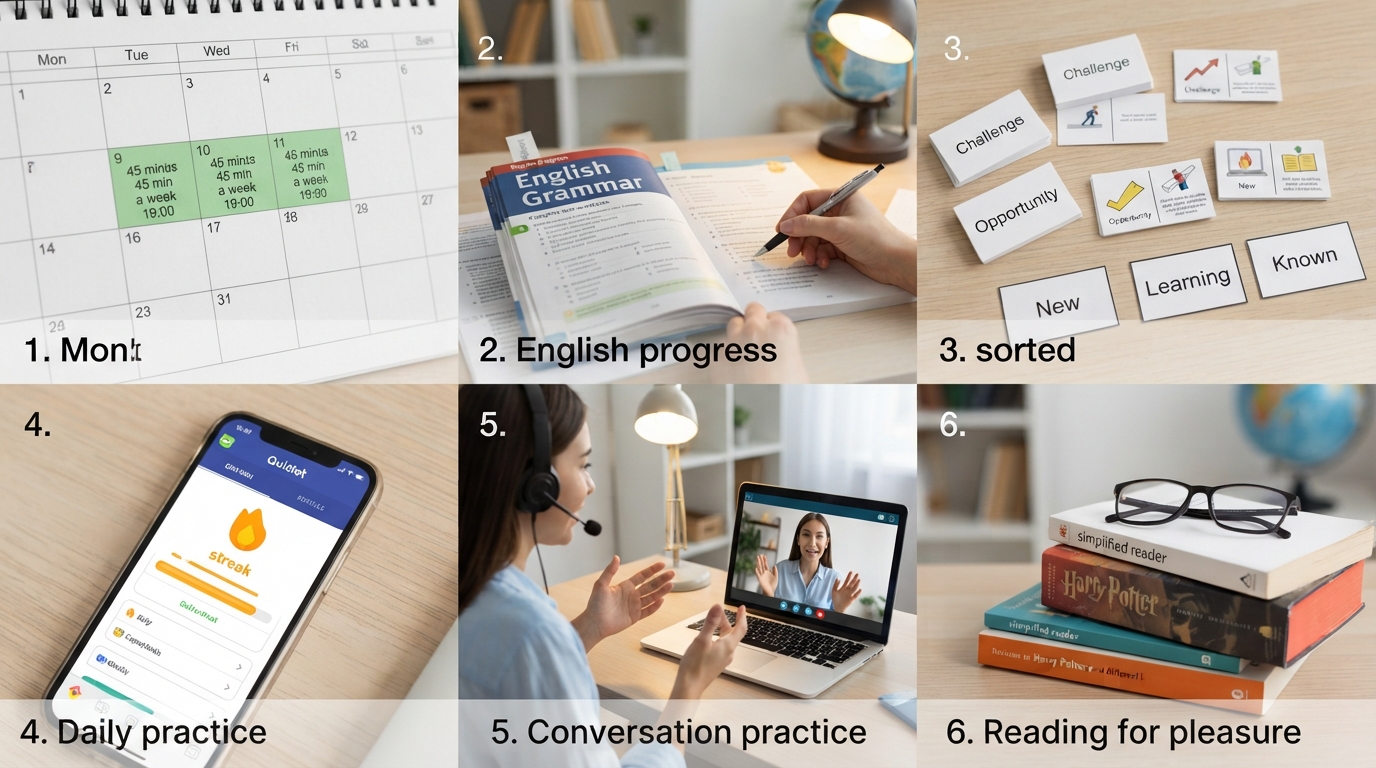
For example, allocate 45 minutes to English 2–3 times a week. Enter the sessions into your calendar in advance and try not to occupy this time with other tasks.
When scheduling, also take into account at what part of the day you feel most productive. If you feel sluggish in the morning, scheduling a session for 7:00 AM is not a very good idea.
In his book "The Power of When," clinical psychologist Michael Breus recommends taking a person's biological rhythms into account when planning a daily routine. In his opinion, some people absorb information better from 10:00 AM to 2:00 PM, while others do so from 4:00 PM to 10:00 PM.
Therefore, you do not need to look to others for the "most correct time" to learn English. Find a time that is convenient for you and that you can follow regularly. The most important thing is to divide the big goal into small steps and perform them consistently. In language learning, it is precisely regularity that leads to results.