

5 famous Soviet actors who spent the last years of their lives in poverty
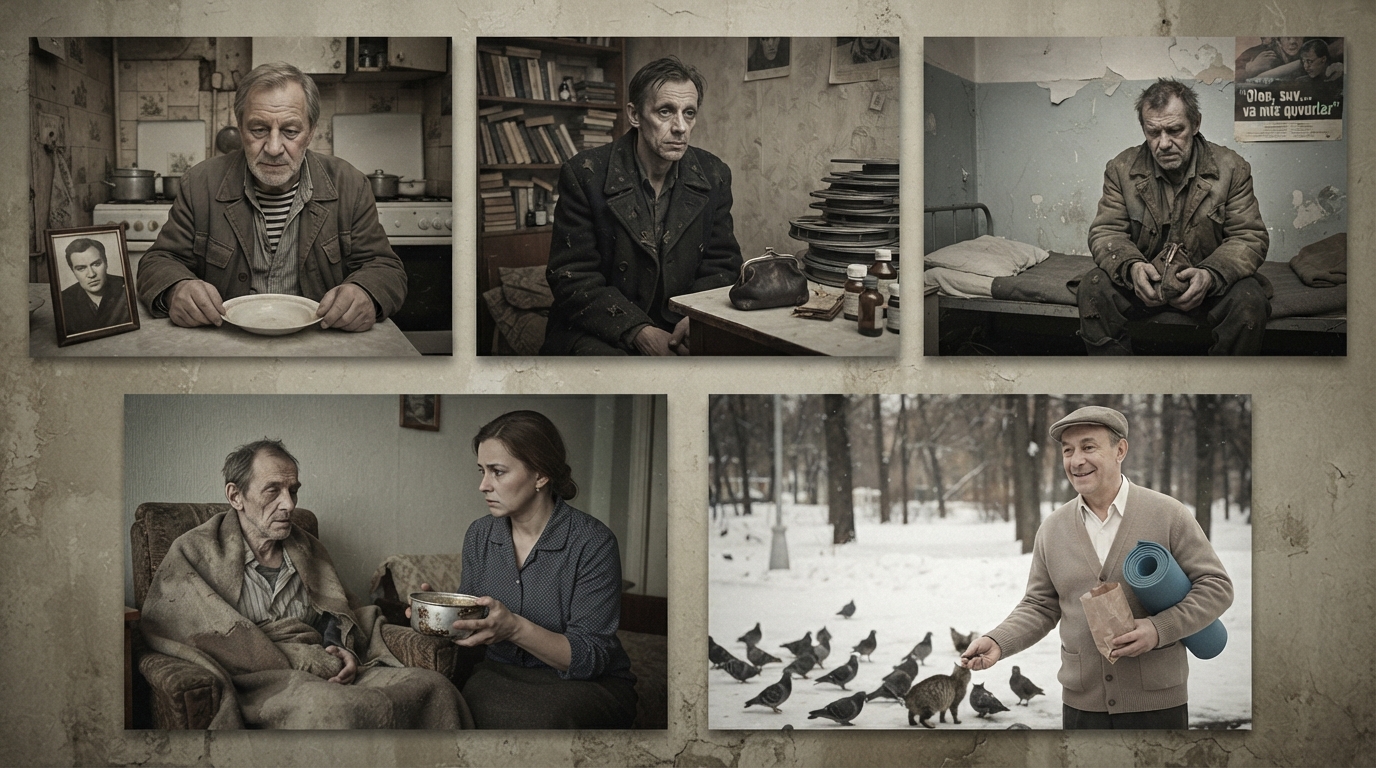
**Famous actors of the USSR: 5 artists who spent the last years of their lives in poverty**
Even the highest-ranking artists during the Soviet Union worked only for a salary, not having the opportunity to direct their income to business. Therefore, many famous actors, having retired or having fallen ill, found themselves in a difficult situation. Below we will tell you about five famous artists who spent the last years of their lives in financial difficulties.
**Alexey Smirnov**
A war veteran and Honored Artist of the RSFSR, Alexey Smirnov was known to the public for his small but bright and funny roles in many films. The audience remembers him best for the images of the farm manager in Elem Klimov's film "Strangers Are Not Allowed", the hooligan Fedya in Leonid Gaidai's "Operation I" and Mikhalich in the film "Only Old Men Enter the Battle".
Due to a serious injury received in the war, the actor was deprived of the happiness of having children, which put an end to his family life. In addition, he had to take care of his mother, who lost her second son Arkady in the war. Because of this, he could not go on long-term filming and was forced to take on secondary roles that required less time.
Being very modest by nature, the famous artist could not demand any conditions or privileges from the state for himself. As a result, he lived in a communal apartment with his mother all his life. After he was over fifty, his health deteriorated and he was forced to reduce his roles, so his already small fee turned into a pittance. But the most severe blow in his life was the death of his close friend, actor and director Leonid Bykov in a car accident. Hearing this news, Smirnov became addicted to alcohol, ended up in the hospital, and died on May 7, 1979.
**Sergey Filippov**
During his half-century career in the world of cinema, the master of episodes, Sergei Filippov, played more than a hundred roles and created bright, unforgettable images on the screen. His most famous works are the roles of the speaker Nikodilov in the comedy "Carnival Night" and Kisa Vorobyaninov in Leonid Gaidai's film "12 Chairs". Filippov played his last role in the film "Private Detective, or Operation 'Cooperation'" by the same director, as a war veteran.
It cannot be said that Sergei Filippov spent the last years of his life in poverty. He had his own apartment, a large library that he had collected over many years, his favorite paintings, and expensive furniture. However, in his old age, due to the decrease in roles, he had no income left. The actor could not afford to sell his household appliances, nor would his pride allow it.
Filippov spent the last twenty years of his life battling cancer, which required huge expenses and made his daily life difficult. In addition, after his wife died, he became completely alone and distanced himself from people. After her death, the management of the Lenfilm film studio, where he worked for a quarter of a century, did not allocate money for his funeral. The situation was saved by actor Alexander Demyanenko. He collected money from colleagues who knew Filippov and organized a modest funeral for him.
**Alexey Katyshev**
The unusually handsome and handsome actor Alexey Katyshev became known to the entire Soviet Union at the age of 18, when he starred in Alexander Rowe's fairy tale "Fire, Water... and Copper Pipes". Katyshev went straight from the set to the army. However, the director Rowe liked the blue-eyed, sincere and open-minded young man so much that he arranged special conditions for him in the army. This condition allowed him to star in the fairy tale "The Beautiful Barbara", which became even more famous along with his military service.
Rowe's next plan was the fairy tale "Finist - Sarlochin", in which he saw only Katyshev in the lead role. However, in December 1973, the director died. The new director Gennady Vasilyev, who took over the project, chose the more energetic and serious-looking Vyacheslav Voskresensky for the role of Finist. Other directors did not come looking for Alexei Katyshev themselves, although he himself went and asked for roles.
To support his family, the former actor learned to drive a truck and got a job at a dairy factory. Unfulfilled dreams and aspirations led Katyshev to alcoholism, which ultimately led to the breakup of his family. He moved to Yalta, to his mother's house, but soon fell into the trap of fraudsters and lost his apartment. By this time, the Soviet Union had collapsed, and the new Ukrainian government was no longer interested in the once-popular actor. He could not pass the civil registry until the end of his life. Without it, he would not have been hired anywhere. In November 2006, Alexey Katyshev, who had been beaten up after a drunken brawl with his family, was taken to a Yalta hospital. Tests showed that the former actor had many serious illnesses, but he did not have the money to pay for treatment. Two days after being hospitalized, Katyshev died.
**Borislav Brondukov**
Like Sergey Filippov, Borislav Brondukov became a star with small, sometimes only a few-minute episodic roles. However, the smallness of the role did not prevent the actor from creating a bright and memorable image on the screen. These include the images of the boastful inspector Lestrade in "The Adventures of Sherlock Holmes and Dr. Watson" and the drunkard Fedul in "Afonya". At the same time, the actor's speech had a very strong Ukrainian accent, so out of his more than a hundred roles, about forty were voiced by others.
Brondukov starred in films from the early 1960s and continued to appear on the screen after the collapse of the USSR. True, in the 1990s he was increasingly given small and insignificant roles, as the actor's health was not good. He suffered his first stroke on the set in 1984, at the age of 46. The next one, which occurred in 1993, seriously undermined the actor's health. After a third stroke in 1997, he was completely bedridden.
The family's financial situation worsened due to the huge amount of money needed for treatment, as his wife Ekaterina had to quit her job to take care of her husband. The family literally went hungry. Brondukov's youngest son Bogdan would ask a familiar butcher for bones, saying "let's give them to our dogs," and then the family would boil soup from them. After a long illness, the once very popular actor passed away on March 10, 2004.
**Georgey Vitsin**
Poverty and deprivation do not always follow life's failures. The famous actor, People's Artist of the USSR Georgy Vitsin, of his own free will, chose to live a simple and modest life.
Georgy Vitsin was one of the most famous stars of the Soviet Union. Due to his unique voice and appearance, he often played the role of drunkards in the cinema, although he himself never drank a drop of alcohol or smoked tobacco in his life. Vitsin practiced yoga and looked quite young even in old age. He created more than 300 roles in film and radio. Thanks to a healthy lifestyle, the actor lived to be 84 years old and served in the troupe of the Film Actors Theater-Studio until the last days of his life. He never lost his job even in the difficult 1990s. Despite this, he lived an extremely modest life.
According to those who knew him closely, Vitsin and the concept of "wealth" were completely alien to each other. He even gifted his daughter a comfortable apartment in the center of Moscow, which was given to him by the state in exchange for his services, while he himself lived in a simple, old apartment building. When it came to clothes, Vitsin did not indulge in expensive fabrics or traditional styles, always appreciating simplicity and comfort. The actor also avoided giving interviews, considering them completely unnecessary. Preferring not to talk to strangers, he preferred to feed street birds and stray dogs rather than be surrounded by thousands of fans.