

'You could smell someone' who worked at Raleigh
The company was more than just a employer, for years it was part of the fabric of Nottingham.
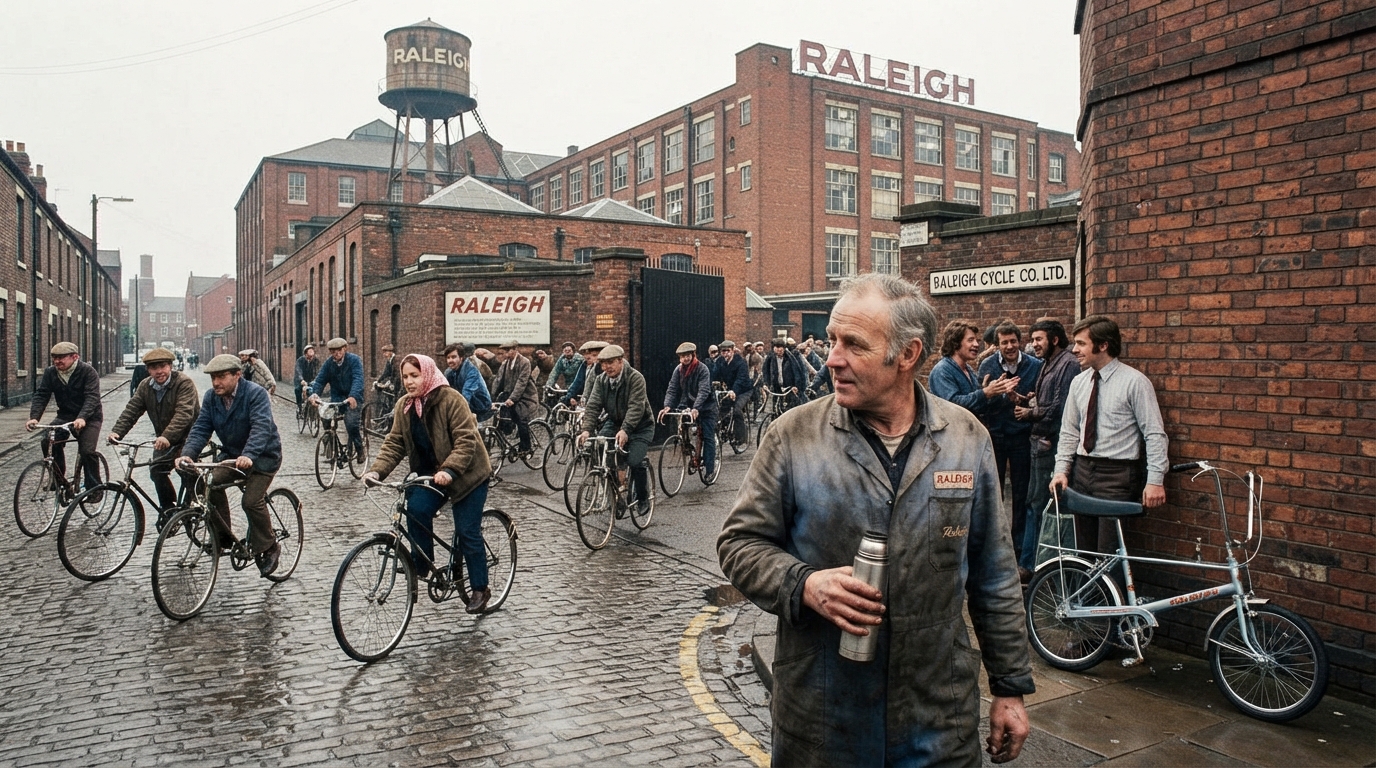
The potential demise of Raleigh, a name synonymous with Nottingham's manufacturing heritage, looms as its parent company initiates insolvency proceedings. Once a titan employing 8,000 individuals and churning out thousands of bicycles monthly, Raleigh stood alongside Boots and Players cigarettes as one of the city's top three employers. Now, it faces the prospect of fading into little more than a brand logo.
Yet, over its long history, Raleigh profoundly impacted countless lives, from its workforce to the riders of its bicycles. Many are now sharing their personal connections to the iconic company.
Mark Hallam, who grew up with a view of the Raleigh factory from his backyard, joined the company in 1978. "Raleigh – and Players and Boots too – came to the school offering careers, and since it was so close, I went for Raleigh," he recounted. He began by learning to assemble brakes and spoke wheels. Hallam described a vibrant, friendly, and diverse atmosphere, though one where good-natured teasing was common. The social club was a particular highlight.
He noted a peculiar phenomenon: "One weird thing was you could smell if someone worked for Raleigh. I think it was the metal mixed with grease and oil." The factory's dominance in the area was also striking. Hallam recalled seeing workers pressed against the gate just before 4 PM, poised to "run" at the end of their shift, leading to the local saying, "get the bus before Raleigh chucks out." Ironically, despite his years at the company, Hallam admitted, "I never rode a Raleigh as I couldn't afford one."
David Marsland reluctantly followed his father into Raleigh in 1973, having initially aspired to be a surveyor. "I had grown up with Raleigh... I gained new friends at every stage of my 47 years and met my wife there, so it was very much the background to my life," he shared. The company's large workforce even supported its own football league. However, Marsland witnessed the onset of redundancies, recalling the anxiety of entering his office unsure if his job would still be there. He pinpointed a turning point: "One time we had all these plans for a new factory in Bulwell but when it became clear that our steel bicycles couldn't match the prices of aluminium bicycles from the Far East, it all got binned. I think that was the moment Raleigh changed."
Sarah Nixon, from Daybrook, shared that her parents met while working at Raleigh in the 1950s. Her mother worked in the offices, and her father was a work study engineer. They described it as "a really great place to work, it was very social, more of a community than a workplace." They also emphasized the sheer scale of the factory. "My dad told me they used to ride bikes between the departments because it was just that huge," Nixon said.
For Maureen Vines, Raleigh was a family affair. Living near Faraday Road, she recalled most of her uncles working at Raleigh and her aunts at Players, with the road often filled with cyclists. She also remembered the filming of the 1960 movie *Saturday Night, Sunday Morning*, where the lead character worked at Raleigh, taking place on her street. "One of my uncles, Charlie, he rode his bike for that and you can still see him in the background, in the film, riding down the street," she noted. The news of Raleigh's potential end is "a bit of a shock to think there'll be no more Raleigh. It's one of the firms which built Nottingham."
Helen Crowder's connection to Raleigh began with a promise. In the 1950s, living in Grantham, she was promised a Raleigh bicycle if she passed her 11+ exam. "Luckily I did that and my parents said, 'right, we'll have to go to Nottingham' which was quite an adventure because we had to get the train," she recounted. She received a full-sized bike due to her height and used it through school, her teenage years, and into her first job. After marrying and moving away, she left it with her mother, but later retrieved it and rode with each of her three children on the back. "It was a super-strong, well made bike, really excellent and I only had to give it up when it was really worn out. I must have ridden it for the best part of 50 years," Crowder stated.
Andrew Dutton, from Silverdale, maintained brand loyalty throughout his childhood. "I got my first one aged about six and I had a Grifter, then a Sprinter Racing bike and a Raleigh Super Burner BMX," he said. These bikes were often Christmas presents, a "nice surprise" that would be ridden immediately, "no matter what the weather, rain or snow." He recalled riding with his brother and other children in West Bridgford. "They were great bikes, really well made," Dutton affirmed, concluding, "I have to say it – it's the end of an era."